

Obverse
Description:
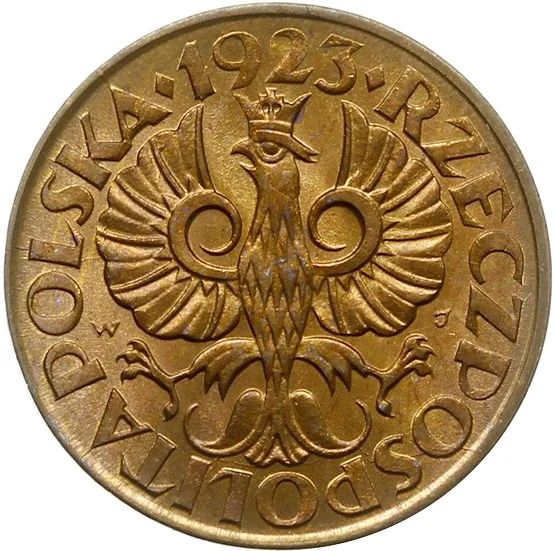
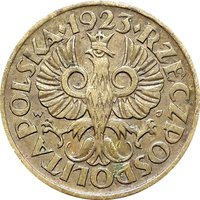
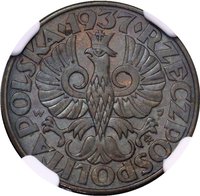
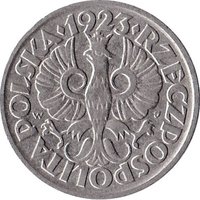
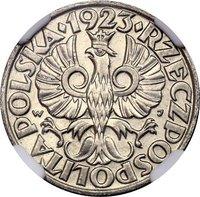
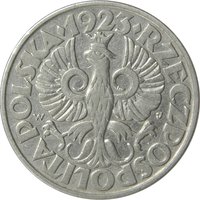
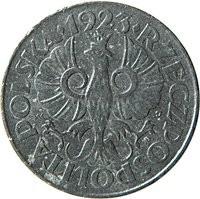
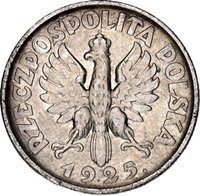
Majestic eagle in flight.
Inscription:
RZECZPOSPOLITA POLSKA .1923.
Translation:
REPUBLIC OF POLAND .1923.
Script: Latin
Language: Polish
Engraver: Wojciech Jastrzębowski
Reverse
Edge
Plain
Mints
| Name | Mark |
|---|---|
| Mint of Poland | W |
Mintings
| Year | Mint Mark | Mintage | Quality | Collection |
|---|---|---|---|---|
| 1923 | W | 20,500,000 |
Historical background
In 1923, Poland faced a catastrophic hyperinflation, marking the peak of a currency crisis that had been building since the nation's rebirth in 1918. The newly established Second Polish Republic inherited a chaotic monetary landscape, with several different currencies from the former partitioning powers (Germany, Austria-Hungary, and Russia) still in circulation. The government introduced the Polish marka as a unified currency in 1919, but it was not backed by gold or substantial foreign reserves. To finance the Polish-Soviet War (1919-1921) and subsequent reconstruction, the state resorted to simply printing money, leading to a massive expansion of the money supply without corresponding economic growth.
The situation spiraled out of control in 1923. As prices skyrocketed, the currency became virtually worthless. Inflation reached a staggering monthly rate of over 275% in November 1923, with workers often needing wheelbarrows full of banknotes to buy basic goods. Wages were adjusted daily, and the economy began to revert to barter. The crisis was exacerbated by the occupation of the industrial heartland of Upper Silesia by German workers and the government's loss of control over its budget, as tax revenues collected in depreciating marks could not keep pace with expenditures.
This period of hyperinflation culminated in a profound loss of public confidence and social unrest, including widespread strikes. Recognizing that the Polish marka was beyond salvation, the government, led by Prime Minister Władysław Grabski, enacted radical reforms in early 1924. These reforms established a new, independent central bank (Bank Polski) and introduced a new, gold-backed currency—the złoty—which successfully stabilized the economy and ended the hyperinflationary nightmare. The crisis of 1923 thus stands as a pivotal, traumatic chapter that demonstrated the fundamental necessity of fiscal discipline and a stable monetary foundation for the young state.
The situation spiraled out of control in 1923. As prices skyrocketed, the currency became virtually worthless. Inflation reached a staggering monthly rate of over 275% in November 1923, with workers often needing wheelbarrows full of banknotes to buy basic goods. Wages were adjusted daily, and the economy began to revert to barter. The crisis was exacerbated by the occupation of the industrial heartland of Upper Silesia by German workers and the government's loss of control over its budget, as tax revenues collected in depreciating marks could not keep pace with expenditures.
This period of hyperinflation culminated in a profound loss of public confidence and social unrest, including widespread strikes. Recognizing that the Polish marka was beyond salvation, the government, led by Prime Minister Władysław Grabski, enacted radical reforms in early 1924. These reforms established a new, independent central bank (Bank Polski) and introduced a new, gold-backed currency—the złoty—which successfully stabilized the economy and ended the hyperinflationary nightmare. The crisis of 1923 thus stands as a pivotal, traumatic chapter that demonstrated the fundamental necessity of fiscal discipline and a stable monetary foundation for the young state.
Series: 1923 Poland circulation coins
🌱 Common