

10 réis – Angola
Add to wishlist
Angola
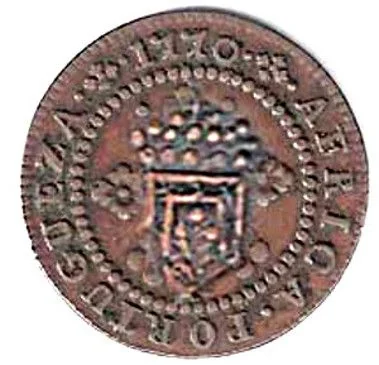
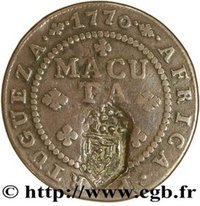
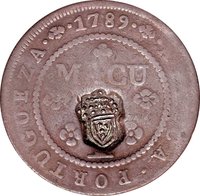
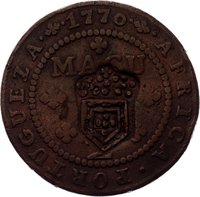
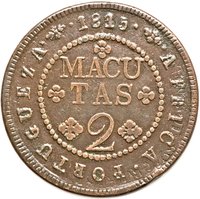
Obverse
Inscription:
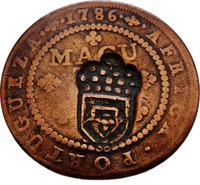
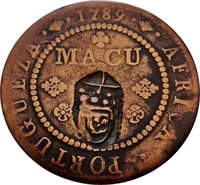
AFRICA·PORTUGUEZA·1770
· V · (Stamped over "V")
· V · (Stamped over "V")
Translation:
AFRICA·PORTUGUESE·1770
· V ·
· V ·
Script: Latin
Language: Portuguese
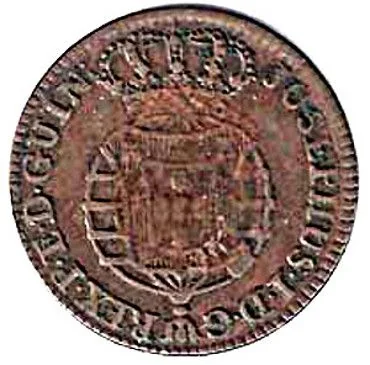
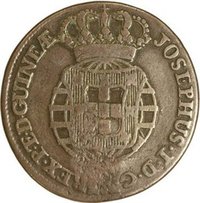
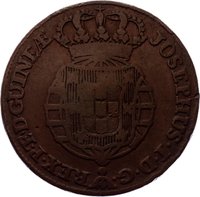
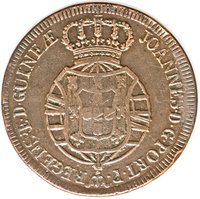
Reverse
Description:
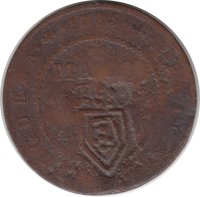
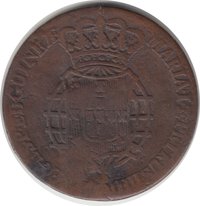
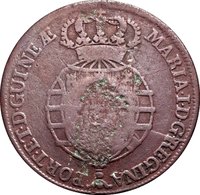
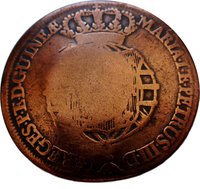
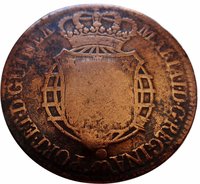
Countermark of Portugal's coat of arms, per the 1837 Edict, doubling the coin's value. This stamps KM# 19 (5 Reis) to create KM# 48 (10 Reis).
Inscription:
JOSEPHUS·I·D·G·REX·P·ET·D·GUIN·
Script: Latin
Edge
Plain
Mintings
| Year | Mint Mark | Mintage | Quality | Collection |
|---|---|---|---|---|
| 1837 | — | — |
Historical background
In 1837, the currency situation in Angola, then a Portuguese colony, was characterized by chronic scarcity and confusion, heavily reliant on a dysfunctional barter system. The official Portuguese currency, the real, was scarcely in circulation outside of Luanda and a few coastal enclaves. Instead, the colonial economy, particularly the internal slave trade which dominated the period, operated largely through commodity money. The most widely accepted unit of account was the libra (pound) of prime-quality fazenda—strips of imported linen or cotton cloth from Europe—which served as the benchmark for valuing goods and people. Other common mediums included bundles of tobacco, barrels of rum (gerebita), and salt bars, creating a complex and localized system of valuation.
This reliance on barter and commodity currency was a direct result of Portugal's mercantilist policies and its economic frailty. The metropolis could not supply sufficient coinage to its colony, and what little hard currency (like Spanish and Portuguese silver coins) arrived was often hoarded or quickly re-exported to pay for imports, draining the colony of specie. The system was inefficient and prone to manipulation, as the value of cloth or tobacco could fluctuate wildly based on shipment arrivals, quality, and local conditions. This instability hampered administrative efficiency, as even tax collection (múltiplos) was often conducted in goods rather than cash.
Consequently, the economic landscape was one of fragmentation and constraint. The lack of a unified, stable monetary system stifled broader commercial development and tied the colony's economic activity almost entirely to the export of enslaved people and the import of goods used to purchase them. While Portuguese authorities recognized the problem, effective solutions in 1837 remained elusive. The currency situation thus reflected Angola's entrenched position within the Atlantic slave trade and its status as an underdeveloped extractive colony, awaiting the shifts that would come with the gradual international pressure to abolish the slave trade in the mid-19th century.
This reliance on barter and commodity currency was a direct result of Portugal's mercantilist policies and its economic frailty. The metropolis could not supply sufficient coinage to its colony, and what little hard currency (like Spanish and Portuguese silver coins) arrived was often hoarded or quickly re-exported to pay for imports, draining the colony of specie. The system was inefficient and prone to manipulation, as the value of cloth or tobacco could fluctuate wildly based on shipment arrivals, quality, and local conditions. This instability hampered administrative efficiency, as even tax collection (múltiplos) was often conducted in goods rather than cash.
Consequently, the economic landscape was one of fragmentation and constraint. The lack of a unified, stable monetary system stifled broader commercial development and tied the colony's economic activity almost entirely to the export of enslaved people and the import of goods used to purchase them. While Portuguese authorities recognized the problem, effective solutions in 1837 remained elusive. The currency situation thus reflected Angola's entrenched position within the Atlantic slave trade and its status as an underdeveloped extractive colony, awaiting the shifts that would come with the gradual international pressure to abolish the slave trade in the mid-19th century.
Series: 1837 Angola circulation coins
💎 Extremely Rare