

25 Centimes – Belgium
Belgium
Context
Years: 1942–1946
Issuer: Belgium 
Ruler: Leopold III
Currency:
(1832—2001)
Demonetization: 1 March 1968
Total mintage: 48,560,000
Material
Diameter: 26 mm
Weight: 6.5 g
Thickness: 1.9 mm
Shape: Round with a round hole
Composition: Zinc
Magnetic: No
Technique: Milled
Alignment: Coin alignment
flip
References
KM: #Click to copy to clipboard132
Numista: #5331
Value
Exchange value: 0.25 BEF
Obverse
Description:
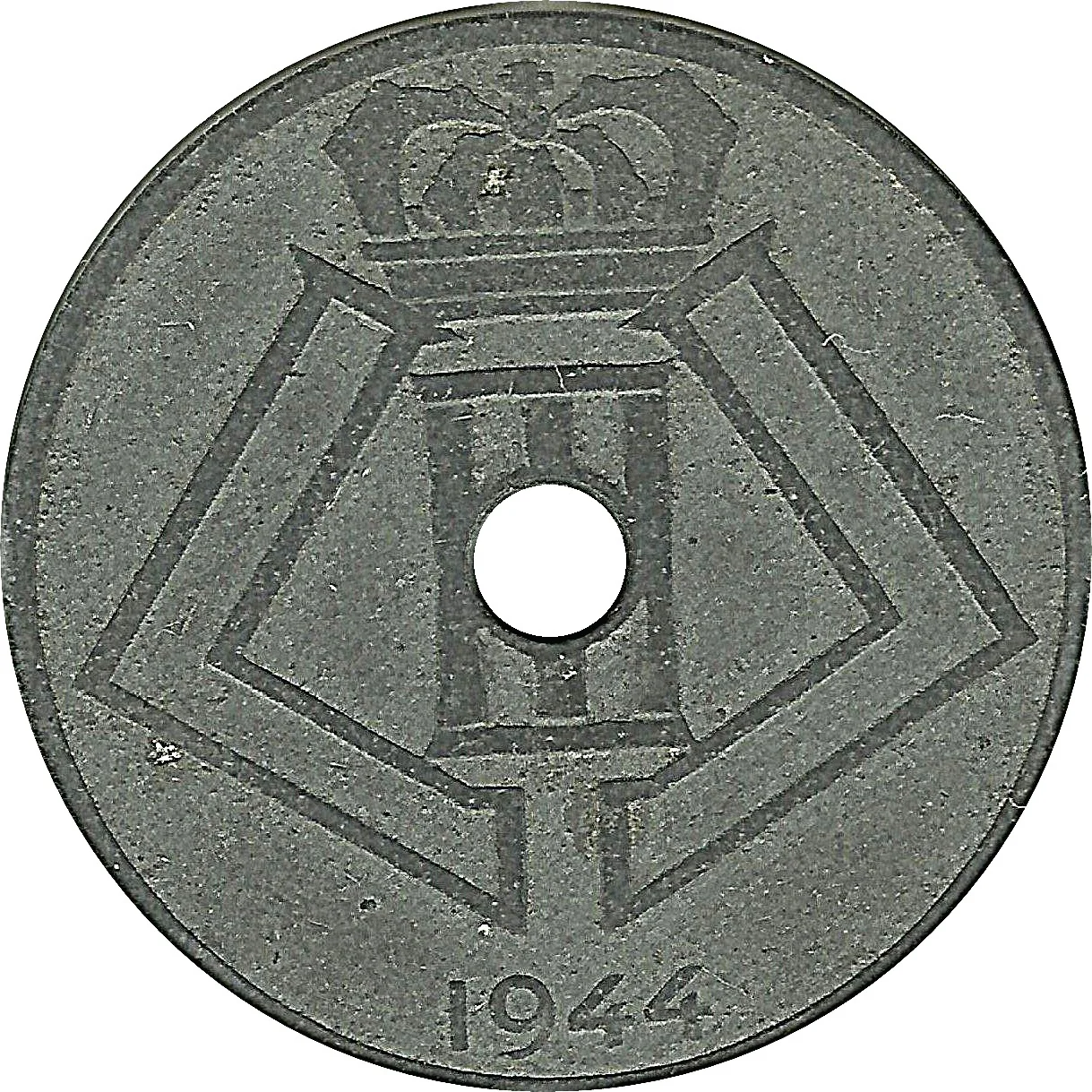
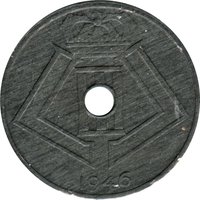
Léopold III monogram around hole, date below.
Inscription:
1944
Script: Latin
Engraver: Oscar Jespers
Reverse
Description:
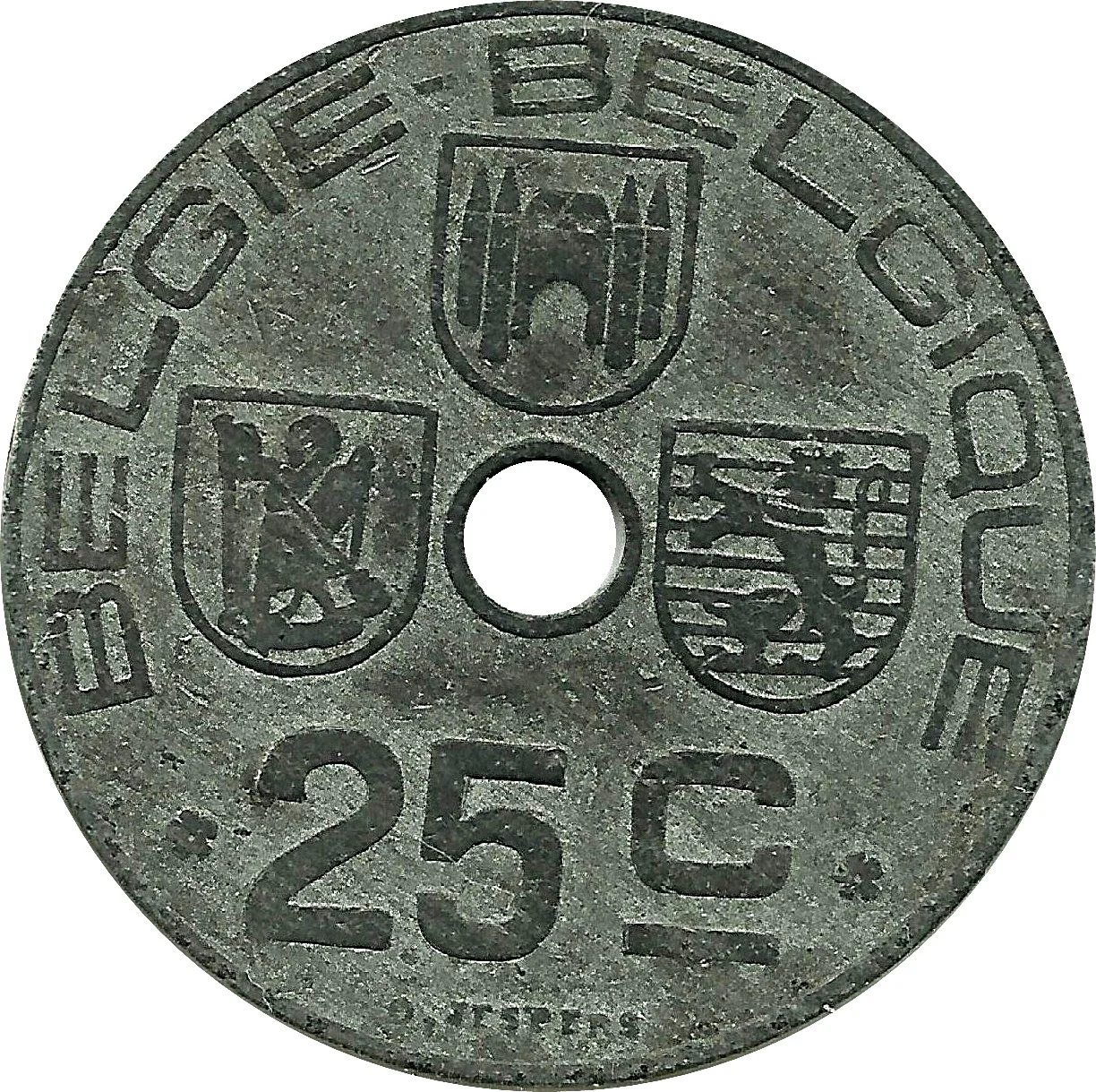
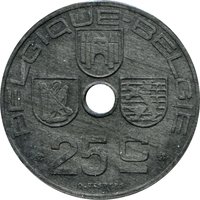
Coats of arms of Brussels, Mons, and Bruges with bilingual legends. Value and designer below.
Inscription:
BELGIE-BELGIQUE
25C
O.JESPERS
25C
O.JESPERS
Translation:
Belgium
25 Centimes
O. Jespers
25 Centimes
O. Jespers
Script: Latin
Engraver: Oscar Jespers
Edge
Plain
Categories
| Symbols> Coat of Arms |
| Symbols> Monogram |
Mints
| Name | Mark |
|---|---|
| Royal Mint of Belgium | — |
Mintings
| Year | Mint Mark | Mintage | Quality | Collection |
|---|---|---|---|---|
| 1942 | — | 14,400,000 | ||
| 1943 | — | — | ||
| 1944 | — | 25,960,000 | ||
| 1945 | — | 8,200,000 | ||
| 1946 | — | — |
Historical background
In 1942, Belgium was in the third year of its occupation by Nazi Germany, and the currency situation was characterized by severe inflation and economic exploitation. The Belgian franc remained the official currency, but its stability was deliberately undermined by the German Reichsbank. The occupiers financed their costs through massive "occupation costs" levied on the Belgian state, paid for by the National Bank of Belgium printing new francs. This forced monetary expansion, combined with wartime shortages and a crippled economy, led to a rapid increase in the money supply and a sharp decline in the franc's purchasing power.
The German authorities also enforced a fixed, highly advantageous exchange rate of 10 Belgian francs to 1 Reichsmark. This artificial rate facilitated the systematic plundering of the Belgian economy, as German authorities and soldiers could purchase goods and resources cheaply. Alongside the official currency, a thriving black market emerged where goods could be obtained for vastly inflated prices, effectively creating a dual economy. This market operated largely on cash, further fueling the demand for francs and distorting the real value of money.
Consequently, the Belgian population faced a daily struggle with rising prices, strict rationing, and the diminishing real value of their savings and wages. The government-in-exile in London and the National Bank directors, who had relocated, attempted to maintain some monetary policy from abroad, but their influence was limited. The 1942 currency environment was thus a direct instrument of occupation policy, leading to widespread economic hardship, resource extraction for the German war effort, and a loss of public confidence in the monetary system that would require significant stabilization after liberation.
The German authorities also enforced a fixed, highly advantageous exchange rate of 10 Belgian francs to 1 Reichsmark. This artificial rate facilitated the systematic plundering of the Belgian economy, as German authorities and soldiers could purchase goods and resources cheaply. Alongside the official currency, a thriving black market emerged where goods could be obtained for vastly inflated prices, effectively creating a dual economy. This market operated largely on cash, further fueling the demand for francs and distorting the real value of money.
Consequently, the Belgian population faced a daily struggle with rising prices, strict rationing, and the diminishing real value of their savings and wages. The government-in-exile in London and the National Bank directors, who had relocated, attempted to maintain some monetary policy from abroad, but their influence was limited. The 1942 currency environment was thus a direct instrument of occupation policy, leading to widespread economic hardship, resource extraction for the German war effort, and a loss of public confidence in the monetary system that would require significant stabilization after liberation.
Series: 1942 Belgium circulation coins
🌱 Very Common