

2 francs – Belgium
Add to wishlist
Belgium
Context
Year: 1944
Issuer: Belgium
Ruler: Leopold III
Currency:
(1832—2001)
Demonetized: Yes
Total mintage: 25,000,000
Material
References
KM: #
Numista: #3103
Value
Exchange value: 2 BEF
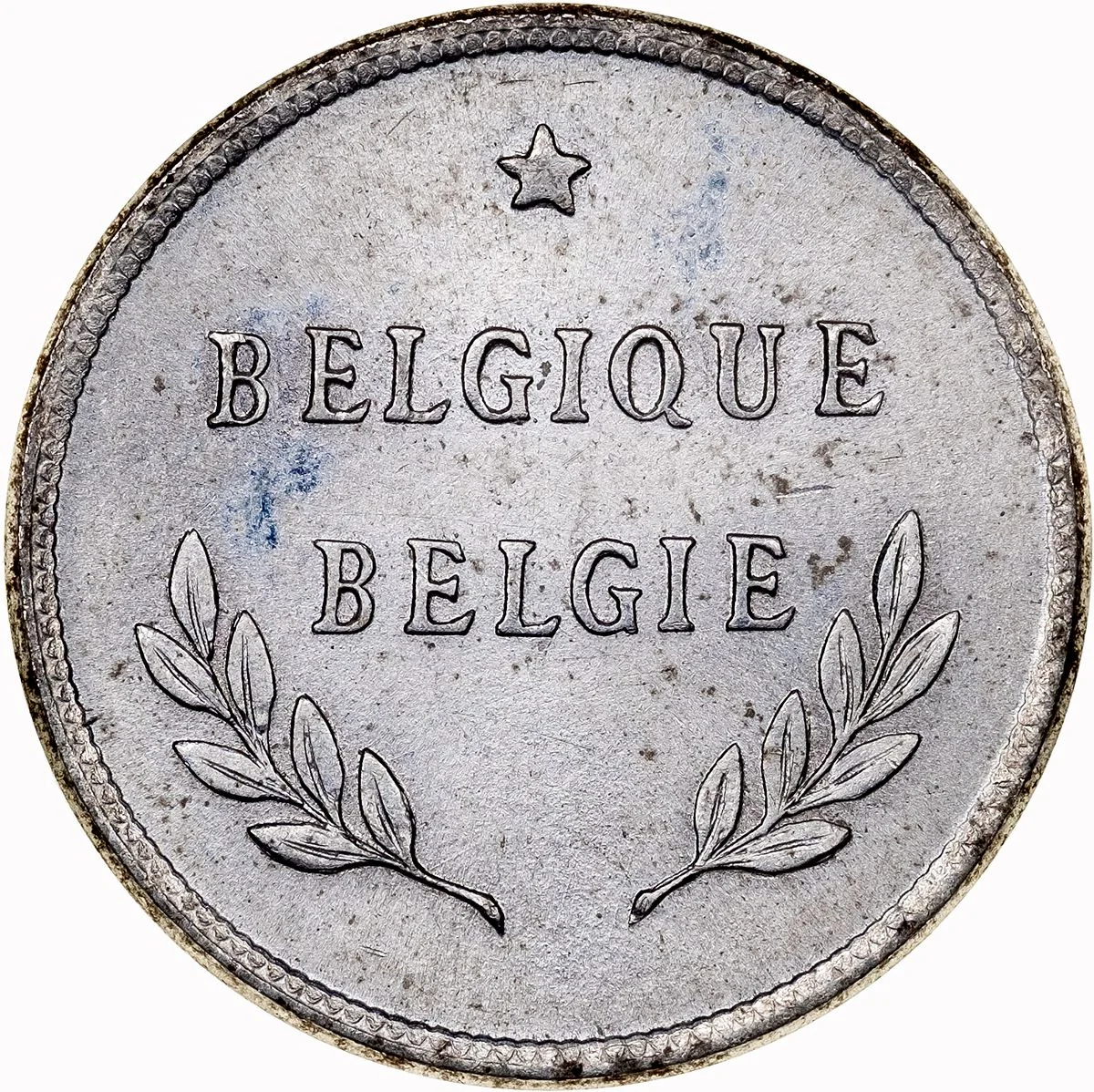
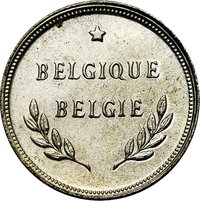
Obverse
Description:
Bilingual French/Dutch spray with star above.
Inscription:
★
BELGIQUE
BELGIE
BELGIQUE
BELGIE
Translation:
Belgium
Belgium
Belgium
Script: Latin
Engraver: John R. Sinnock
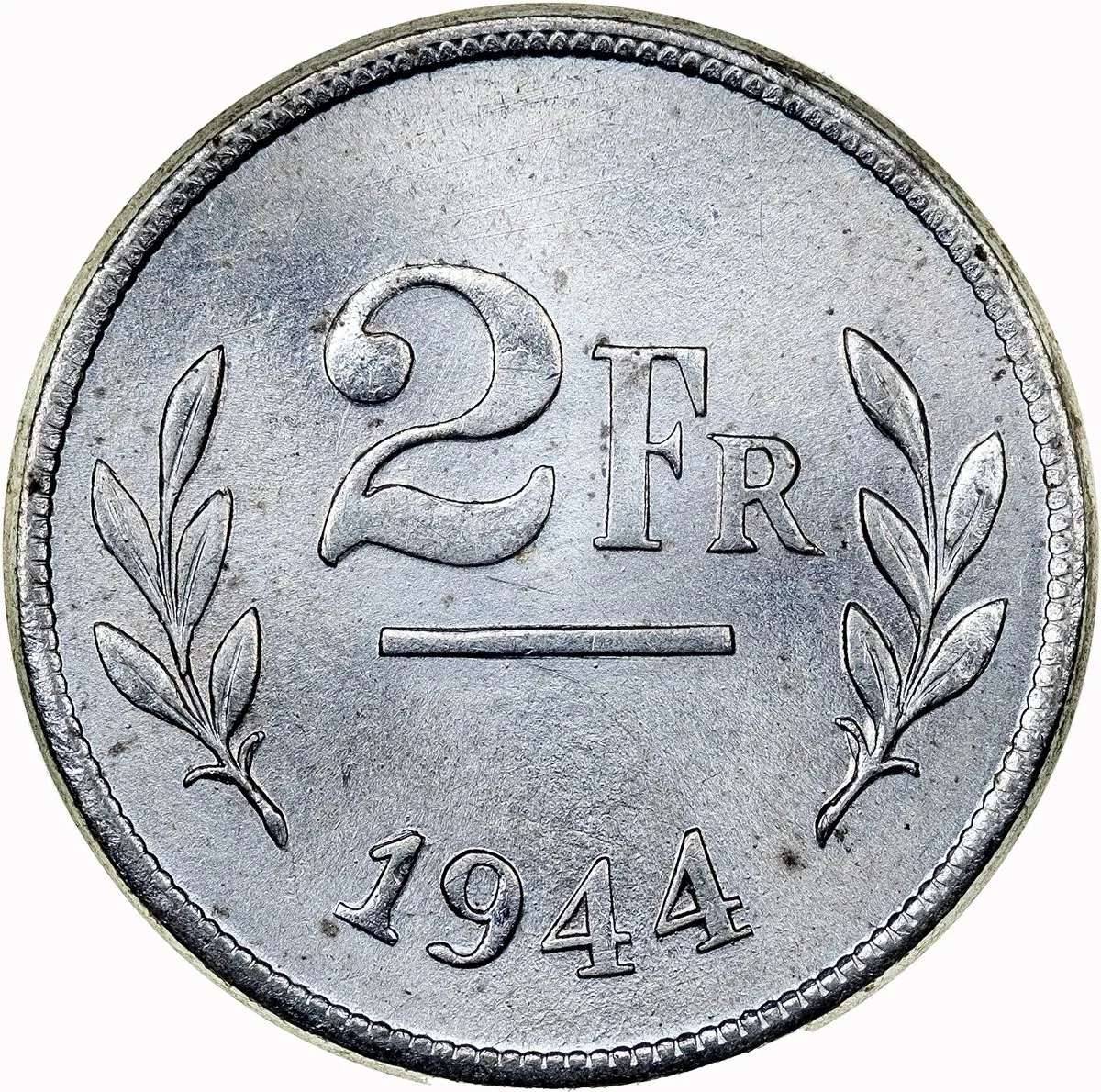
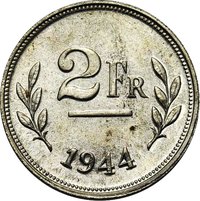
Reverse
Description:
Underlined denomination with flanking sprays, date beneath.
Inscription:
2 FR
1944
1944
Script: Latin
Engraver: John R. Sinnock
Edge
Plain
Mints
| Name | Mark |
|---|---|
| United States Mint of Philadelphia | — |
Mintings
| Year | Mint Mark | Mintage | Quality | Collection |
|---|---|---|---|---|
| 1944 | — | 25,000,000 |
Historical background
In the autumn of 1944, Belgium was in a state of monetary chaos following its liberation from Nazi occupation. The occupying regime had heavily exploited the economy, financing its operations by forcing the Belgian National Bank to provide massive "occupation costs" loans. This led to a vast increase in the money supply, with the Belgian franc in circulation soaring from 28 billion in 1940 to 164 billion by 1944. Alongside this, a proliferation of counterfeit notes and various occupation scrip further undermined confidence in the currency, creating severe inflationary pressures and a looming economic crisis.
To avert disaster, the Belgian government-in-exile, under Finance Minister Camille Gutt, implemented a radical monetary reform immediately upon its return in October 1944. Known as the Gutt Operation, it was a sweeping and compulsory exchange of banknotes. All 100-franc and larger notes were withdrawn from circulation and had to be presented to banks for validation and exchange. A strict limit was placed on the amount that could be converted freely; sums above 2,000 francs were blocked in accounts and investigated for their origin to target war profiteers and collaborators. This bold move effectively froze a large portion of the money supply overnight.
The reform was a remarkable success in stabilizing the franc and curbing inflation, though it was socially painful. By drastically reducing the currency in circulation and flushing out illicit funds, it restored public confidence in the monetary system. This provided a stable foundation for Belgium's post-war economic recovery and reconstruction. The Gutt Operation remains a landmark case study in decisive post-conflict monetary policy, demonstrating how a tough, technically sound reform could reset a shattered economy.
To avert disaster, the Belgian government-in-exile, under Finance Minister Camille Gutt, implemented a radical monetary reform immediately upon its return in October 1944. Known as the Gutt Operation, it was a sweeping and compulsory exchange of banknotes. All 100-franc and larger notes were withdrawn from circulation and had to be presented to banks for validation and exchange. A strict limit was placed on the amount that could be converted freely; sums above 2,000 francs were blocked in accounts and investigated for their origin to target war profiteers and collaborators. This bold move effectively froze a large portion of the money supply overnight.
The reform was a remarkable success in stabilizing the franc and curbing inflation, though it was socially painful. By drastically reducing the currency in circulation and flushing out illicit funds, it restored public confidence in the monetary system. This provided a stable foundation for Belgium's post-war economic recovery and reconstruction. The Gutt Operation remains a landmark case study in decisive post-conflict monetary policy, demonstrating how a tough, technically sound reform could reset a shattered economy.
🌱 Very Common