

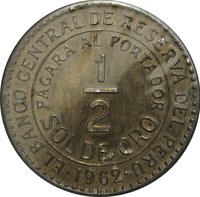
½ Sol – Peru
Peru
Context
Years: 1935–1965
Issuer: Peru 
Issuing organization: Central Reserve Bank of Peru
Period:
(since 1822)
Demonetized: Yes
Total mintage: 81,946,000
Material
References
KM: #Click to copy to clipboard220
Numista: #5310
Value
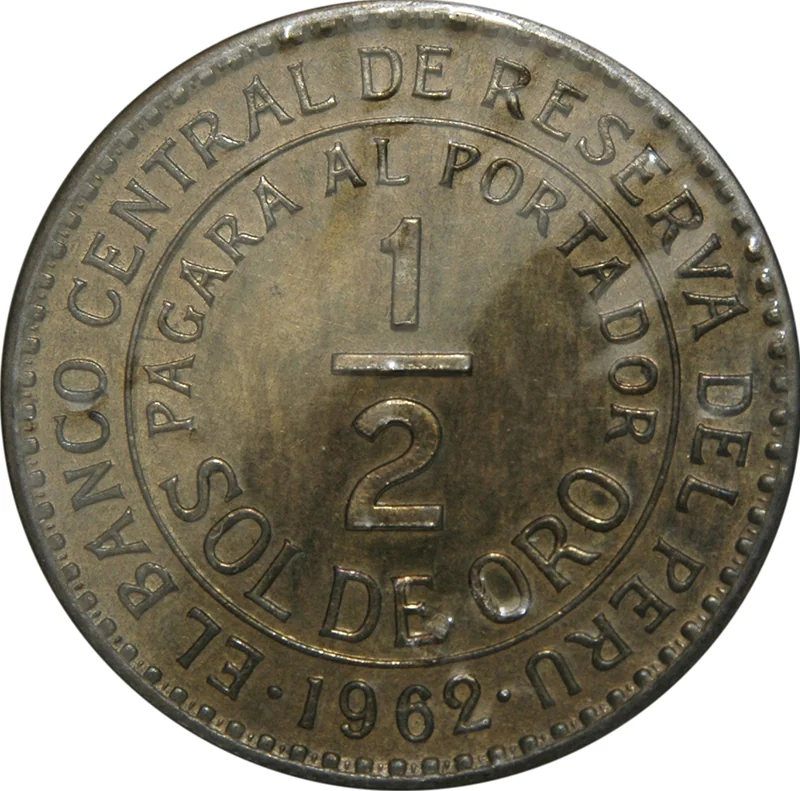
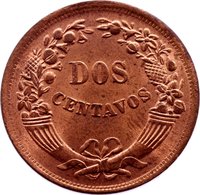
Exchange value: ½ PEH
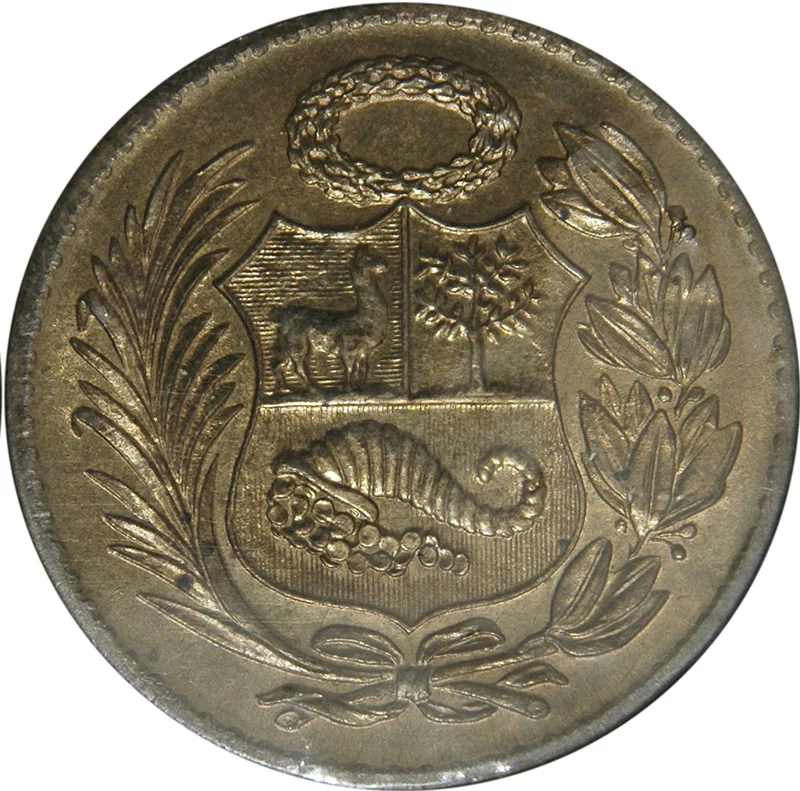
Obverse
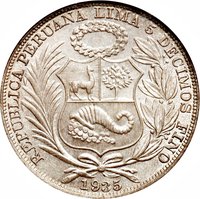
Description:
Peru's coat of arms.
Reverse
Edge
Reeded
Categories
| Symbols> Coat of Arms |
| Symbol> Cornucopia |
Mints
| Name | Mark |
|---|---|
| Lima | — |
| Royal Mint (Tower Hill) | — |
| United States Mint of Philadelphia | — |
| United States Mint of San Francisco | S |
Mintings
| Year | Mint Mark | Mintage | Quality | Collection |
|---|---|---|---|---|
| 1935 | — | — | Proof | |
| 1935 | — | 10,000,000 | ||
| 1941 | — | 2,000,000 | ||
| 1942 | — | — | ||
| 1942 | S | 1,668,000 | ||
| 1943 | — | 2,000,000 | ||
| 1943 | S | 6,332,000 | ||
| 1944 | — | — | ||
| 1945 | — | — | ||
| 1946 | — | 3,744,000 | ||
| 1947 | — | 6,066,000 | ||
| 1948 | — | 3,324,000 | ||
| 1949 | — | 420,000 | ||
| 1950 | — | 91,000 | ||
| 1951 | — | 930,000 | ||
| 1952 | — | 935,000 | ||
| 1953 | — | 817,000 | ||
| 1954 | — | 637,000 | ||
| 1955 | — | 1,383,000 | ||
| 1956 | — | 2,309,000 | ||
| 1957 | — | 2,700,000 | ||
| 1958 | — | 2,691,000 | ||
| 1959 | — | 3,609,000 | ||
| 1960 | — | 5,600,000 | ||
| 1961 | — | 4,400,000 | ||
| 1962 | — | 3,540,000 | ||
| 1963 | — | 4,345,000 | ||
| 1964 | — | 5,315,000 | ||
| 1965 | — | 7,090,000 | ||
| 1965 | — | — | Proof |
Historical background
In 1935, Peru's currency situation was characterized by the dominance of the Peruvian sol (SLP), a silver-based currency that had been the nation's monetary unit since 1863. However, the global economic turmoil of the Great Depression and a preceding period of fiscal instability had severely impacted its value and stability. The country had experienced significant inflation and exchange rate volatility in the early 1930s, exacerbated by a balance of payments crisis and falling export revenues from key commodities like cotton and sugar. By 1935, the sol was a depreciated currency, struggling within a context of constrained international trade and limited foreign reserves.
Monetary authority was vested in the Reserve Bank of Peru (Banco de Reserva del Perú), established in 1922. While it acted as a central bank, its ability to manage the currency was limited by its own statutes and the economic climate. The bank held a mix of gold, silver, and foreign exchange reserves, but its capacity to defend a fixed parity was weak. Consequently, Peru did not adhere strictly to the gold standard in practice during this period, operating with a managed but de facto floating exchange rate influenced by the market and administrative controls on foreign exchange.
Looking forward, the situation in 1935 was a precursor to significant reform. The persistent economic challenges highlighted the need for a stronger central banking institution with greater authority to issue currency and manage monetary policy. This culminated just a few years later, in 1936, with the closure of the Reserve Bank and the founding of the Central Reserve Bank of Peru (Banco Central de Reserva del Perú), which was granted exclusive note-issuing rights. Therefore, the currency situation in 1935 represents the final years of an older, less stable monetary system on the brink of institutional modernization.
Monetary authority was vested in the Reserve Bank of Peru (Banco de Reserva del Perú), established in 1922. While it acted as a central bank, its ability to manage the currency was limited by its own statutes and the economic climate. The bank held a mix of gold, silver, and foreign exchange reserves, but its capacity to defend a fixed parity was weak. Consequently, Peru did not adhere strictly to the gold standard in practice during this period, operating with a managed but de facto floating exchange rate influenced by the market and administrative controls on foreign exchange.
Looking forward, the situation in 1935 was a precursor to significant reform. The persistent economic challenges highlighted the need for a stronger central banking institution with greater authority to issue currency and manage monetary policy. This culminated just a few years later, in 1936, with the closure of the Reserve Bank and the founding of the Central Reserve Bank of Peru (Banco Central de Reserva del Perú), which was granted exclusive note-issuing rights. Therefore, the currency situation in 1935 represents the final years of an older, less stable monetary system on the brink of institutional modernization.
🌱 Very Common