

1 øre – Denmark
Add to wishlist
Denmark
Context
Years: 1874–1904
Issuer: Denmark
Ruler: Christian IX
Currency:
(since 1873)
Demonetization: 31 March 1973
Total mintage: 53,320,000
Material
References
KM: #
Numista: #5265
Value
Exchange value: 0.01 DKK
Obverse
Description:
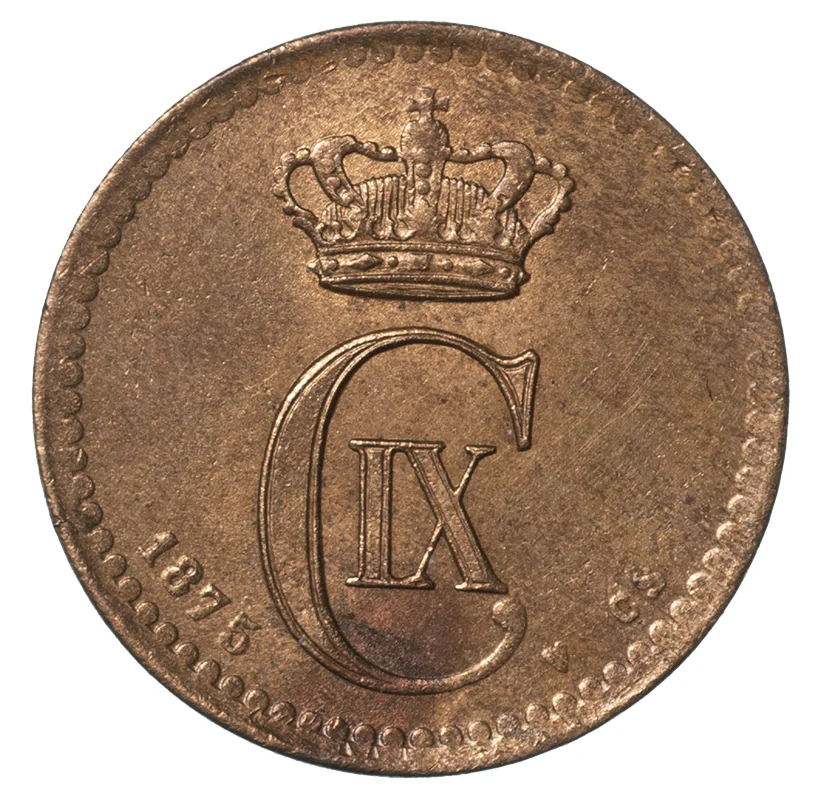
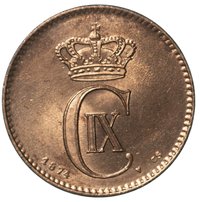
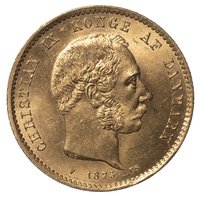
Christian IX monogram, King of Denmark (1863–1906), with date lower left.
Inscription:
C IX
1875
CS
1875
CS
Script: Latin
Reverse
Edge
Plain
Mints
| Name | Mark |
|---|---|
| Royal Danish Mint | — |
Mintings
| Year | Mint Mark | Mintage | Quality | Collection |
|---|---|---|---|---|
| 1874 | — | 5,540,000 | ||
| 1875 | — | 2,361,000 | ||
| 1876 | — | 1,483,000 | ||
| 1878 | — | 1,016,000 | ||
| 1879 | — | 1,491,000 | ||
| 1880 | — | 1,989,000 | ||
| 1881 | — | 260,000 | ||
| 1882 | — | 1,782,000 | ||
| 1883 | — | 2,989,000 | ||
| 1886 | — | 997,000 | ||
| 1887 | — | 3,007,000 | ||
| 1888 | — | 1,505,000 | ||
| 1889 | — | 2,999,000 | ||
| 1891 | — | 4,488,000 | ||
| 1892 | — | 492,000 | ||
| 1894 | — | 4,982,000 | ||
| 1897 | — | 2,988,000 | ||
| 1899 | — | 5,012,000 | ||
| 1902 | — | 2,977,000 | ||
| 1904 | — | 4,962,000 |
Historical background
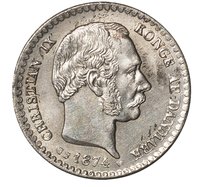
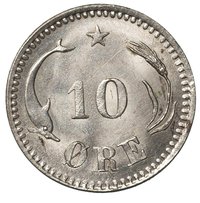
In 1874, Denmark made a decisive move to solidify its monetary system by joining the Scandinavian Monetary Union (SMU), a landmark agreement with Sweden and, later, Norway. This union was established to create a stable, uniform currency zone across the three kingdoms, facilitating trade and economic integration. The core of the agreement was the adoption of a common gold standard, with the new Danish krone (crown) replacing the older rigsdaler at a rate of 2 kroner to 1 rigsdaler. The krone was subdivided into 100 øre and was defined by a specific weight of gold, aligning it precisely with the Swedish krona.
This reform was driven by both practical and strategic considerations. Domestically, it provided a much-needed modernization of Denmark's complex and somewhat antiquated currency system. Internationally, it was a response to the wider European shift towards the gold standard, exemplified by the newly unified German Empire's adoption of the gold-backed mark in 1873. By aligning with its Scandinavian neighbors, Denmark sought greater financial stability, enhanced credibility in international markets, and reduced transaction costs for its important regional trade.
The union functioned successfully for decades, with member nations accepting each other's coins at par value. The Danish krone introduced in 1874 remains Denmark's currency to this day, a testament to the reform's enduring legacy. While the formal monetary union gradually dissolved in the early 20th century due to the strains of World War I and the abandonment of the gold standard, the 1874 agreement successfully established a stable and modern monetary foundation for Denmark's rapid industrial and agricultural development in the late 19th century.
This reform was driven by both practical and strategic considerations. Domestically, it provided a much-needed modernization of Denmark's complex and somewhat antiquated currency system. Internationally, it was a response to the wider European shift towards the gold standard, exemplified by the newly unified German Empire's adoption of the gold-backed mark in 1873. By aligning with its Scandinavian neighbors, Denmark sought greater financial stability, enhanced credibility in international markets, and reduced transaction costs for its important regional trade.
The union functioned successfully for decades, with member nations accepting each other's coins at par value. The Danish krone introduced in 1874 remains Denmark's currency to this day, a testament to the reform's enduring legacy. While the formal monetary union gradually dissolved in the early 20th century due to the strains of World War I and the abandonment of the gold standard, the 1874 agreement successfully established a stable and modern monetary foundation for Denmark's rapid industrial and agricultural development in the late 19th century.
Series: 1874 Denmark circulation coins
🌱 Very Common