

10000 lire – Vatican City
Add to wishlist
Vatican City
Context
Year: 1995
Issuer: Vatican City
Ruler: John Paul II
Currency:
(1929—2001)
Demonetization: 1 March 2002
Total mintage: 30,000
Material
References
KM: #
Numista: #52308
Value
Exchange value: 10000 VAL
Bullion value: $45.85
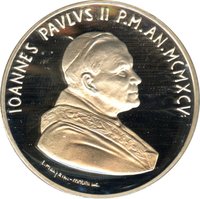
Obverse
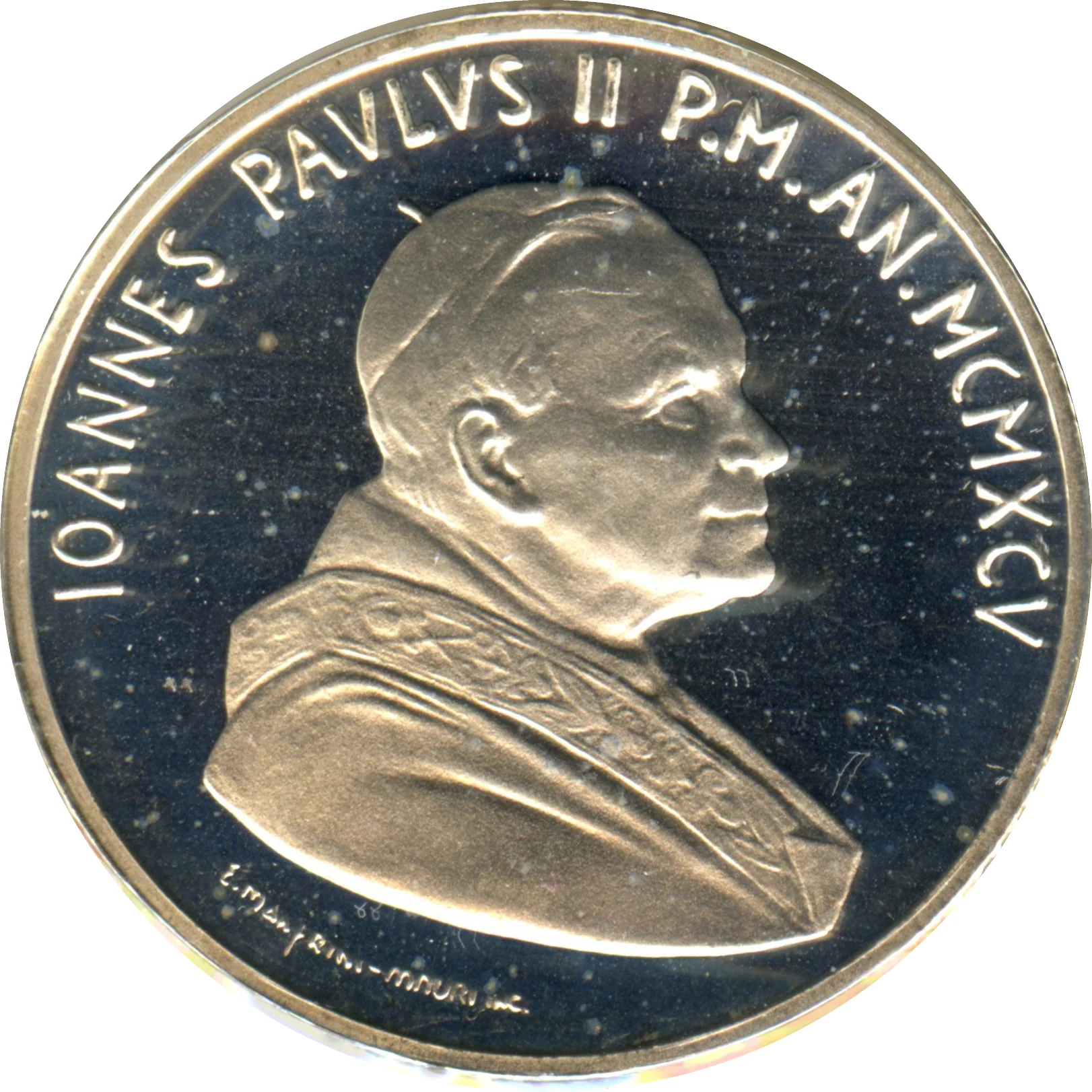
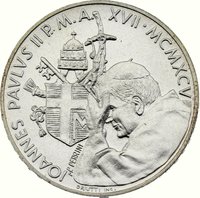
Description:
Get in. Let's go.
Inscription:
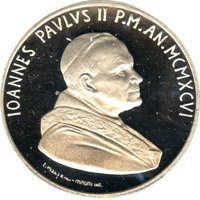
IOANNES PAULUS II P.M.AN.MCMXCV
Translation:
John Paul II, Supreme Pontiff, Year 1995
Script: Latin
Language: Latin
Engraver: Roberto Mauri
Designer: Enrico Manfrini
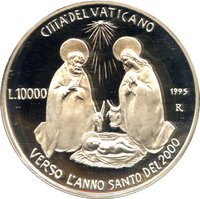
Reverse
Description:
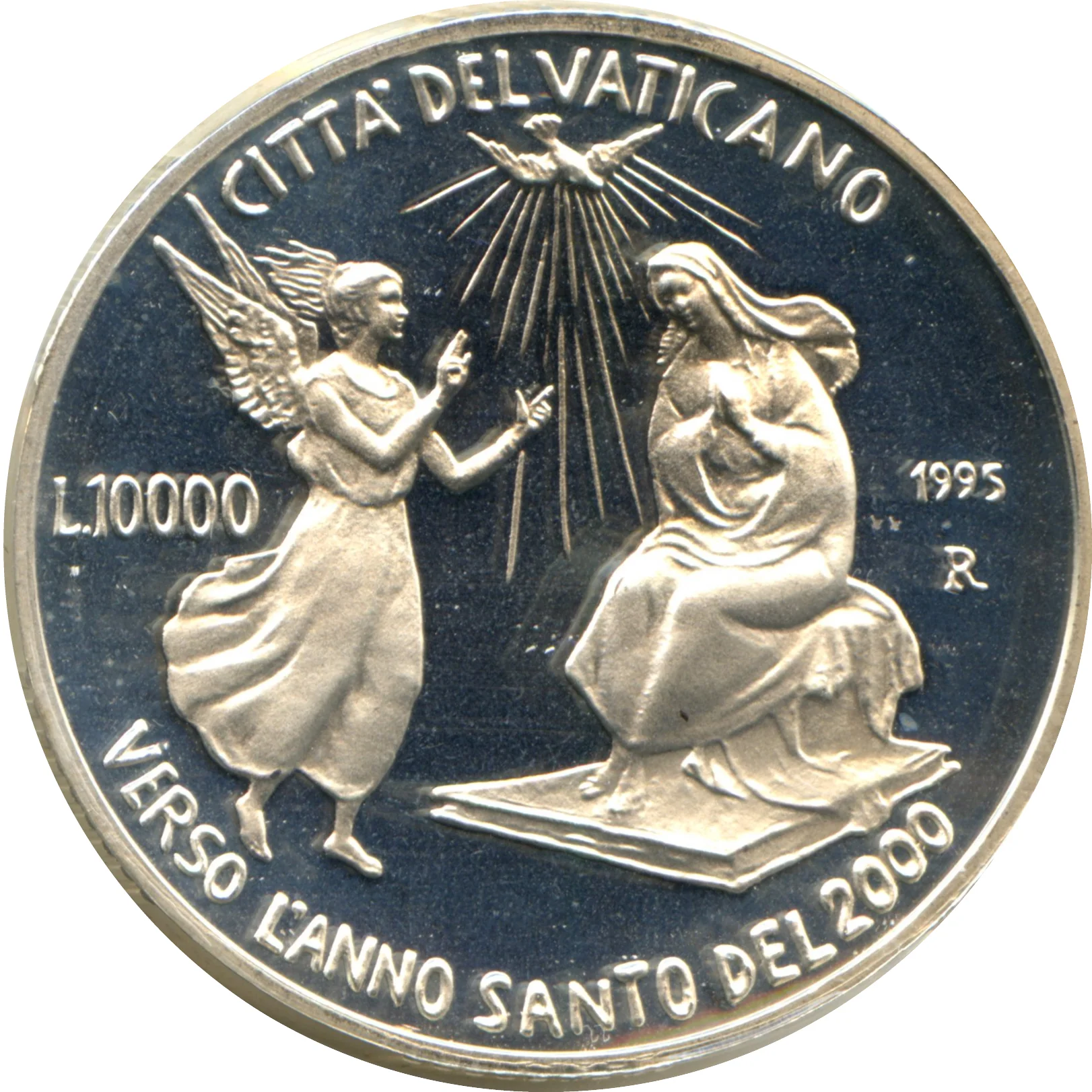
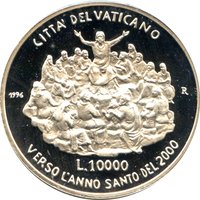
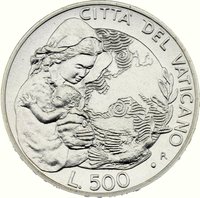
Gabriel announces to Mary, with the Holy Spirit as a dove above.
Inscription:
CITTA' DEL VATICANO
VERSO L'ANNO SANTO DEL 2000
L.10000 1995 R
VERSO L'ANNO SANTO DEL 2000
L.10000 1995 R
Translation:
VATICAN CITY
TOWARDS THE HOLY YEAR OF 2000
L.10000 1995 R
TOWARDS THE HOLY YEAR OF 2000
L.10000 1995 R
Script: Latin
Language: Italian
Engraver: Roberto Mauri
Designer: Enrico Manfrini
Edge
Segmented reeding6 smooth segments - 6 reeded segments (9 grooves each)
Mints
| Name | Mark |
|---|---|
| Rome | — |
Mintings
| Year | Mint Mark | Mintage | Quality | Collection |
|---|---|---|---|---|
| 1995 | R | 30,000 |
Historical background
In 1995, Vatican City’s currency situation was defined by its unique status as a sovereign state without an independent monetary policy. As a result of the Lateran Treaty of 1929, the Vatican had the right to issue its own coinage, the Vatican lira, which was pegged at par and was legally interchangeable with the Italian lira. This arrangement made the Italian lira the de facto circulating currency for everyday transactions within the tiny city-state, while Vatican coins—minted for collectors and commemorative purposes—held limited transactional use but significant numismatic value.
The year fell within a period of significant monetary transition for Italy and, by extension, the Vatican. Italy was experiencing severe economic turbulence in the early 1990s, with high public debt and a currency crisis that forced the lira out of the European Exchange Rate Mechanism (ERM) in 1992. Consequently, the Vatican lira, being pegged to the Italian currency, mirrored this instability. This period underscored the practical and economic dependency of the Vatican on Italy, as its monetary system was directly exposed to the weaknesses of the Italian economy and lira volatility.
Looking ahead, a major change was on the horizon that would reshape the entire framework. The 1992 Maastricht Treaty had set a path for European Economic and Monetary Union, and by 1995, plans for the introduction of the euro were advancing. The Vatican, while not a member of the European Union, began negotiations to ensure its continued right to issue its own currency in the new era. These discussions would culminate in a 1998 agreement allowing Vatican City to use the euro as its official currency and mint limited quantities of euro coins with its own distinctive design, a transition that took effect in 2002. Thus, 1995 represented the final chapter of the lira era, set against a backdrop of Italian economic uncertainty and impending European monetary integration.
The year fell within a period of significant monetary transition for Italy and, by extension, the Vatican. Italy was experiencing severe economic turbulence in the early 1990s, with high public debt and a currency crisis that forced the lira out of the European Exchange Rate Mechanism (ERM) in 1992. Consequently, the Vatican lira, being pegged to the Italian currency, mirrored this instability. This period underscored the practical and economic dependency of the Vatican on Italy, as its monetary system was directly exposed to the weaknesses of the Italian economy and lira volatility.
Looking ahead, a major change was on the horizon that would reshape the entire framework. The 1992 Maastricht Treaty had set a path for European Economic and Monetary Union, and by 1995, plans for the introduction of the euro were advancing. The Vatican, while not a member of the European Union, began negotiations to ensure its continued right to issue its own currency in the new era. These discussions would culminate in a 1998 agreement allowing Vatican City to use the euro as its official currency and mint limited quantities of euro coins with its own distinctive design, a transition that took effect in 2002. Thus, 1995 represented the final chapter of the lira era, set against a backdrop of Italian economic uncertainty and impending European monetary integration.
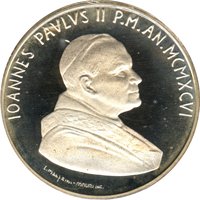
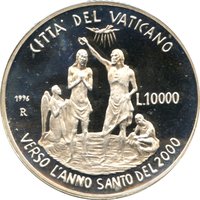
Series: Towards The Holy Year of 2000
⭐ Rare