

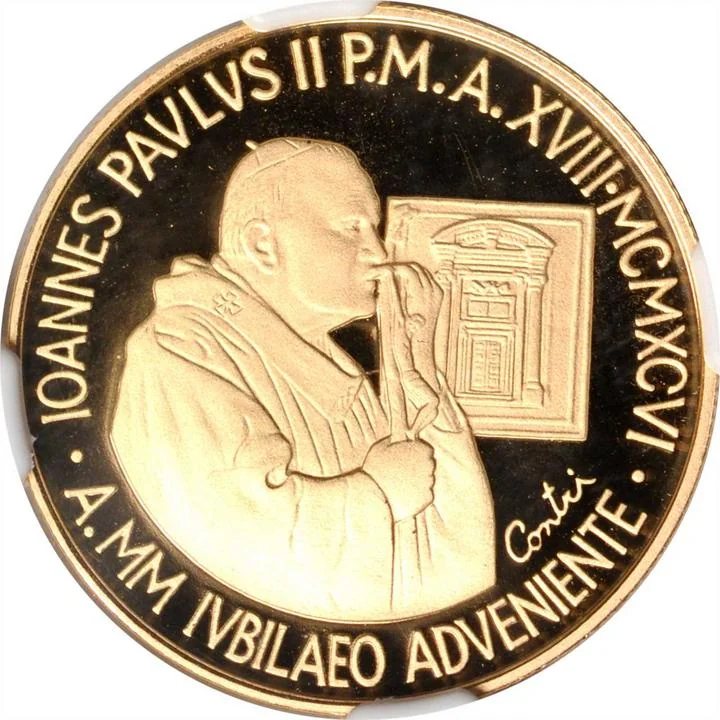
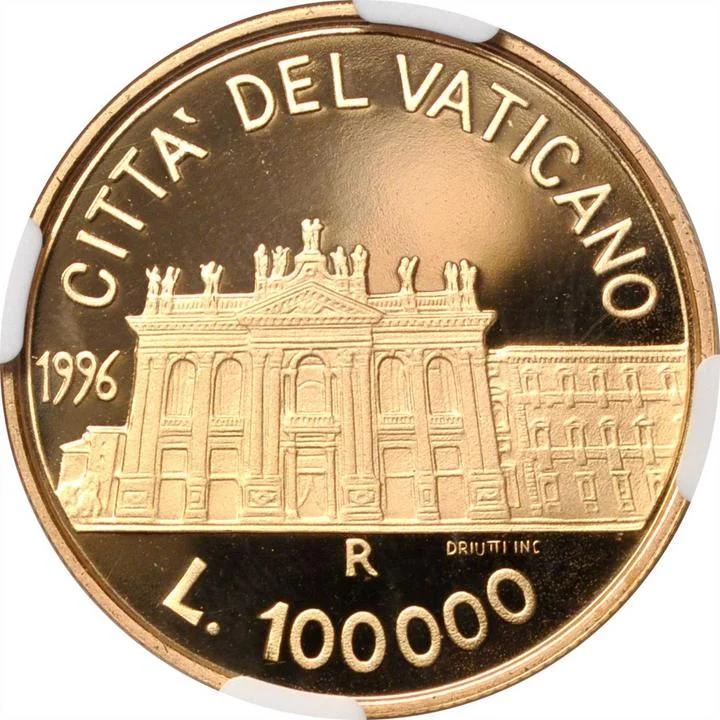
100000 lire – Vatican City
Add to wishlist
Non-circulating coins
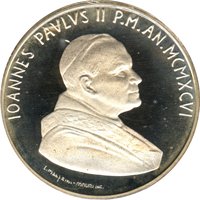
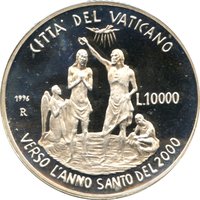
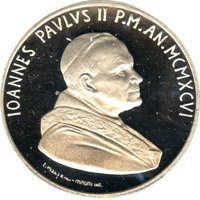
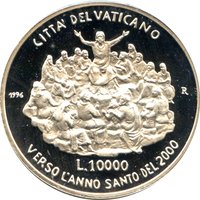
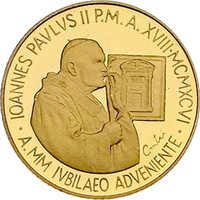
Commemoration: Pope and Holy Year Door - Basilica of St. John Lateran
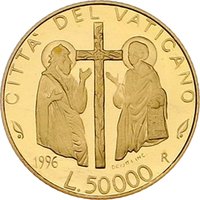
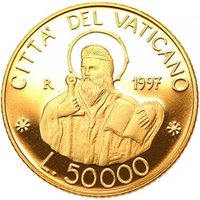
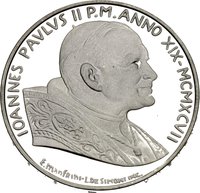
Series: Towards The Holy Year of 2000
Vatican City
Context
Year: 1996
Issuer: Vatican City
Ruler: John Paul II
Currency:
(1929—2001)
Demonetized: Yes
Total mintage: 6,000
Material
References
KM: #
Numista: #160646
Value
Exchange value: 100000 VAL
Bullion value: $2117.41
Categories
| Building> Religious building |
| Person> Religious figure |
Mints
| Name | Mark |
|---|---|
| Rome | R |
Mintings
| Year | Mint Mark | Mintage | Quality | Collection |
|---|---|---|---|---|
| 1996 | R | 6,000 |
Historical background
In 1996, the currency situation in Vatican City was defined by its unique status as a sovereign entity with a minuscule domestic economy, entirely reliant on the Italian lira for its practical, day-to-day monetary needs. While the Vatican City State possessed the formal right to issue its own coinage—the Vatican lira—these coins were not intended for independent monetary policy but were minted as limited-run commemorative and collectible items, legally equivalent to Italian lira and circulating at a 1:1 parity. The vast majority of physical currency used within its walls for purchases, salaries, and operational expenses was, in effect, the Italian lira, making the Vatican functionally part of the Italian monetary zone under a special bilateral agreement.
This arrangement was rooted in the 1929 Lateran Treaty, which established Vatican City's sovereignty and granted it coinage rights. A subsequent 1930 Monetary Convention with Italy formalized the lira as the official currency and allowed for the minting of Vatican lire. By 1996, this convention had been repeatedly renewed, with the latest agreement signed in 1991. Crucially, the Vatican's coin issuance was strictly limited in quantity, a condition imposed by Italy to prevent any disruptive or speculative minting from its enclave. Consequently, Vatican coins, while legal tender, were primarily sought by collectors and tourists rather than used in general circulation.
The year 1996 fell within a period of significant European monetary transition, as the Maastricht Treaty (1992) had set a path for Economic and Monetary Union (EMU). Vatican officials were already engaged in diplomatic discussions to ensure the city-state's inclusion in the upcoming euro system. Their goal was to secure a new agreement that would allow the Vatican to continue minting its own euro coins, despite not being a member of the European Union. This foresight ensured that when the euro was introduced in 1999 (and as physical cash in 2002), Vatican City would successfully transition from its dependency on the Italian lira to a new, similar dependency on the euro, preserving its numismatic tradition and fiscal functionality.
This arrangement was rooted in the 1929 Lateran Treaty, which established Vatican City's sovereignty and granted it coinage rights. A subsequent 1930 Monetary Convention with Italy formalized the lira as the official currency and allowed for the minting of Vatican lire. By 1996, this convention had been repeatedly renewed, with the latest agreement signed in 1991. Crucially, the Vatican's coin issuance was strictly limited in quantity, a condition imposed by Italy to prevent any disruptive or speculative minting from its enclave. Consequently, Vatican coins, while legal tender, were primarily sought by collectors and tourists rather than used in general circulation.
The year 1996 fell within a period of significant European monetary transition, as the Maastricht Treaty (1992) had set a path for Economic and Monetary Union (EMU). Vatican officials were already engaged in diplomatic discussions to ensure the city-state's inclusion in the upcoming euro system. Their goal was to secure a new agreement that would allow the Vatican to continue minting its own euro coins, despite not being a member of the European Union. This foresight ensured that when the euro was introduced in 1999 (and as physical cash in 2002), Vatican City would successfully transition from its dependency on the Italian lira to a new, similar dependency on the euro, preserving its numismatic tradition and fiscal functionality.
Series: Towards The Holy Year of 2000
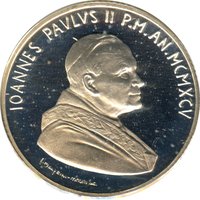
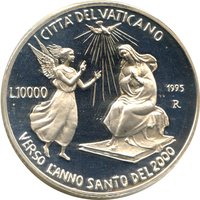
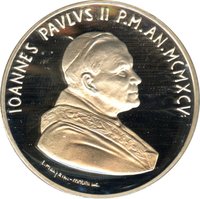
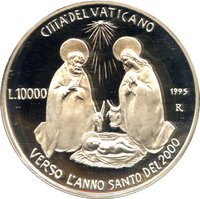

✨ Legendary