

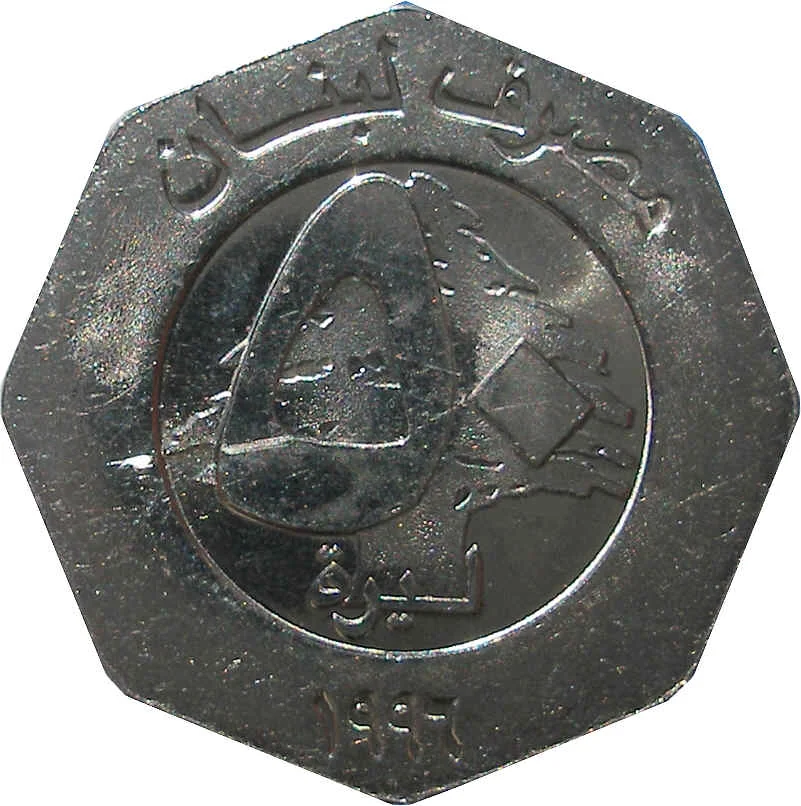
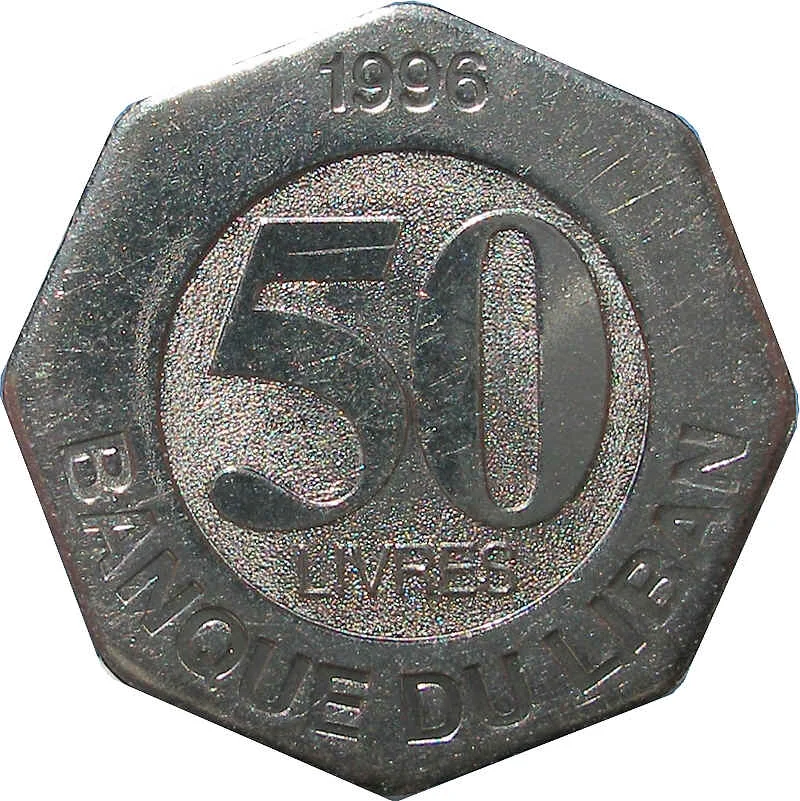
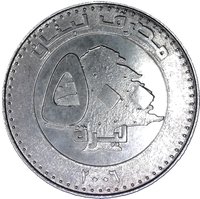
50 Livres – Lebanon
Lebanon
Context

Material
Diameter: 18.5 mm
Weight: 2.25 g
Thickness: 1.15 mm
Shape: Octagonal
Composition: Stainless steel
Technique: Milled
Alignment: Coin alignment
flip
References
KM: #Click to copy to clipboard37
Numista: #5222
Value
Exchange value: 50 LBP
Obverse
Reverse
Edge
Plain
Mints
| Name | Mark |
|---|---|
| Royal Canadian Mint of Winnipeg | — |
Mintings
| Year | Mint Mark | Mintage | Quality | Collection |
|---|---|---|---|---|
| 1996 | — | — |
Historical background
In 1996, Lebanon was in the early stages of implementing a pivotal and controversial monetary policy known as "the peg." Following the devastation of the 1975-1990 civil war, the Lebanese pound (LBP) was highly unstable and volatile. To anchor the economy, attract reconstruction capital, and stabilize prices, the Banque du Liban (BDL), under Governor Riad Salameh, formally pegged the national currency to the US dollar in the early 1990s, with the rate officially set at £L1,507.5 per dollar by 1996.
This policy was initially deemed a success, creating a crucial period of monetary stability that facilitated significant post-war reconstruction. The fixed exchange rate boosted confidence, allowed the government to borrow heavily in foreign currency, and curbed the hyperinflation of the war years. In 1996, the peg appeared solid, supported by substantial foreign currency reserves from diaspora remittances, banking sector deposits, and incoming foreign investment, particularly in real estate and government debt.
However, the stability of 1996 belied underlying structural vulnerabilities. The peg was maintained not by a strong productive economy or robust exports, but by high-interest rates that attracted speculative financial inflows. This created a growing reliance on continuous foreign capital to finance large twin deficits (fiscal and current account), making the economy increasingly susceptible to external shocks. While the immediate crisis was over a decade away, the foundations of Lebanon's future financial collapse were being laid during this period of artificial calm, as economic growth became dependent on an unsustainable debt-driven model propped up by the fixed exchange rate.
This policy was initially deemed a success, creating a crucial period of monetary stability that facilitated significant post-war reconstruction. The fixed exchange rate boosted confidence, allowed the government to borrow heavily in foreign currency, and curbed the hyperinflation of the war years. In 1996, the peg appeared solid, supported by substantial foreign currency reserves from diaspora remittances, banking sector deposits, and incoming foreign investment, particularly in real estate and government debt.
However, the stability of 1996 belied underlying structural vulnerabilities. The peg was maintained not by a strong productive economy or robust exports, but by high-interest rates that attracted speculative financial inflows. This created a growing reliance on continuous foreign capital to finance large twin deficits (fiscal and current account), making the economy increasingly susceptible to external shocks. While the immediate crisis was over a decade away, the foundations of Lebanon's future financial collapse were being laid during this period of artificial calm, as economic growth became dependent on an unsustainable debt-driven model propped up by the fixed exchange rate.
🌱 Very Common