

1 dime – United States
Add to wishlist
United States
Context
Years: 1946–1964
Issuer: United States
Period:
(since 1776)
Currency:
(since 1785)
Subdivision: 1 dime = 10 Cents
Total mintage: 6,624,341,427
Material
References
KM: #
Numista: #52
Value
Exchange value: 0.1 USD = $0.10
Bullion value: $5.50
Inflation-adjusted value: 1.78 USD
Obverse
Description:
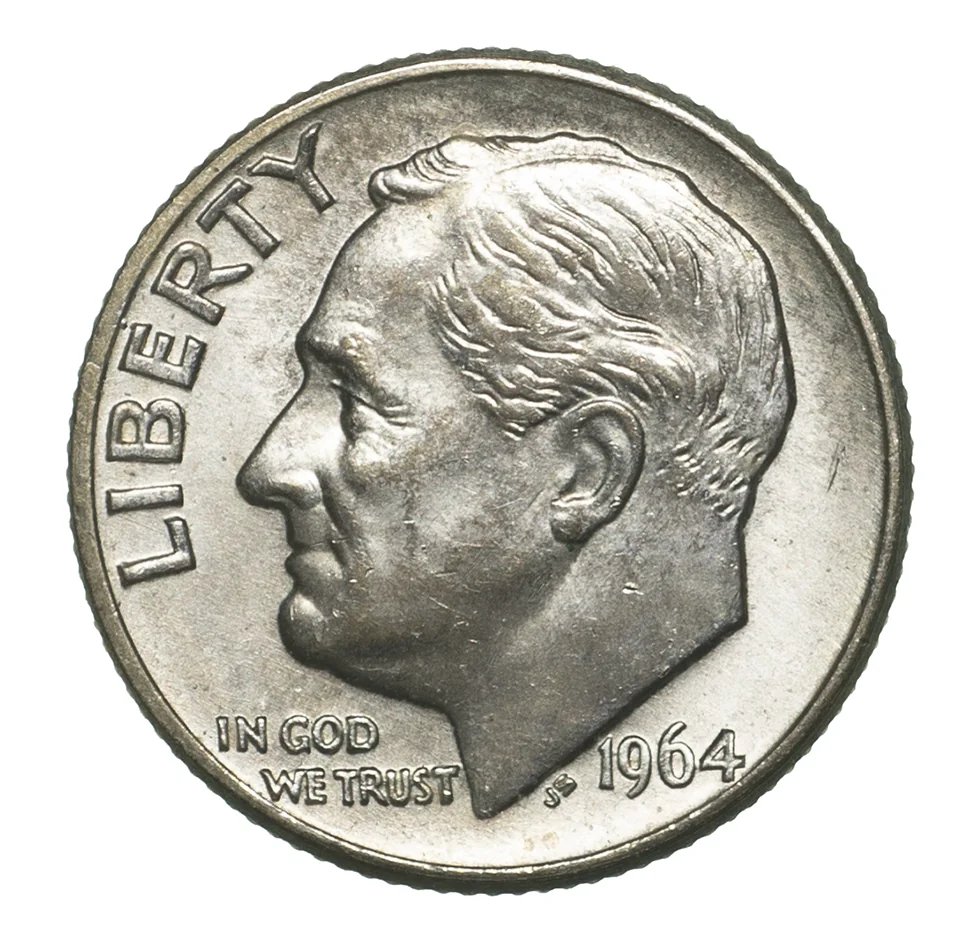
Left-profile portrait of Franklin D. Roosevelt, 32nd U.S. President (1933-1945), with "IN GOD WE TRUST" and "LIBERTY." Engraver's initials below.
Inscription:
LIBERTY
IN GOD
WE TRUST 1964 JS
IN GOD
WE TRUST 1964 JS
Script: Latin
Engraver: John R. Sinnock
Reverse
Description:
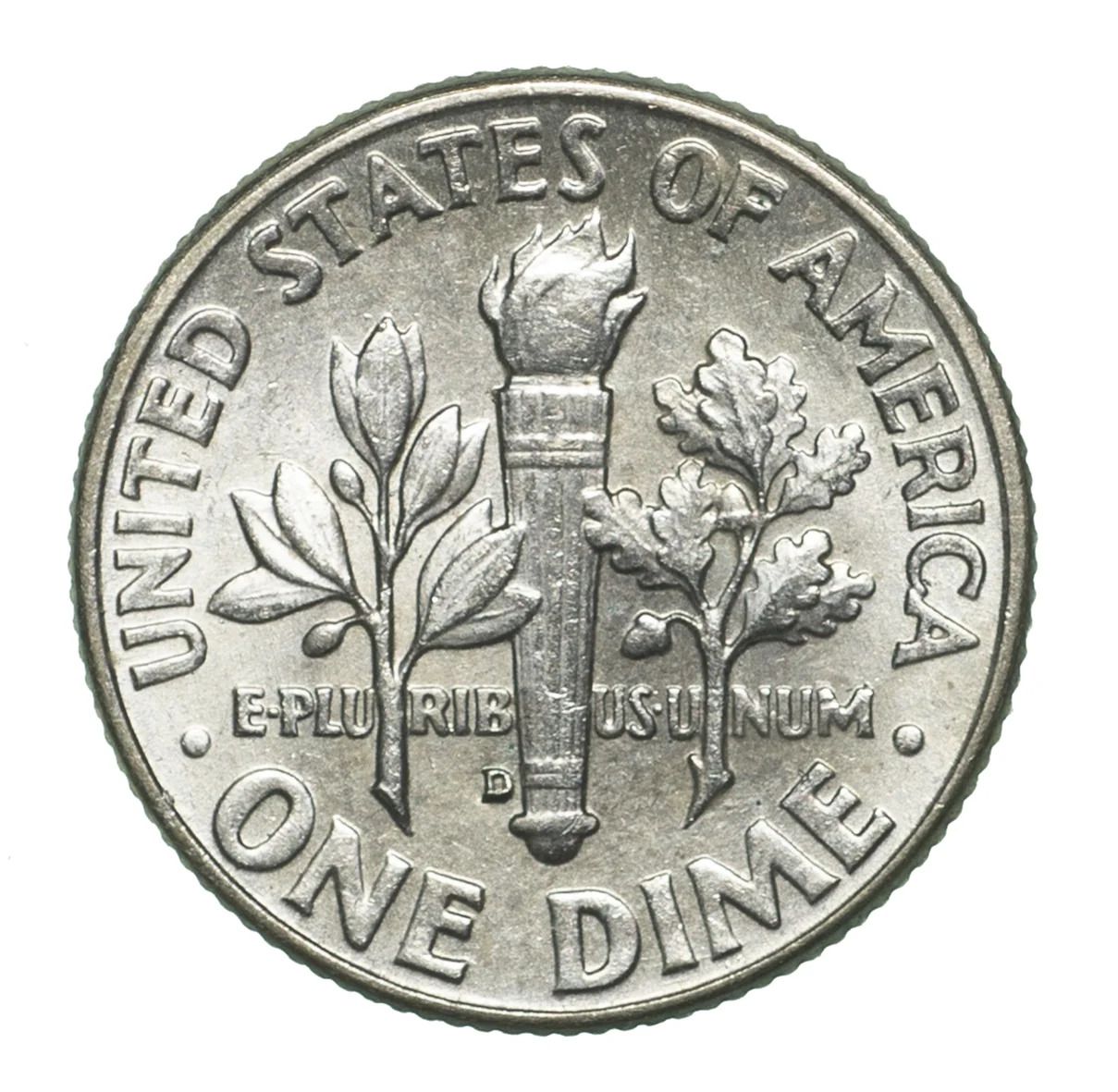
The motto "E PLURIBUS UNUM" is above symbols of peace (olive branch), liberty (torch), and victory (oak branch). The face value and "UNITED STATES OF AMERICA" surround them. A mintmark (D or S) appears below the torch.
Inscription:
UNITED STATES OF AMERICA
E • PLU RIB US • U NUM
• ONE DIME •
E • PLU RIB US • U NUM
• ONE DIME •
Translation:
UNITED STATES OF AMERICA
OUT OF MANY, ONE
• ONE DIME •
OUT OF MANY, ONE
• ONE DIME •
Script: Latin
Engraver: John R. Sinnock
Edge
Reeded (118 reeds)
Categories
| Person> Politician |
Mints
| Name | Mark |
|---|---|
| United States Mint of Philadelphia | — |
| United States Mint of Denver | D |
| United States Mint of San Francisco | S |
Mintings
| Year | Mint Mark | Mintage | Quality | Collection |
|---|---|---|---|---|
| 1946 | S | 27,900,000 | ||
| 1946 | — | 255,300,000 | ||
| 1946 | D | 61,000,000 | ||
| 1947 | — | 121,500,000 | ||
| 1947 | D | 46,800,000 | ||
| 1947 | S | 34,800,000 | ||
| 1948 | — | 75,000,000 | ||
| 1948 | D | 52,800,000 | ||
| 1948 | S | 35,500,000 | ||
| 1949 | — | 30,900,000 | ||
| 1949 | D | 26,000,000 | ||
| 1949 | S | 13,500,000 | ||
| 1950 | — | 51,386 | Proof | |
| 1950 | — | 50,200,000 | ||
| 1950 | D | 46,800,000 | ||
| 1950 | S | 20,400,000 | ||
| 1951 | — | 57,500 | Proof | |
| 1951 | — | 103,900,000 | ||
| 1951 | D | 52,200,000 | ||
| 1951 | S | 31,600,000 | ||
| 1952 | — | 81,980 | Proof | |
| 1952 | — | 99,100,000 | ||
| 1952 | D | 122,100,000 | ||
| 1952 | S | 44,400,000 | ||
| 1953 | — | 53,600,000 | ||
| 1953 | — | 128,800 | Proof | |
| 1953 | D | 136,400,000 | ||
| 1953 | S | 39,200,000 | ||
| 1954 | — | 114,200,000 | ||
| 1954 | — | 233,300 | Proof | |
| 1954 | D | 106,400,000 | ||
| 1954 | S | 22,900,000 | ||
| 1955 | — | 12,800,000 | ||
| 1955 | — | 378,200 | Proof | |
| 1955 | D | 14,000,000 | ||
| 1955 | S | 18,500,000 | ||
| 1956 | — | 109,300,000 | ||
| 1956 | — | 669,384 | Proof | |
| 1956 | D | 108,000,000 | ||
| 1957 | — | 161,400,000 | ||
| 1957 | — | 1,247,952 | Proof | |
| 1957 | D | 113,800,000 | ||
| 1958 | — | 32,700,000 | ||
| 1958 | — | 875,652 | Proof | |
| 1958 | D | 137,000,000 | ||
| 1959 | — | 86,900,000 | ||
| 1959 | — | 1,149,291 | Proof | |
| 1959 | D | 164,900,000 | ||
| 1960 | — | 72,100,000 | ||
| 1960 | — | 1,691,602 | Proof | |
| 1960 | D | 200,200,000 | ||
| 1961 | — | 96,800,000 | ||
| 1961 | — | 3,028,244 | Proof | |
| 1961 | D | 209,100,000 | ||
| 1962 | — | 75,700,000 | ||
| 1962 | — | 3,218,019 | Proof | |
| 1962 | D | 334,900,000 | ||
| 1963 | — | 123,650,000 | ||
| 1963 | — | 3,075,645 | Proof | |
| 1963 | D | 421,476,530 | ||
| 1964 | — | 929,360,000 | ||
| 1964 | — | 3,950,762 | Proof | |
| 1964 | D | 1,357,517,180 |
Historical background
In 1946, the United States emerged from World War II with a uniquely dominant and stable currency, positioned as the undisputed anchor of the global financial system. Domestically, the economy was transitioning from wartime controls to a peacetime footing, but inflationary pressures were a primary concern. The Office of Price Administration (OPA) had kept prices in check during the war, but its authority was waning, leading to significant political battles over its extension. When most controls finally lapsed in mid-1946, pent-up consumer demand met supply shortages, triggering a sharp spike in inflation, which reached nearly 18% for the year. This created a complex currency environment where the dollar's international strength contrasted with domestic purchasing power anxieties.
Internationally, the dollar's situation was defined by the Bretton Woods Agreement of 1944, which became fully operational in the postwar period. The U.S. dollar was established as the world's central reserve currency, directly convertible to gold at a fixed rate of $35 per ounce for foreign governments and central banks. All other major currencies were pegged to the dollar, making it the essential medium for global trade and reconstruction. This system bestowed immense economic and political power on the United States, as the devastated economies of Europe and Asia desperately needed dollars to purchase vital American goods and finance their recovery, leading to an initial "dollar shortage" abroad.
Thus, the currency situation of 1946 was one of dual realities: a robust and sought-after dollar on the world stage, underpinning a new era of American economic leadership, and a domestically vulnerable dollar grappling with the disruptive aftershocks of war demobilization. This dichotomy set the stage for the coming decades, where the dollar's global role would expand even as its domestic value faced ongoing challenges from inflation and economic policy. The year solidified the transition from a wartime to a consumer economy and marked the beginning of the "Pax Americana" in finance, with the U.S. Treasury and the Federal Reserve now playing central roles in both national and international monetary stability.
Internationally, the dollar's situation was defined by the Bretton Woods Agreement of 1944, which became fully operational in the postwar period. The U.S. dollar was established as the world's central reserve currency, directly convertible to gold at a fixed rate of $35 per ounce for foreign governments and central banks. All other major currencies were pegged to the dollar, making it the essential medium for global trade and reconstruction. This system bestowed immense economic and political power on the United States, as the devastated economies of Europe and Asia desperately needed dollars to purchase vital American goods and finance their recovery, leading to an initial "dollar shortage" abroad.
Thus, the currency situation of 1946 was one of dual realities: a robust and sought-after dollar on the world stage, underpinning a new era of American economic leadership, and a domestically vulnerable dollar grappling with the disruptive aftershocks of war demobilization. This dichotomy set the stage for the coming decades, where the dollar's global role would expand even as its domestic value faced ongoing challenges from inflation and economic policy. The year solidified the transition from a wartime to a consumer economy and marked the beginning of the "Pax Americana" in finance, with the U.S. Treasury and the Federal Reserve now playing central roles in both national and international monetary stability.
🌱 Very Common