

25 pesos – Argentina
Add to wishlist
Circulating commemorative coins
Commemoration: 1st issue of National Coinage in 1813
Argentina
Context
Years: 1964–1968
Issuer: Argentina
Period:
(since 1861)
Currency:
(1881—1969)
Demonetization: 1 January 1970
Total mintage: 71,975,158
Material
Diameter: 25.5 mm
Weight: 6.5 g
Thickness: 2 mm
Shape: Dodecagonal
Technique: Milled
Alignment: Medal alignment
flip
References
KM: #
Numista: #5190
Value
Exchange value: 25 ARM
Obverse
Reverse
Description:
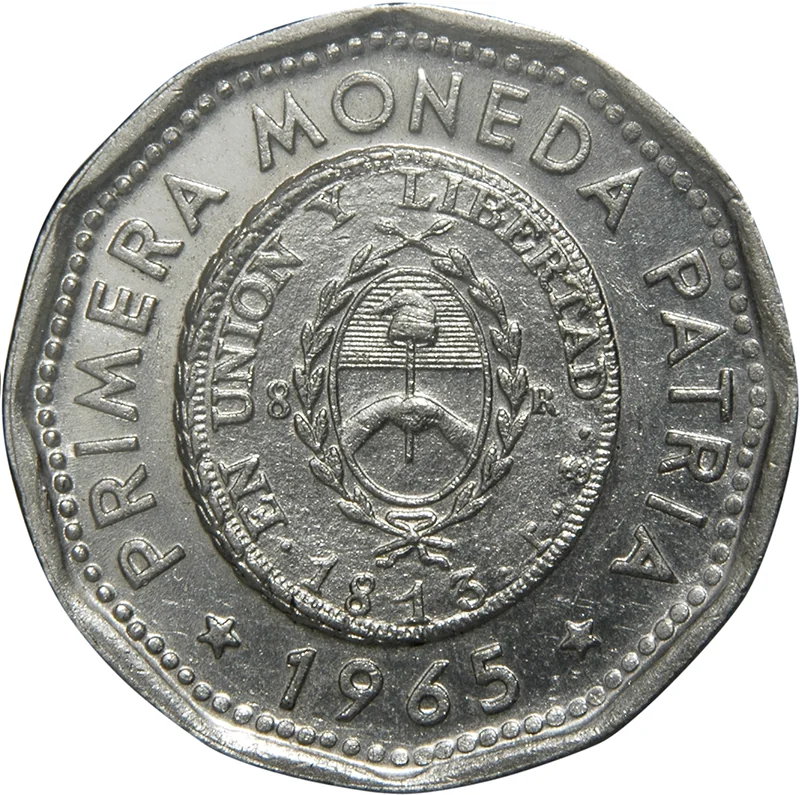
A laurel wreath encircles two hands holding a liberty pole topped with a Phrygian cap and a rising sun, symbolizing unity in freedom's defense.
Inscription:
EN UNION Y LIBERTAD 1813
8R
PRIMERA MONEDA PATRIA
1965
8R
PRIMERA MONEDA PATRIA
1965
Translation:
In Union and Liberty 1813
8R
First Homeland Coin
1965
8R
First Homeland Coin
1965
Script: Latin
Language: Spanish
Edge
Plain
Categories
| Symbol> Phrygian cap |
| Currency> Coin depiction |
| Symbols> Coat of Arms |
| Symbol> Sun |
Mintings
| Year | Mint Mark | Mintage | Quality | Collection |
|---|---|---|---|---|
| 1964 | — | 20,485,000 | ||
| 1965 | — | 14,884,000 | ||
| 1966 | — | 16,426,028 | ||
| 1967 | — | 15,734,000 | ||
| 1968 | — | 4,446,130 |
Historical background
Argentina's currency situation in 1964 was defined by the persistent and structural economic instability that characterized much of the mid-20th century. The country was operating under a complex system of multiple exchange rates, a common tool used by the government to control the balance of payments and subsidize specific sectors. The official peso was pegged at 138 to the U.S. dollar for essential imports and debt servicing, but a thriving parallel "black market" for dollars existed at a significant premium, reflecting a severe lack of confidence in the currency and underlying inflationary pressures. This duality created distortions, encouraged speculation, and hampered genuine economic growth.
The root causes of this fragility were deep-seated. Chronic fiscal deficits, driven by expansive public spending and a large state-owned sector, were monetized by the central bank, leading to persistent inflation that eroded the peso's value. Furthermore, Argentina's reliance on agricultural exports for foreign exchange made the currency vulnerable to volatile commodity prices. The administration of President Arturo Illia, who took office in 1963, faced the immense challenge of stabilizing the economy without triggering a recession, all while navigating a fragile political landscape following the overthrow of the previous Peronist government.
Ultimately, 1964 represented a point of precarious equilibrium within a longer cycle of crisis. While not experiencing the hyperinflation or dramatic devaluations of other periods, the multi-tiered exchange system and black market were clear symptoms of fundamental imbalances. The measures taken, including limited austerity and attempts to secure international credit, proved insufficient to break the cycle of stop-go economic policies, setting the stage for continued monetary instability and a succession of deeper crises in the decades to follow.
The root causes of this fragility were deep-seated. Chronic fiscal deficits, driven by expansive public spending and a large state-owned sector, were monetized by the central bank, leading to persistent inflation that eroded the peso's value. Furthermore, Argentina's reliance on agricultural exports for foreign exchange made the currency vulnerable to volatile commodity prices. The administration of President Arturo Illia, who took office in 1963, faced the immense challenge of stabilizing the economy without triggering a recession, all while navigating a fragile political landscape following the overthrow of the previous Peronist government.
Ultimately, 1964 represented a point of precarious equilibrium within a longer cycle of crisis. While not experiencing the hyperinflation or dramatic devaluations of other periods, the multi-tiered exchange system and black market were clear symptoms of fundamental imbalances. The measures taken, including limited austerity and attempts to secure international credit, proved insufficient to break the cycle of stop-go economic policies, setting the stage for continued monetary instability and a succession of deeper crises in the decades to follow.
🌱 Very Common