

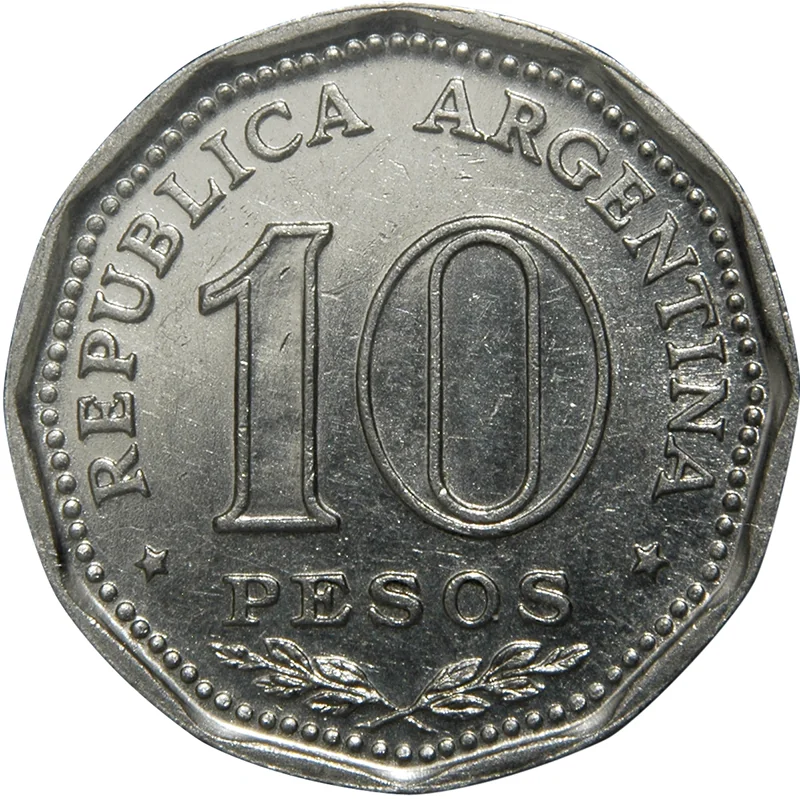
10 pesos (Declaration of Independence) – Argentina
Add to wishlist
Circulating commemorative coins
Commemoration: 150th Anniversary of the Declaration of Independence
Argentina
Context
Year: 1966
Issuer: Argentina
Period:
(since 1861)
Currency:
(1881—1969)
Demonetization: 1 January 1970
Total mintage: 29,335,504
Material
Diameter: 23.6 mm
Weight: 5 g
Thickness: 1.9 mm
Shape: Dodecagonal
Technique: Milled
Alignment: Coin alignment
flip
References
KM: #
Numista: #3999
Value
Exchange value: 10 ARM
Obverse
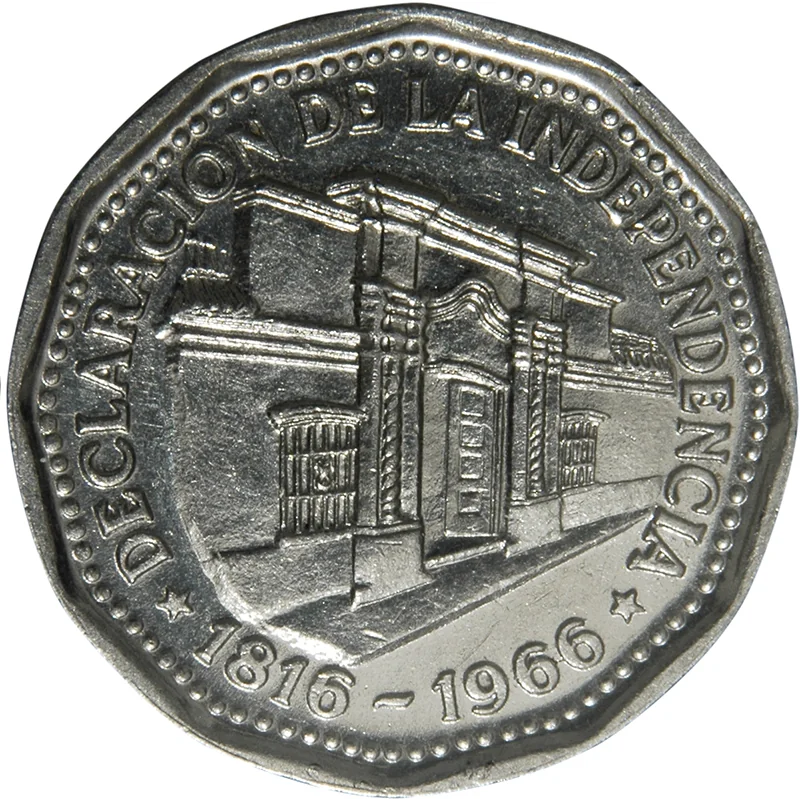
Reverse
Description:
Casa de Tucumán, where Argentina's Independence was declared on July 9, 1816.
Inscription:
DECLARACION DE LA INDEPENDENCIA
1816-1966
1816-1966
Script: Latin
Edge
Plain
Categories
| Building> Museum |
| Event> Independence |
Mintings
| Year | Mint Mark | Mintage | Quality | Collection |
|---|---|---|---|---|
| 1966 | — | 29,335,504 |
Historical background
In 1966, Argentina's currency situation was characterized by chronic instability and inflationary pressures, a legacy of the political and economic volatility that had plagued the nation for decades. The country was operating under the peso moneda nacional, but its value was eroding steadily. The root causes were persistent fiscal deficits financed by money creation, a pattern of stop-go economic policies, and declining confidence in institutions. The recent overthrow of President Arturo Illia by a military coup in June 1966, which established the authoritarian regime of General Juan Carlos Onganía, underscored the political dimension of the economic crisis, as the new leadership sought to impose order on what it perceived as economic mismanagement.
Economically, Argentina struggled with low foreign exchange reserves and a burdensome external debt, which constrained its ability to stabilize the currency. Inflation, though not yet in the hyperinflationary spirals that would come later, was a persistent and worsening problem, undermining purchasing power and creating uncertainty for both businesses and savers. The government maintained a system of multiple exchange rates and strict controls in an attempt to manage the balance of payments and protect reserves, but these measures often led to a thriving black market for U.S. dollars, where the peso traded at a significant discount.
The Onganía regime initially responded with an orthodox austerity plan, seeking to curb inflation and restore fiscal discipline. However, these measures, combined with wage controls, would soon lead to social unrest and industrial action. Thus, in 1966, the Argentine peso was fundamentally weak, caught in a cycle of devaluation pressures, controlled official rates, and parallel market premiums. This environment set the stage for the repeated devaluations and failed stabilization plans that would mark the following decades, as the structural issues of fiscal profligacy and political instability remained unresolved.
Economically, Argentina struggled with low foreign exchange reserves and a burdensome external debt, which constrained its ability to stabilize the currency. Inflation, though not yet in the hyperinflationary spirals that would come later, was a persistent and worsening problem, undermining purchasing power and creating uncertainty for both businesses and savers. The government maintained a system of multiple exchange rates and strict controls in an attempt to manage the balance of payments and protect reserves, but these measures often led to a thriving black market for U.S. dollars, where the peso traded at a significant discount.
The Onganía regime initially responded with an orthodox austerity plan, seeking to curb inflation and restore fiscal discipline. However, these measures, combined with wage controls, would soon lead to social unrest and industrial action. Thus, in 1966, the Argentine peso was fundamentally weak, caught in a cycle of devaluation pressures, controlled official rates, and parallel market premiums. This environment set the stage for the repeated devaluations and failed stabilization plans that would mark the following decades, as the structural issues of fiscal profligacy and political instability remained unresolved.
🌱 Very Common