

1 Lats – Latvia
Latvia
Context

Material
Diameter: 38.61 mm
Weight: 31.47 g
Silver weight: 29.11 g
Shape: Round
Composition: 92.5% Silver
Standard: Silver ounce
Magnetic: No
Technique: Milled
Alignment: Medal alignment
flip
References
KM: #Click to copy to clipboard68
Numista: #51674
Value
Exchange value: 1 LVL
Bullion value: $82.73
Inflation-adjusted value: 2.33 LVL
Obverse
Description:
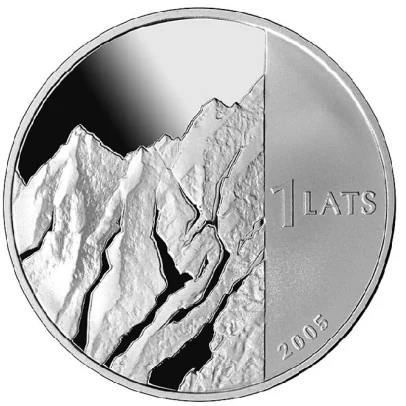
The coin's obverse is vertically split (2:1 ratio). The right side centers "1 LATS" with the year 2005 arched below, while the left side depicts mountain peaks.
Inscription:
1 LATS
2005
2005
Script: Latin
Engraver: Ligita Franckeviča
Designer: Arta Ozola - Jaunarāja
Reverse
Description:
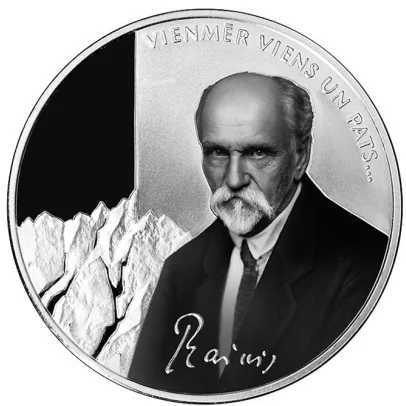
The reverse vertically divides the field (1:2). The right side shows Rainis's portrait with the semicircular inscription "VIENMĒR VIENS UN PATS..." and his facsimile signature. The left side depicts mountain peaks.
Inscription:
VIENMĒR VIENS UN PATS...
Rainis
Rainis
Translation:
Always one and the same...
Rainis
Rainis
Script: Latin
Language: Latvian
Engraver: Ligita Franckeviča
Designer: Arta Ozola - Jaunarāja
Edge
Legend:
LATVIJAS REPUBLIKA ● LATVIJAS BANKA ●
Translation:
REPUBLIC OF LATVIA ● BANK OF LATVIA ●
Language: Latvian
Categories
| Art> Literature |
| Mustache/Beard |
| Geography> Mountain |
Mints
| Name | Mark |
|---|---|
| Royal Dutch Mint | — |
Mintings
| Year | Mint Mark | Mintage | Quality | Collection |
|---|---|---|---|---|
| 2005 | — | 5,000 | Proof |
Historical background
In 2005, Latvia was in a period of robust economic growth, having successfully navigated the post-Soviet transition. The country's currency was the Latvian lats (LVL), which had been reintroduced in 1993 after independence. A cornerstone of its financial stability was the hard peg to the Special Drawing Rights (SDR) basket, and since January 2005, a fixed peg to the euro at a rate of 0.702804 LVL to 1 EUR. This policy, managed by the Bank of Latvia, was designed to ensure low inflation and foster confidence for foreign investment, which was flowing heavily into the booming real estate and financial sectors.
However, this fixed exchange rate regime existed alongside significant macroeconomic imbalances. The economy was overheating, with GDP growth exceeding 10% in 2005, fueled by massive credit expansion and a consumption-led boom. This drove inflation to persistently high levels, well above the Maastricht criterion limits required for euro adoption. Consequently, Latvia faced the "impossible trinity" dilemma: it maintained a fixed exchange rate and free capital movement, but in doing so, it relinquished control over its independent monetary policy. The Bank of Latvia could not effectively raise interest rates to cool the overheating economy without attracting even more speculative capital inflows that would exacerbate inflation.
The situation in 2005 was therefore one of contrasting stability and underlying strain. The lats was formally stable and trusted, a symbol of Latvia's successful integration into European structures, with official policy firmly aimed at eventual eurozone membership. Yet, economists increasingly warned that the rigid peg, while providing an anchor, was amplifying internal economic pressures. The year highlighted the challenging path toward euro adoption, as Latvia had to engineer a "soft landing" to curb inflation without triggering a recession, all while maintaining its unwavering currency peg—a delicate balancing act that would be severely tested during the global financial crisis just a few years later.
However, this fixed exchange rate regime existed alongside significant macroeconomic imbalances. The economy was overheating, with GDP growth exceeding 10% in 2005, fueled by massive credit expansion and a consumption-led boom. This drove inflation to persistently high levels, well above the Maastricht criterion limits required for euro adoption. Consequently, Latvia faced the "impossible trinity" dilemma: it maintained a fixed exchange rate and free capital movement, but in doing so, it relinquished control over its independent monetary policy. The Bank of Latvia could not effectively raise interest rates to cool the overheating economy without attracting even more speculative capital inflows that would exacerbate inflation.
The situation in 2005 was therefore one of contrasting stability and underlying strain. The lats was formally stable and trusted, a symbol of Latvia's successful integration into European structures, with official policy firmly aimed at eventual eurozone membership. Yet, economists increasingly warned that the rigid peg, while providing an anchor, was amplifying internal economic pressures. The year highlighted the challenging path toward euro adoption, as Latvia had to engineer a "soft landing" to curb inflation without triggering a recession, all while maintaining its unwavering currency peg—a delicate balancing act that would be severely tested during the global financial crisis just a few years later.
💎 Extremely Rare