

5 Francs – French Somaliland
Somalia
Context
Year: 1948
Country: Somalia 
Issuer: French Somaliland
Period:
(1946—1958)
Currency:
(1883—1949)
Demonetized: Yes
Total mintage: 500,000
Material
References
KM: #Click to copy to clipboard6
Numista: #5164
Obverse
Description:
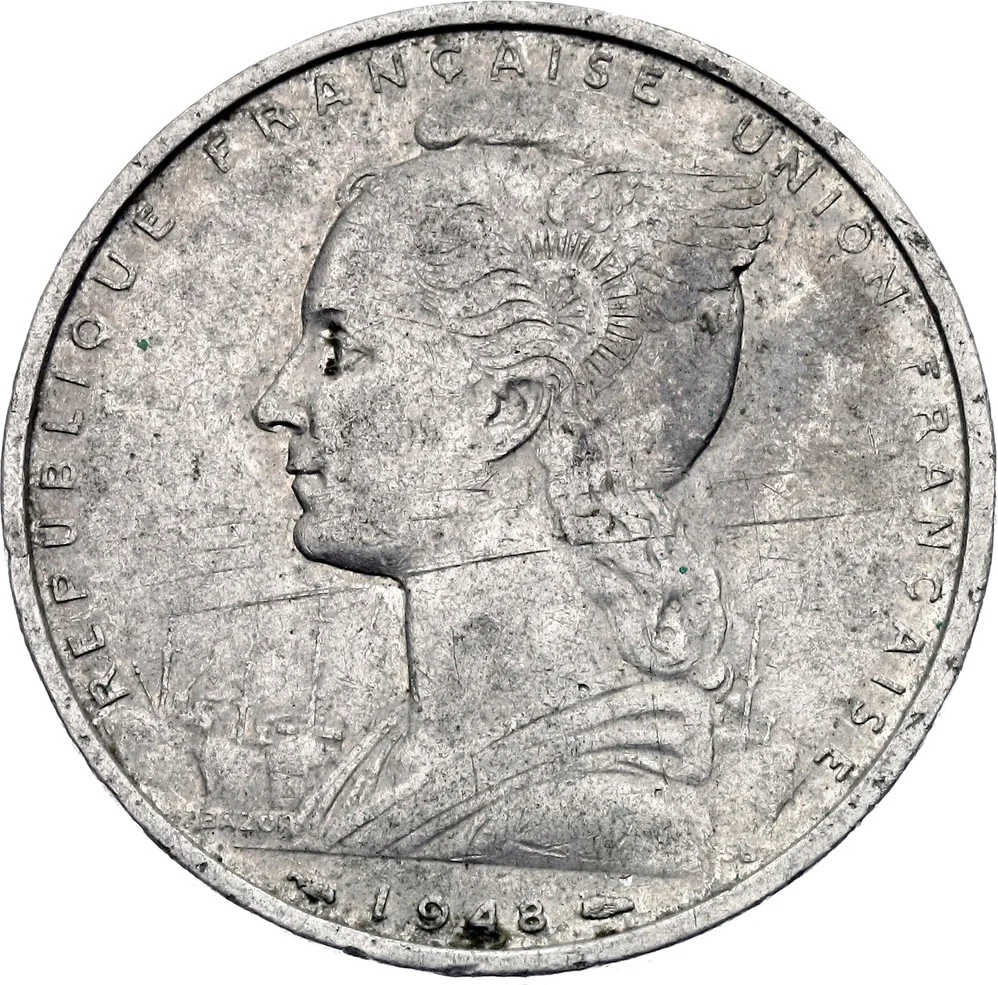
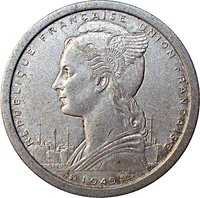
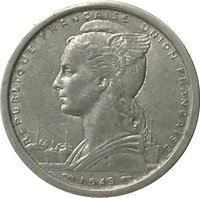
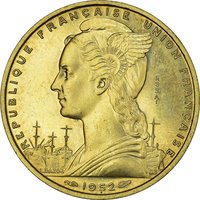
Marianne faces left in a winged Phrygian cap, with four ships in the background. The date and a privy mark are below.
Inscription:
REPUBLIQUE FRANÇAISE UNION FRANÇAISE
L.BAZOR GB
1948
L.BAZOR GB
1948
Translation:
FRENCH REPUBLIC FRENCH UNION
L.BAZOR GB
1948
L.BAZOR GB
1948
Script: Latin
Language: French
Engraver: Lucien Georges Bazor
Reverse
Description:
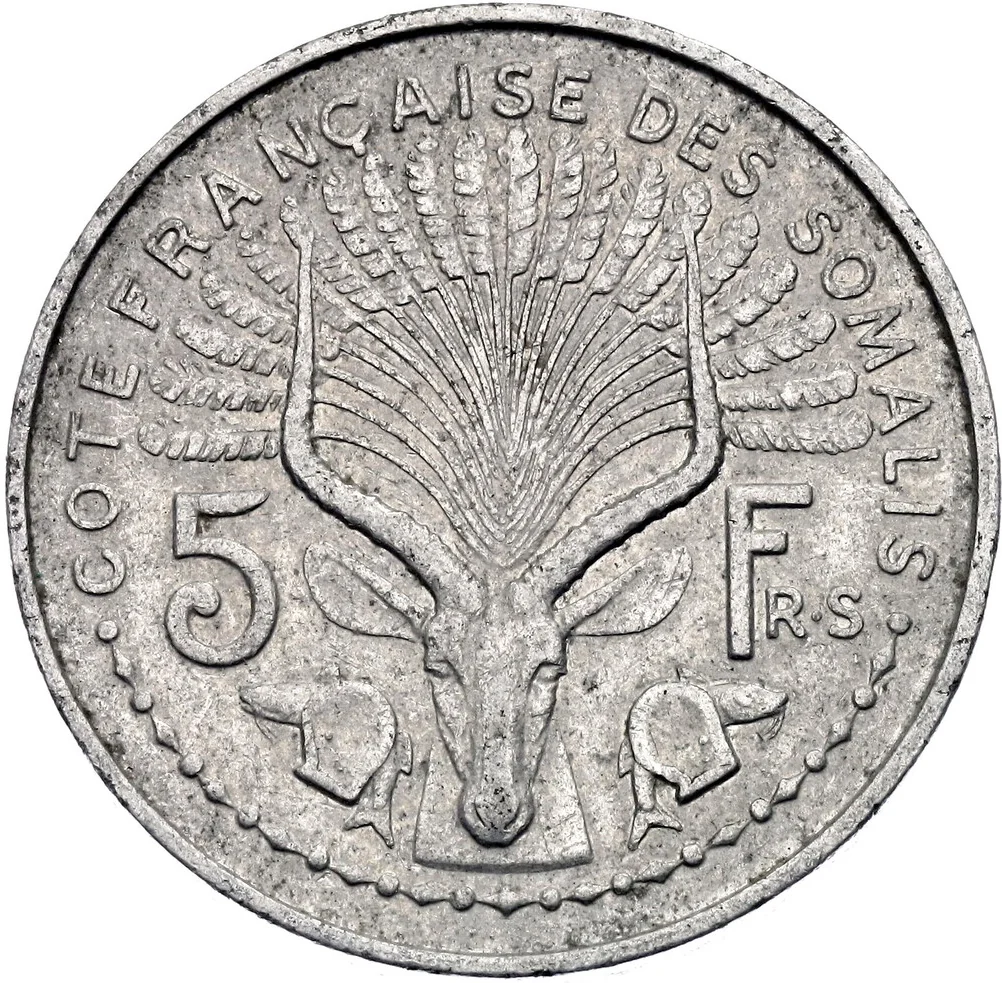
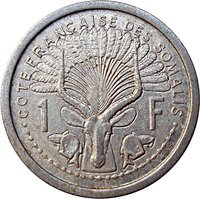
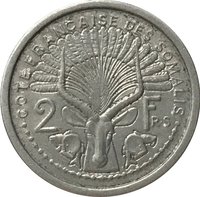
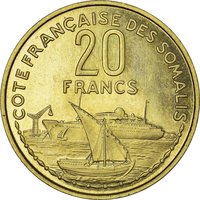
Waterbuck head with long horns flanked by shells, each over a fish. A palm spreads above.
Inscription:
COTE FRANÇAISE DES SOMALIS
5 FR·S
5 FR·S
Translation:
French Coast of the Somalis
5 Francs
5 Francs
Script: Latin
Language: French
Engraver: Lucien Georges Bazor
Edge
Plain
Mints
| Name | Mark |
|---|---|
| Monnaie de Paris | — |
Mintings
| Year | Mint Mark | Mintage | Quality | Collection |
|---|---|---|---|---|
| 1948 | — | 500,000 |
Historical background
In 1948, the currency situation in French Somaliland (present-day Djibouti) was defined by its unique status as a strategic colonial port and its integration into the Franc Zone. The official currency was the French Somaliland franc (CFSF), which was issued by the Banque de l'Indochine, acting as the colony's bank of issue. This currency was pegged at a fixed parity to the metropolitan French franc, but crucially, it was a distinct currency with its own banknotes and coins, not directly interchangeable with notes from France itself. This system provided monetary stability tied to France but was managed specifically for the local economy, which was heavily reliant on the port of Djibouti, the Ethio-Djibouti Railway, and servicing regional trade.
The colony's monetary policy was shaped by its role as a commercial and financial hub for the wider Horn of Africa. A key feature was the concurrent circulation of the Ethiopian thalers (Maria Theresa and Menelik) alongside the official CFSF, particularly in border areas and for trade with Ethiopia. This de facto bimetallism reflected the territory's economic dependence on its hinterland. Furthermore, the Banque de l'Indochine's involvement underscored the colony's financial links to the broader French imperial network in Asia and Africa, rather than a direct subordination to Parisian banking authorities.
This monetary arrangement in 1948 existed in a period of post-war transition and growing political consciousness. While it provided stability, it also tied the territory's economic fate directly to the French franc, which itself was experiencing instability and devaluations in the late 1940s. The system would remain largely intact until the late 1960s, but the situation in 1948 laid the groundwork for future debates about monetary sovereignty that would emerge in the lead-up to independence in 1977.
The colony's monetary policy was shaped by its role as a commercial and financial hub for the wider Horn of Africa. A key feature was the concurrent circulation of the Ethiopian thalers (Maria Theresa and Menelik) alongside the official CFSF, particularly in border areas and for trade with Ethiopia. This de facto bimetallism reflected the territory's economic dependence on its hinterland. Furthermore, the Banque de l'Indochine's involvement underscored the colony's financial links to the broader French imperial network in Asia and Africa, rather than a direct subordination to Parisian banking authorities.
This monetary arrangement in 1948 existed in a period of post-war transition and growing political consciousness. While it provided stability, it also tied the territory's economic fate directly to the French franc, which itself was experiencing instability and devaluations in the late 1940s. The system would remain largely intact until the late 1960s, but the situation in 1948 laid the groundwork for future debates about monetary sovereignty that would emerge in the lead-up to independence in 1977.
🌱 Common