

20 Francs – French Somaliland
Somalia
Context
Year: 1952
Country: Somalia 
Issuer: French Somaliland
Period:
(1946—1958)
Currency:
(1949—1967)
Demonetized: Yes
Total mintage: 1,200
Material
Diameter: 23.5 mm
Weight: 3.7 g
Thickness: 1 mm
Shape: Round
Composition: Aluminium bronze
Magnetic: No
Technique: Milled
Alignment: Coin alignment
flip
References
KM: #Click to copy to clipboard7
Numista: #5162
Obverse
Description:
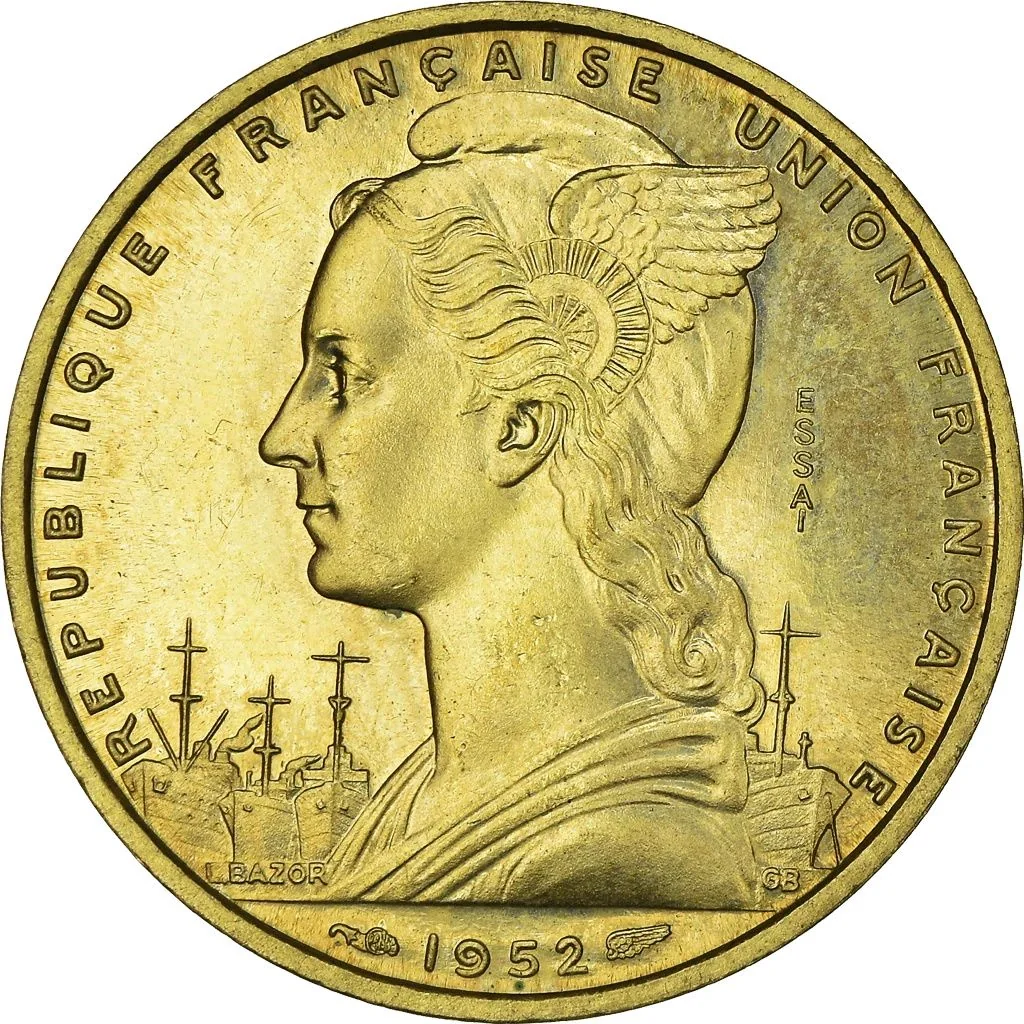
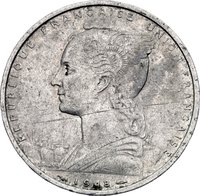
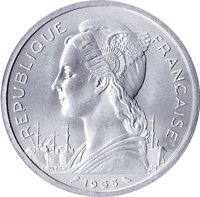
Marianne faces left in a winged Phrygian cap, with four ships in the background. The date and a privy mark are below.
Inscription:
REPUBLIQUE FRANÇAISE UNION FRANÇAISE
L.BAZOR GB
1952
L.BAZOR GB
1952
Translation:
FRENCH REPUBLIC FRENCH UNION
L.BAZOR GB
1952
L.BAZOR GB
1952
Script: Latin
Language: French
Engraver: Lucien Georges Bazor
Reverse
Description:
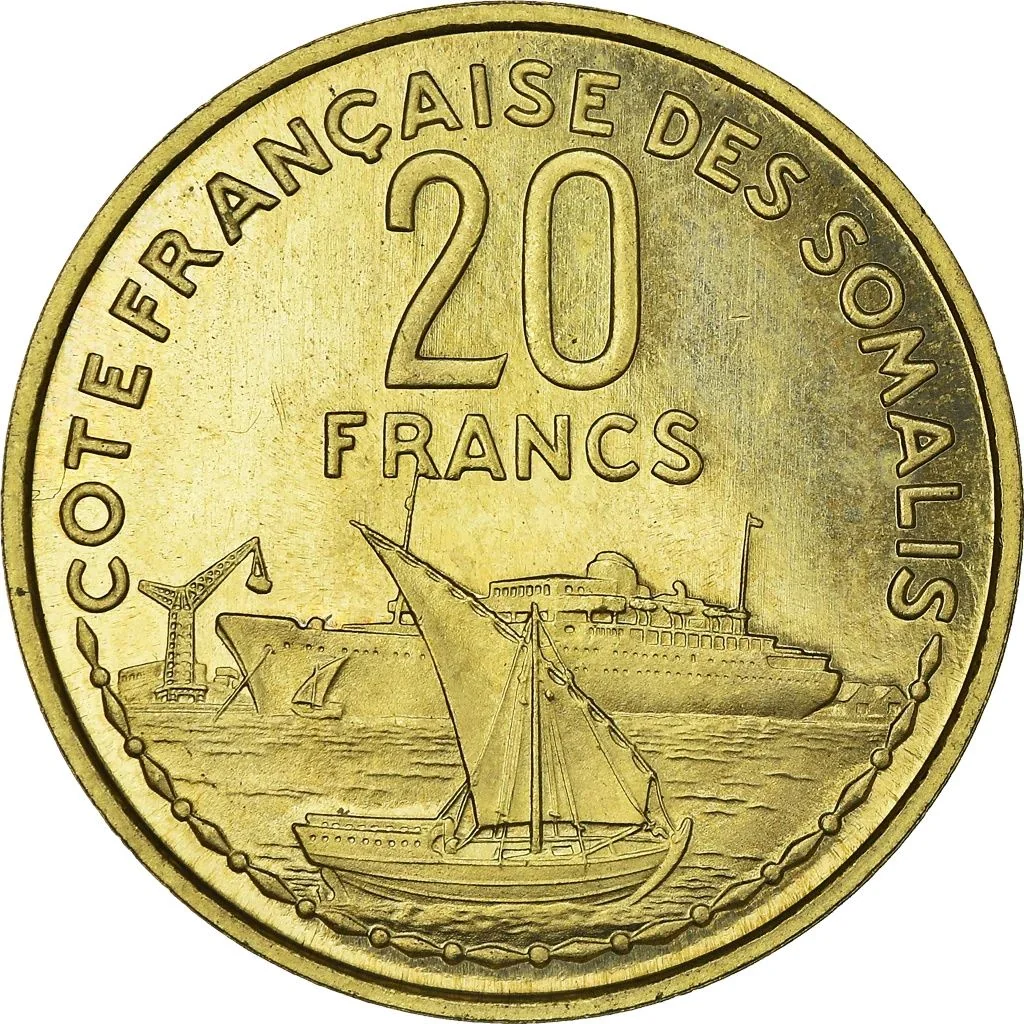
Dhow, ocean liner, two boats.
Inscription:
COTE FRANÇAISE DES SOMALIS
20
FRANCS
20
FRANCS
Translation:
French Coast of the Somalis
20
Francs
20
Francs
Script: Latin
Language: French
Engraver: Lucien Georges Bazor
Edge
Plain
Categories
| Transportation> Watercraft |
| Symbol> Allegory |
| Symbol> Phrygian cap |
Mints
| Name | Mark |
|---|---|
| Monnaie de Paris | — |
Mintings
| Year | Mint Mark | Mintage | Quality | Collection |
|---|---|---|---|---|
| 1952 | — | 1,200 |
Historical background
In 1952, the currency situation in French Somaliland (present-day Djibouti) was defined by its integration into the French colonial monetary system and its unique role as a regional financial hub. The official currency was the French Somaliland franc (Franc de la Côte française des Somalis), which was issued by a privileged private institution, the Banque de l'Indochine. This bank held the note-issuing monopoly for the territory, a right it exercised across several French Asian and African possessions. Crucially, the local franc was not pegged to the metropolitan French franc but was instead fixed to a stable international reserve: the US dollar, at a rate of 214.392 FS francs = 1 USD.
This dollar peg was a strategic decision reflecting the colony's primary economic function: servicing the critical Ethiopian railway linking Addis Ababa to the port of Djibouti. As Ethiopia's main maritime outlet, French Somaliland handled a vast portion of its trade. The stable, dollar-linked currency facilitated international commerce and provided a reliable exchange mechanism for Ethiopian merchants, shielding the port's operations from the frequent devaluations affecting the metropolitan French franc in the post-war period. The territory effectively operated as a foreign exchange enclave, with its currency board-style system ensuring full convertibility.
Thus, the monetary landscape in 1952 was one of deliberate stability and external orientation. The arrangement underscored the colony's economic dependency on Ethiopian transit trade and its financial separation from the broader Franc Zone's fluctuations. This system would remain in place until 1949, when the peg was slightly adjusted, and ultimately until the territory's independence in 1973, when the Djiboutian franc replaced it, maintaining a similar dollar peg to ensure continuity for its port-centric economy.
This dollar peg was a strategic decision reflecting the colony's primary economic function: servicing the critical Ethiopian railway linking Addis Ababa to the port of Djibouti. As Ethiopia's main maritime outlet, French Somaliland handled a vast portion of its trade. The stable, dollar-linked currency facilitated international commerce and provided a reliable exchange mechanism for Ethiopian merchants, shielding the port's operations from the frequent devaluations affecting the metropolitan French franc in the post-war period. The territory effectively operated as a foreign exchange enclave, with its currency board-style system ensuring full convertibility.
Thus, the monetary landscape in 1952 was one of deliberate stability and external orientation. The arrangement underscored the colony's economic dependency on Ethiopian transit trade and its financial separation from the broader Franc Zone's fluctuations. This system would remain in place until 1949, when the peg was slightly adjusted, and ultimately until the territory's independence in 1973, when the Djiboutian franc replaced it, maintaining a similar dollar peg to ensure continuity for its port-centric economy.
🌱 Common