

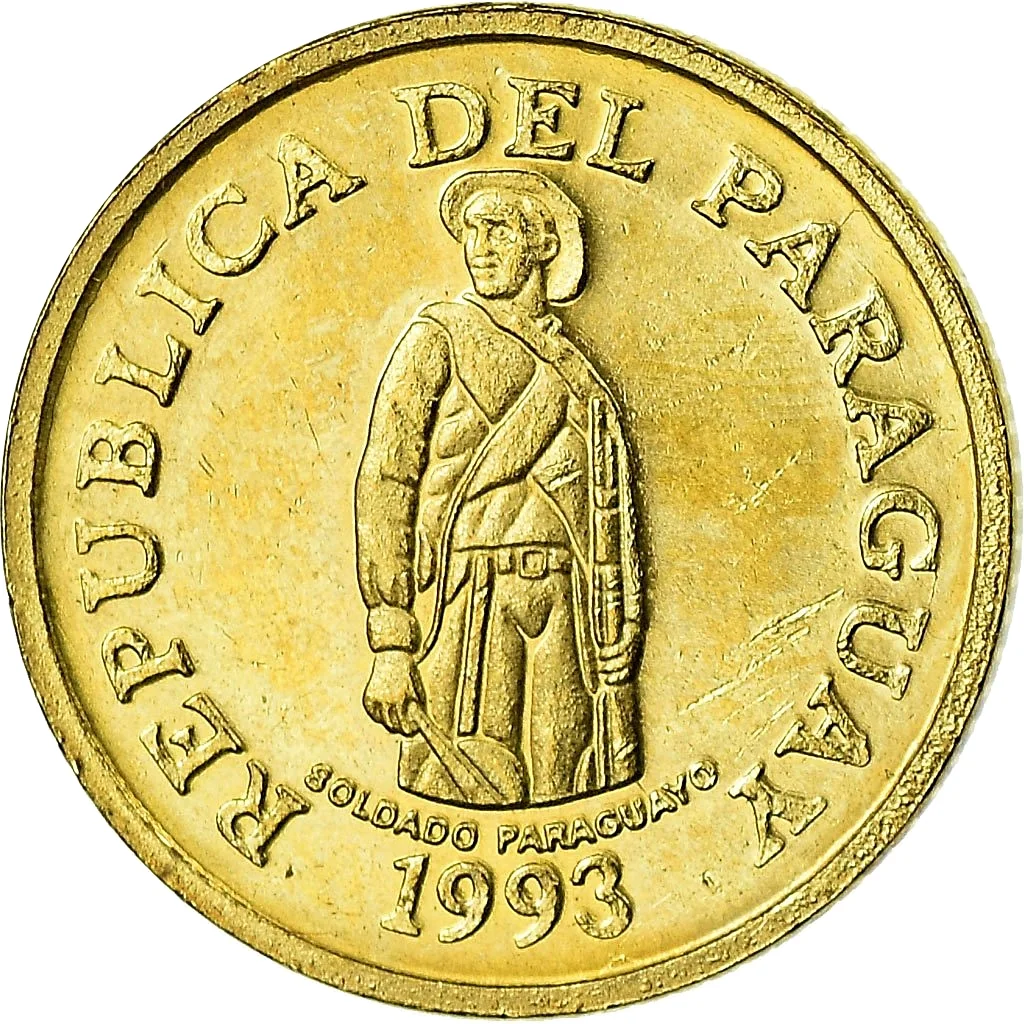
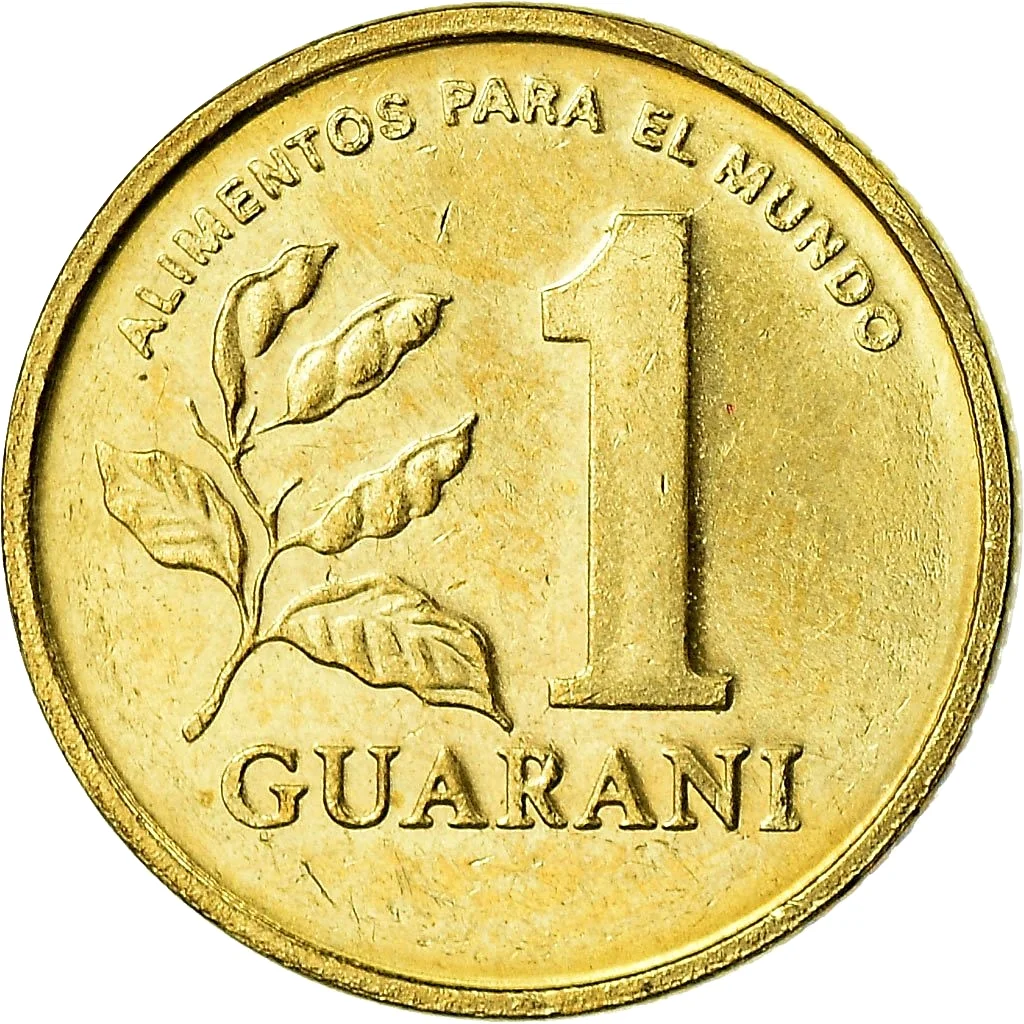
1 guaraní – Paraguay
Add to wishlist
Circulating commemorative coins
Commemoration: F.A.O.
Paraguay
Context
Year: 1993
Issuer: Paraguay
Issuing organization: Central Bank of Paraguay
Period:
(since 1811)
Currency:
(since 1944)
Demonetization: 17 January 2014
Total mintage: 5,000,000
Material
References
KM: #
Numista: #5156
Value
Exchange value: 1 PYG
Obverse
Reverse
Edge
Reeded
Categories
| Agriculture |
| Organization> FAO |
| History> War |
Mints
| Name | Mark |
|---|---|
| Casa de Moneda de Chile | — |
Mintings
| Year | Mint Mark | Mintage | Quality | Collection |
|---|---|---|---|---|
| 1993 | — | 5,000,000 |
Historical background
In 1993, Paraguay's currency situation was characterized by a period of relative stability under the long-standing regime of the Guaraní (PYG), which had been the nation's sole legal tender since 1943. This stability, however, existed within a context of underlying economic fragility and followed a tumultuous decade. The 1980s had brought severe economic distress, including a banking crisis and bouts of hyperinflation, which peaked at over 30% in 1990. By 1993, the government of President Juan Carlos Wasmosy, Paraguay's first civilian president after the 35-year Stroessner dictatorship, was grappling with the legacy of these challenges while implementing early structural reforms under guidance from the International Monetary Fund (IMF).
The Central Bank of Paraguay (BCP) maintained a managed floating exchange rate system in 1993. Unlike a fixed peg, the Guaraní's value was allowed to fluctuate based on market forces within a band, with the BCP intervening to smooth out excessive volatility. This policy aimed to balance the need for export competitiveness with the control of inflationary pressures. Inflation remained a primary concern, though it had been brought down significantly from its early-1990s peak to approximately 20% in 1993—still high but moving in a positive direction due to tighter fiscal and monetary policies.
Economically, 1993 was a transitional year. The currency's stability was bolstered by strong agricultural exports, particularly soybeans, which generated vital foreign exchange. However, the economy was also marked by a large informal sector, widespread dollarization of major transactions and savings (a lingering practice from past instability), and vulnerability to external shocks. Thus, while the Guaraní itself was not in crisis in 1993, its environment was one of cautious management as Paraguay's nascent democratic institutions worked to solidify macroeconomic gains and build confidence in the national currency after a turbulent past.
The Central Bank of Paraguay (BCP) maintained a managed floating exchange rate system in 1993. Unlike a fixed peg, the Guaraní's value was allowed to fluctuate based on market forces within a band, with the BCP intervening to smooth out excessive volatility. This policy aimed to balance the need for export competitiveness with the control of inflationary pressures. Inflation remained a primary concern, though it had been brought down significantly from its early-1990s peak to approximately 20% in 1993—still high but moving in a positive direction due to tighter fiscal and monetary policies.
Economically, 1993 was a transitional year. The currency's stability was bolstered by strong agricultural exports, particularly soybeans, which generated vital foreign exchange. However, the economy was also marked by a large informal sector, widespread dollarization of major transactions and savings (a lingering practice from past instability), and vulnerability to external shocks. Thus, while the Guaraní itself was not in crisis in 1993, its environment was one of cautious management as Paraguay's nascent democratic institutions worked to solidify macroeconomic gains and build confidence in the national currency after a turbulent past.
🌱 Very Common