

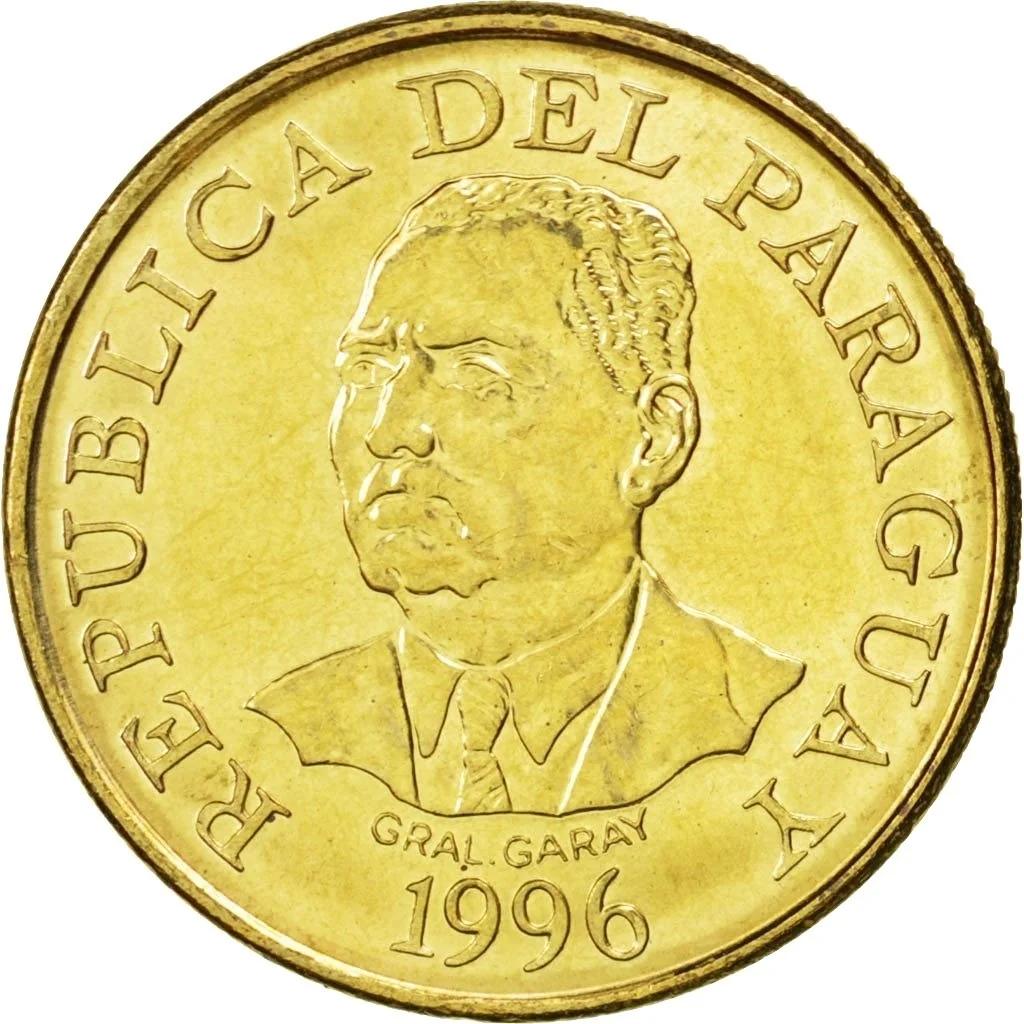
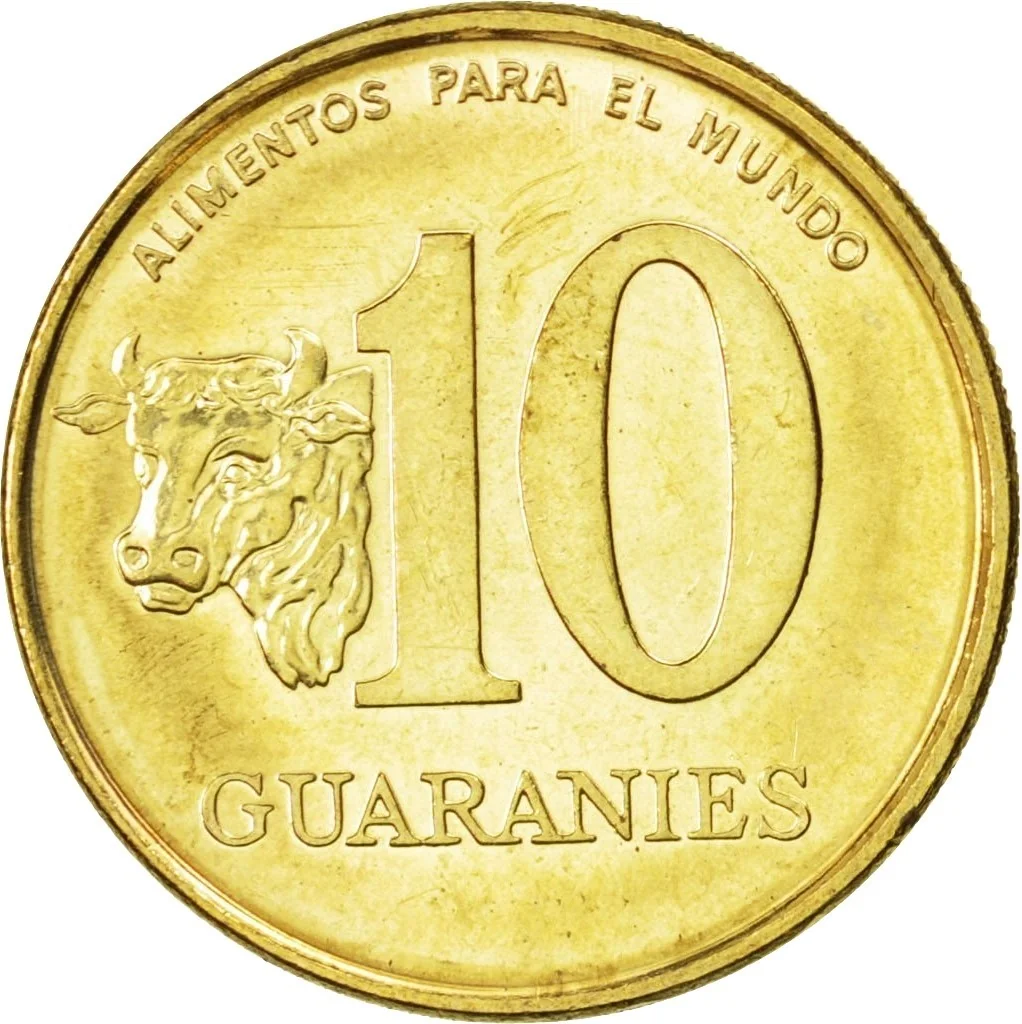
10 guaraníes – Paraguay
Add to wishlist
Circulating commemorative coins
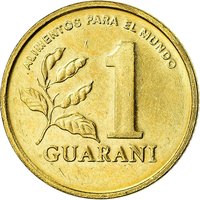
Commemoration: F.A.O.
Paraguay
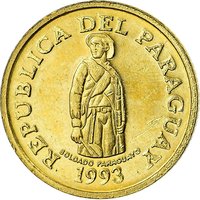
Obverse
Reverse
Edge
Reeded
Categories
| Animal> Cow |
| Person> Military leader |
| Organization> FAO |
Mints
| Name | Mark |
|---|---|
| Casa de Moneda de Chile | — |
Mintings
| Year | Mint Mark | Mintage | Quality | Collection |
|---|---|---|---|---|
| 1996 | — | 20,000,000 |
Historical background
In 1996, Paraguay's currency situation was characterized by relative stability under the Guaraní (PYG), which had been the nation's sole legal tender since 1943. Unlike many of its South American neighbors in the 1980s and early 1990s, Paraguay avoided hyperinflation and major currency crises, largely due to its historically conservative monetary policy and a less developed financial system. The Central Bank of Paraguay maintained a managed float exchange rate regime, where the value of the Guaraní was influenced by market forces but with occasional intervention to prevent excessive volatility. The exchange rate hovered around 2,100 Guaraníes to one US Dollar for much of the year, reflecting a period of calm following the economic turbulence associated with the end of the Alfredo Stroessner dictatorship in 1989.
This stability, however, existed alongside significant underlying challenges. The economy was highly dollarized, particularly for large transactions, real estate, and savings, reflecting a deep-seated lack of public confidence in the domestic currency over the long term. Furthermore, Paraguay's economy was heavily dependent on agricultural exports (especially soybeans and cotton) and cross-border trade, making the Guaraní susceptible to terms-of-trade shocks and fluctuations in the currencies of its major partners, Brazil and Argentina. The informal economy was substantial, and widespread smuggling across porous borders created parallel currency flows that complicated monetary management.
The year 1996 fell within a broader period of economic transition following the 1995 banking crisis, which had exposed severe weaknesses in financial supervision. In response, authorities were implementing structural reforms aimed at strengthening the banking sector and central bank independence. While not a year of dramatic currency upheaval, 1996 represented a fragile equilibrium where macroeconomic stability was maintained, but the foundations of the currency were tested by dollarization, external vulnerabilities, and the ongoing effort to build robust financial institutions after a significant crisis.
This stability, however, existed alongside significant underlying challenges. The economy was highly dollarized, particularly for large transactions, real estate, and savings, reflecting a deep-seated lack of public confidence in the domestic currency over the long term. Furthermore, Paraguay's economy was heavily dependent on agricultural exports (especially soybeans and cotton) and cross-border trade, making the Guaraní susceptible to terms-of-trade shocks and fluctuations in the currencies of its major partners, Brazil and Argentina. The informal economy was substantial, and widespread smuggling across porous borders created parallel currency flows that complicated monetary management.
The year 1996 fell within a broader period of economic transition following the 1995 banking crisis, which had exposed severe weaknesses in financial supervision. In response, authorities were implementing structural reforms aimed at strengthening the banking sector and central bank independence. While not a year of dramatic currency upheaval, 1996 represented a fragile equilibrium where macroeconomic stability was maintained, but the foundations of the currency were tested by dollarization, external vulnerabilities, and the ongoing effort to build robust financial institutions after a significant crisis.
🌱 Very Common