

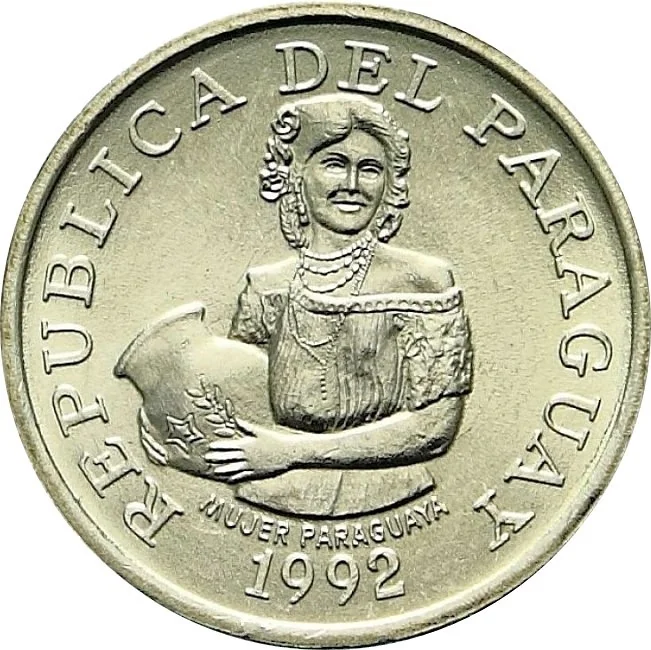
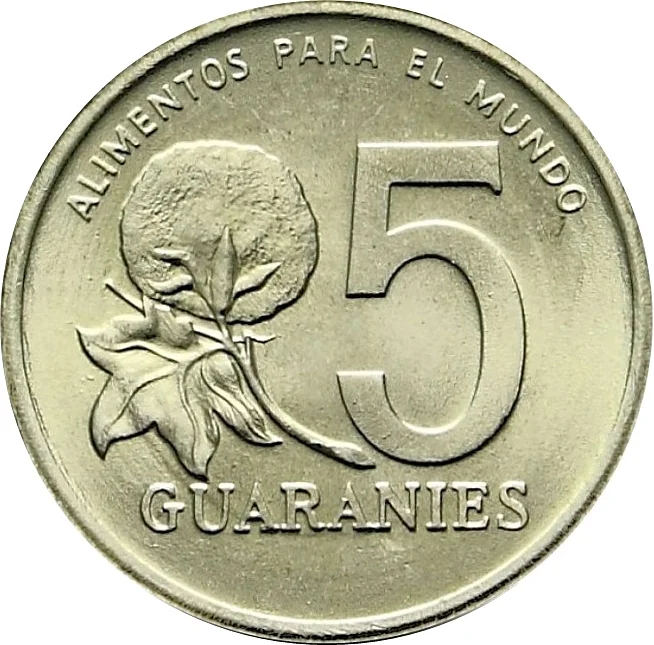
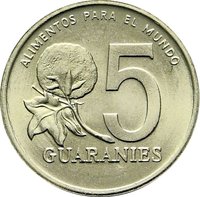
5 Guaraníes – Paraguay
Paraguay
Context
Year: 1992
Issuer: Paraguay 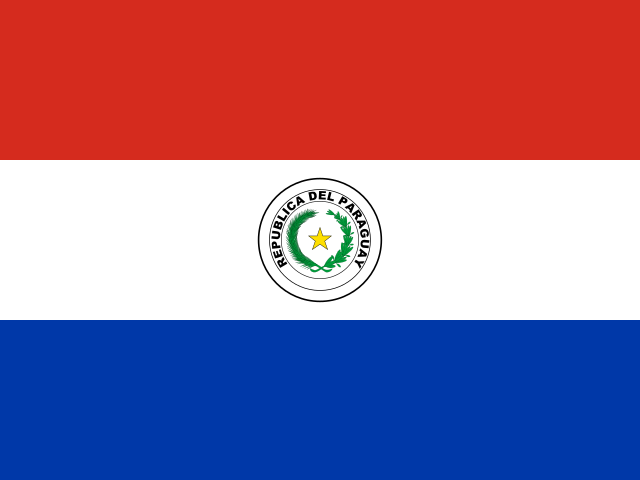
Issuing organization: Central Bank of Paraguay
Period:
(since 1811)
Currency:
(since 1944)
Demonetization: 17 January 2014
Total mintage: 15,000,000
Material
Diameter: 17 mm
Weight: 2 g
Thickness: 1.25 mm
Shape: Round
Composition: Nickel brass
Magnetic: No
Technique: Milled
Alignment: Coin alignment
flip
References
KM: #Click to copy to clipboard166a
Numista: #5155
Value
Exchange value: 5 PYG
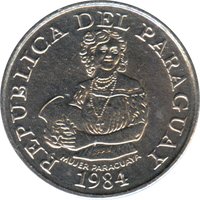
Obverse
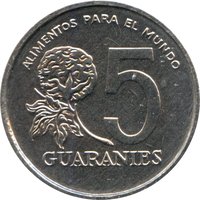
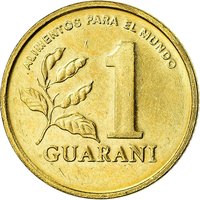
Reverse
Edge
Reeded
Categories
| Agriculture |
| Organization> FAO |
Mints
| Name | Mark |
|---|---|
| Casa de Moneda de Chile | — |
Mintings
| Year | Mint Mark | Mintage | Quality | Collection |
|---|---|---|---|---|
| 1992 | — | 15,000,000 |
Historical background
In 1992, Paraguay's currency situation was characterized by a period of relative stability under the long-standing regime of the Guaraní (PYG), which had been the nation's sole legal tender since 1943. This stability, however, was set against a backdrop of underlying economic fragility and a history of monetary turbulence. The country was emerging from the 35-year dictatorship of Alfredo Stroessner (overthrown in 1989), and its economy was marked by a large informal sector, widespread smuggling, and significant dependence on agricultural exports, which made it vulnerable to external shocks. The Central Bank of Paraguay maintained a managed float exchange rate system, but the guaraní had experienced persistent, though moderate, devaluation against the US dollar throughout the late 1980s and early 1990s, driven primarily by higher inflation than its major trading partners.
The year itself was significant as Paraguay enacted a new democratic constitution, which included important provisions for central bank autonomy and price stability as key monetary policy objectives. This institutional reform aimed to bolster confidence in the guaraní and create a framework for more disciplined fiscal and monetary management. In practice, however, the currency faced ongoing pressures. Inflation remained a persistent concern, averaging around 15-20% annually in the early 1990s, which continually eroded purchasing power and necessitated periodic central bank intervention to manage liquidity and support the exchange rate.
Furthermore, the economy was highly "dollarized" in practice, particularly for large transactions, real estate, and savings, reflecting a lingering lack of full public confidence in the domestic currency despite its formal stability. This unofficial dual-currency environment was a defining feature of Paraguay's financial landscape. Therefore, while 1992 did not see a currency crisis, the guaraní operated within a delicate equilibrium, with its stability contingent on prudent policy under the new democratic framework and vulnerable to the nation's structural economic challenges and the shadow of its authoritarian past.
The year itself was significant as Paraguay enacted a new democratic constitution, which included important provisions for central bank autonomy and price stability as key monetary policy objectives. This institutional reform aimed to bolster confidence in the guaraní and create a framework for more disciplined fiscal and monetary management. In practice, however, the currency faced ongoing pressures. Inflation remained a persistent concern, averaging around 15-20% annually in the early 1990s, which continually eroded purchasing power and necessitated periodic central bank intervention to manage liquidity and support the exchange rate.
Furthermore, the economy was highly "dollarized" in practice, particularly for large transactions, real estate, and savings, reflecting a lingering lack of full public confidence in the domestic currency despite its formal stability. This unofficial dual-currency environment was a defining feature of Paraguay's financial landscape. Therefore, while 1992 did not see a currency crisis, the guaraní operated within a delicate equilibrium, with its stability contingent on prudent policy under the new democratic framework and vulnerable to the nation's structural economic challenges and the shadow of its authoritarian past.
🌱 Very Common