

20 Mark – Anhalt-Dessau
Germany
Context
Year: 1875
Country: Germany 
Issuer: Anhalt-Dessau
Ruler: Frederick I
Currency:
Demonetization: 16 August 1938
Total mintage: 25,000
Material
References
KM: #Click to copy to clipboard21
Numista: #51469
Value
Bullion value: $1188.99
Obverse
Description:
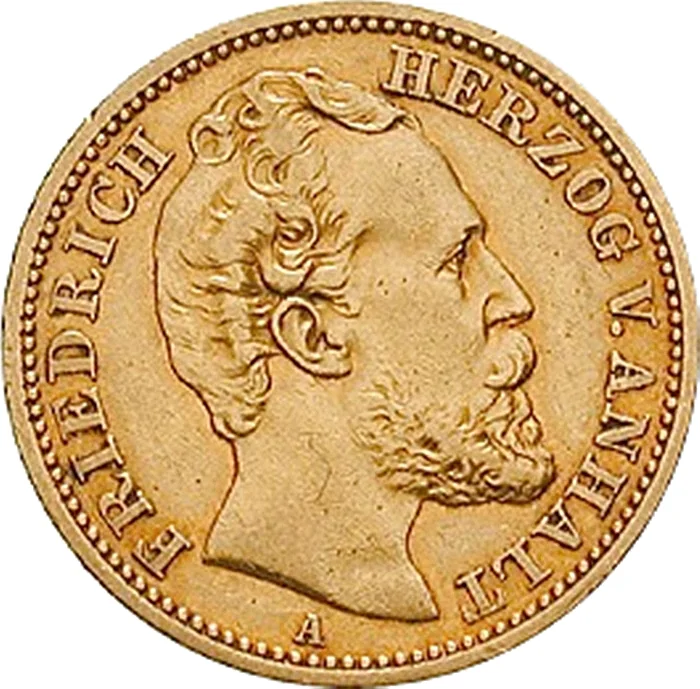
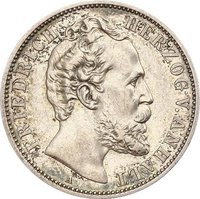
Friedrich I of Anhalt facing right. Mint mark below. Inscription on rim.
Inscription:
FRIEDRICH HERZOG V. ANHALT
Translation:
FREDERICK DUKE OF ANHALT
Script: Latin
Language: German
Designer: Friedrich Wilhelm Kullrich
Reverse
Description:
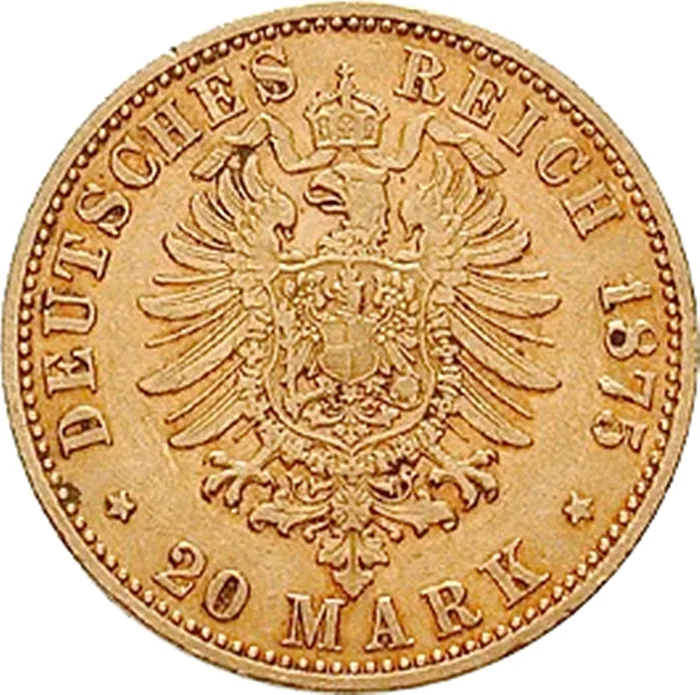
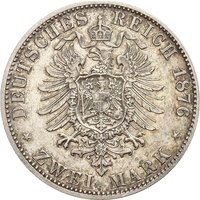
Imperial German eagle with crown, inscriptions for date above and denomination below.
Inscription:
* DEUTSCHES REICH 1875 *
20 MARK
20 MARK
Script: Latin
Edge
Mints
| Name | Mark |
|---|---|
| Berlin | A |
Historical background
By 1875, the currency situation in the Duchy of Anhalt-Dessau (and the unified Anhalt duchies) was one of transition and integration, firmly aligning with the broader monetary unification of the German Empire. Prior to German unification in 1871, the region, like many German states, used the Vereinsthaler (Union Thaler) as part of the Dresden Monetary Convention. This silver-based standard coexisted with a variety of other coins, creating a complex monetary landscape.
The decisive shift came with the introduction of the Goldmark through the Imperial Coinage Act of 1873. Anhalt-Dessau, as a constituent state of the Empire, was required to adopt this new Reich currency, phasing out the old Thaler system. The transition period saw the Vereinsthaler remain legal tender at a fixed exchange rate of 3 Marks to 1 Thaler, but its minting ceased. By 1875, the Duchy’s economy was increasingly operating on the new decimal-based, gold-standard Mark, with Reichsbank notes and new imperial coinage circulating.
Thus, the background for 1875 is not one of local monetary crisis but of administrative implementation. The currency "situation" was effectively resolved by imperial law, with Anhalt-Dessau's authorities and financial institutions managing the practicalities of the switch. The Duchy’s monetary sovereignty was subsumed into the Empire's, marking the end of its distinct coinage and cementing its economic integration into a unified Germany.
The decisive shift came with the introduction of the Goldmark through the Imperial Coinage Act of 1873. Anhalt-Dessau, as a constituent state of the Empire, was required to adopt this new Reich currency, phasing out the old Thaler system. The transition period saw the Vereinsthaler remain legal tender at a fixed exchange rate of 3 Marks to 1 Thaler, but its minting ceased. By 1875, the Duchy’s economy was increasingly operating on the new decimal-based, gold-standard Mark, with Reichsbank notes and new imperial coinage circulating.
Thus, the background for 1875 is not one of local monetary crisis but of administrative implementation. The currency "situation" was effectively resolved by imperial law, with Anhalt-Dessau's authorities and financial institutions managing the practicalities of the switch. The Duchy’s monetary sovereignty was subsumed into the Empire's, marking the end of its distinct coinage and cementing its economic integration into a unified Germany.
✨ Legendary