

2 francs – New Hebrides
Add to wishlist
Vanuatu
Context
Years: 1973–1979
Country: Vanuatu
Issuer: New Hebrides
Issuing organization: Overseas Institution of Issue
Period:
(1906—1980)
Currency:
(1921—1982)
Demonetized: Yes
Total mintage: 900,000
Material
References
KM: #
Numista: #5144
Obverse
Description:
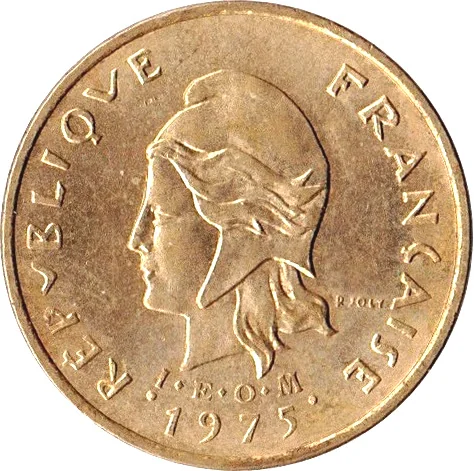
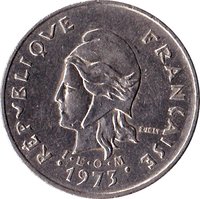
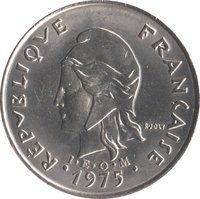
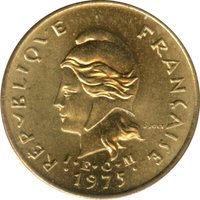
Marianne in profile left, wearing a Phrygian cap.
Inscription:
RÉPVBLIQVE FRANÇAISE
R·JOLY
I·E·O·M
1975
R·JOLY
I·E·O·M
1975
Translation:
FRENCH REPUBLIC
R·JOLY
I·E·O·M
1975
R·JOLY
I·E·O·M
1975
Script: Latin
Language: French
Engraver: Raymond Joly
Reverse
Description:
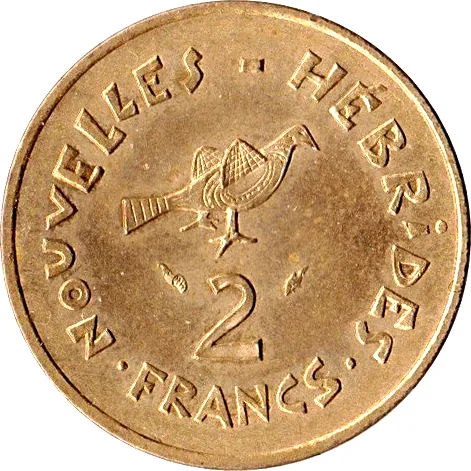
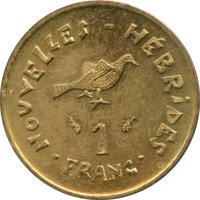
Frigatebird in flight.
Inscription:
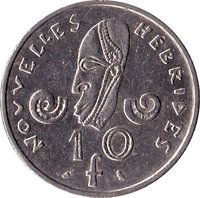
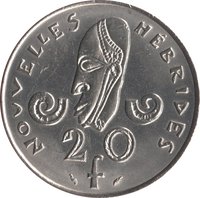
NOUVELLES - HÉBRIDES
2
FRANCS
2
FRANCS
Translation:
New Hebrides
2
Francs
2
Francs
Script: Latin
Language: French
Engraver: Raymond Joly
Edge
Plain
Mints
| Name | Mark |
|---|---|
| Monnaie de Paris | — |
Mintings
| Year | Mint Mark | Mintage | Quality | Collection |
|---|---|---|---|---|
| 1973 | — | 200,000 | ||
| 1975 | — | 300,000 | ||
| 1978 | — | 150,000 | ||
| 1979 | — | 250,000 |
Historical background
In 1973, the New Hebrides condominium, jointly administered by Britain and France, operated under a unique and complex dual-currency system that directly mirrored its unusual political structure. The British pound sterling (£) and the French Pacific franc (CFP franc) were both legal tender and circulated simultaneously throughout the islands. This arrangement was not merely symbolic but functional, with government services and businesses accepting both currencies. The exchange rate was fixed, simplifying daily transactions, but the system inherently reflected the economic and administrative divisions between the two colonial powers.
The practicalities of this dual system were cumbersome. The government issued separate budgets in each currency, and public servants were paid according to their nationality—British officers in pounds and French officers in francs. This created a segmented economy where certain imports and services were tied to one currency bloc. While the fixed rate provided stability, the setup was inefficient for a developing island economy, complicating banking, accounting, and trade. It was a clear economic manifestation of the condominium's "Pandemonium," with duplicated institutions and competing allegiances.
This monetary duality persisted until independence in 1980. Recognizing the need for a unified national symbol and monetary policy, the new government of Vanuatu moved swiftly to replace the dual system. In 1981, the Vanuatu vatu was introduced, finally ending the era of competing colonial currencies and establishing a crucial instrument of economic sovereignty for the nascent nation.
The practicalities of this dual system were cumbersome. The government issued separate budgets in each currency, and public servants were paid according to their nationality—British officers in pounds and French officers in francs. This created a segmented economy where certain imports and services were tied to one currency bloc. While the fixed rate provided stability, the setup was inefficient for a developing island economy, complicating banking, accounting, and trade. It was a clear economic manifestation of the condominium's "Pandemonium," with duplicated institutions and competing allegiances.
This monetary duality persisted until independence in 1980. Recognizing the need for a unified national symbol and monetary policy, the new government of Vanuatu moved swiftly to replace the dual system. In 1981, the Vanuatu vatu was introduced, finally ending the era of competing colonial currencies and establishing a crucial instrument of economic sovereignty for the nascent nation.
🌱 Common