

10 centavos – Honduras
Add to wishlist
Honduras
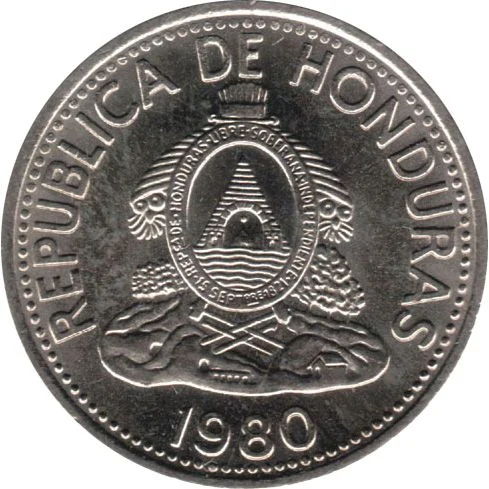
Obverse
Description:
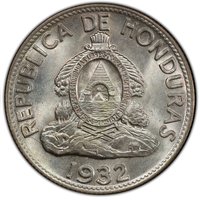
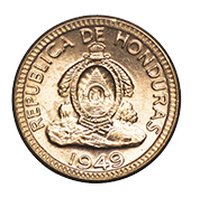
Coat of Arms (pyramid on clear background)
Inscription:
REPUBLICA DE HONDURAS
REP CA DE · HONDURAS · LIBRE · SOBERANA · INDEPENDIENTE
· 15 SEPT BRE 1821 ·
1980
REP CA DE · HONDURAS · LIBRE · SOBERANA · INDEPENDIENTE
· 15 SEPT BRE 1821 ·
1980
Translation:
REPUBLIC OF HONDURAS
REPUBLIC OF HONDURAS FREE SOVEREIGN INDEPENDENT
· 15 SEPTEMBER 1821 ·
1980
REPUBLIC OF HONDURAS FREE SOVEREIGN INDEPENDENT
· 15 SEPTEMBER 1821 ·
1980
Script: Latin
Language: Spanish
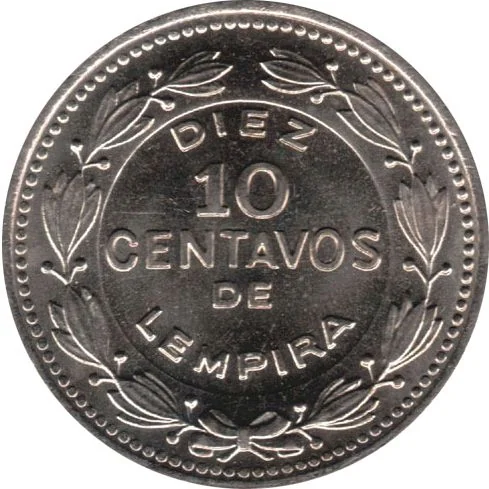
Reverse
Edge
Plain
Categories
| Symbols> Coat of Arms |
| Symbol> Wreath |
Mints
| Name | Mark |
|---|---|
| Casa de Moneda de Chile | — |
| Monnaie de Paris | — |
| Royal Canadian Mint of Winnipeg | — |
| United States Mint of Philadelphia | — |
| VDM Metals / Vereinigte Deutsche Metallwerke | — |
Mintings
| Year | Mint Mark | Mintage | Quality | Collection |
|---|---|---|---|---|
| 1932 | — | 1,500,000 | ||
| 1951 | — | 1,000,000 | ||
| 1954 | — | 1,200,000 | ||
| 1956 | — | 7,559,500 | ||
| 1967 | — | — | ||
| 1980 | — | 15,000,000 | ||
| 1993 | — | — |
Historical background
In 1932, Honduras operated under a silver standard, with the Honduran peso as its official currency. However, the global economic catastrophe of the Great Depression had severely depressed international commodity prices, particularly for Honduras's key exports of bananas, coffee, and silver. This collapse in export revenue drastically reduced the amount of foreign currency (especially US dollars) entering the country, creating a severe balance of payments crisis and depleting the nation's monetary reserves.
The domestic currency situation was further strained by the practices of foreign fruit companies, notably the United Fruit Company. These companies operated within enclaves, often paying workers in company scrip or in US dollars, which circulated alongside the national currency. This created a dual monetary system that undermined the central government's fiscal authority and complicated the national economy. Furthermore, a legacy of foreign debt and loans taken in gold-backed currencies meant Honduras's silver-based peso was vulnerable to external pressures and devaluation.
Consequently, the Honduran government faced immense pressure. With shrinking reserves and a fixed exchange rate becoming unsustainable, the authorities were forced to contemplate abandoning the silver standard, a move that would lead to devaluation. This precarious monetary environment contributed to broader social and political tensions, which famously culminated in the brutal suppression of a peasant uprising in the Sula Valley during the same year. The currency instability of 1932 was thus a critical symptom of Honduras's vulnerable position within the global economic order.
The domestic currency situation was further strained by the practices of foreign fruit companies, notably the United Fruit Company. These companies operated within enclaves, often paying workers in company scrip or in US dollars, which circulated alongside the national currency. This created a dual monetary system that undermined the central government's fiscal authority and complicated the national economy. Furthermore, a legacy of foreign debt and loans taken in gold-backed currencies meant Honduras's silver-based peso was vulnerable to external pressures and devaluation.
Consequently, the Honduran government faced immense pressure. With shrinking reserves and a fixed exchange rate becoming unsustainable, the authorities were forced to contemplate abandoning the silver standard, a move that would lead to devaluation. This precarious monetary environment contributed to broader social and political tensions, which famously culminated in the brutal suppression of a peasant uprising in the Sula Valley during the same year. The currency instability of 1932 was thus a critical symptom of Honduras's vulnerable position within the global economic order.
🌱 Very Common