

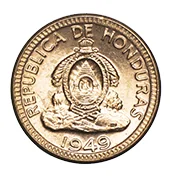
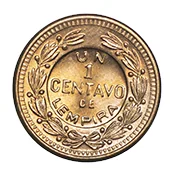
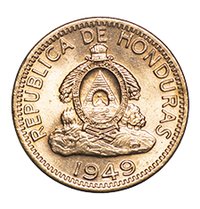
Obverse
Description:
Coat of Arms (pyramid, no clouds) with date beneath.
Inscription:
REPUBLICA DE HONDURAS
REP CA DE · HONDURAS · LIBRE · SOBERANA · INDEPENDIENTE
· 15 SEPT BRE 1821 ·
1949
REP CA DE · HONDURAS · LIBRE · SOBERANA · INDEPENDIENTE
· 15 SEPT BRE 1821 ·
1949
Translation:
REPUBLIC OF HONDURAS
REPUBLIC OF HONDURAS FREE SOVEREIGN INDEPENDENT
15 SEPTEMBER 1821
1949
REPUBLIC OF HONDURAS FREE SOVEREIGN INDEPENDENT
15 SEPTEMBER 1821
1949
Script: Latin
Language: Spanish
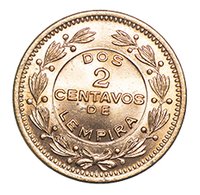
Reverse
Edge
Plain
Categories
| Symbols> Coat of Arms |
| Symbol> Wreath |
Mints
| Name | Mark |
|---|---|
| United States Mint of Philadelphia | — |
Mintings
| Year | Mint Mark | Mintage | Quality | Collection |
|---|---|---|---|---|
| 1935 | — | 2,000,000 | ||
| 1939 | — | 2,000,000 | ||
| 1949 | — | 4,000,000 |
Historical background
In 1935, Honduras operated under a currency system that was both complex and fragile, heavily influenced by its historical reliance on foreign capital and agricultural exports, particularly bananas. The official currency was the Honduran peso, but its value was unstable and it circulated alongside a more trusted foreign medium: the United States dollar. This dollarization was a direct result of decades of extensive investment and economic control by American fruit companies, like the United Fruit Company, which dominated the country's infrastructure and export economy. The dollar became the de facto currency for major commercial transactions and international trade, creating a dual monetary environment where the domestic peso struggled to maintain public confidence.
The period was marked by a significant devaluation of the Honduran peso. The global economic pressures of the Great Depression, which had sharply reduced demand and prices for Honduras's exports, severely strained the national treasury. While some regional neighbors had established central banks to manage monetary policy, Honduras lacked such an institution until 1950, leaving its currency vulnerable to political and economic shocks. Consequently, the peso's value was largely determined by the government's fiscal health and the fluctuating inflow of dollar earnings from the banana enclaves, leading to inflationary pressures and economic uncertainty for the general populace.
Monetary policy was rudimentary and reactive, managed directly by the government and private commercial banks. There were ongoing discussions among economic elites about monetary reform, including proposals to formally peg the peso to the US dollar or to create a stronger, unified national currency. However, in 1935, these ideas remained unrealized. The currency situation thus reflected the broader Honduran reality of the era: a nation with a rich resource base but whose financial sovereignty was constrained by external economic forces and internal institutional weakness, setting the stage for future reforms in the mid-20th century.
The period was marked by a significant devaluation of the Honduran peso. The global economic pressures of the Great Depression, which had sharply reduced demand and prices for Honduras's exports, severely strained the national treasury. While some regional neighbors had established central banks to manage monetary policy, Honduras lacked such an institution until 1950, leaving its currency vulnerable to political and economic shocks. Consequently, the peso's value was largely determined by the government's fiscal health and the fluctuating inflow of dollar earnings from the banana enclaves, leading to inflationary pressures and economic uncertainty for the general populace.
Monetary policy was rudimentary and reactive, managed directly by the government and private commercial banks. There were ongoing discussions among economic elites about monetary reform, including proposals to formally peg the peso to the US dollar or to create a stronger, unified national currency. However, in 1935, these ideas remained unrealized. The currency situation thus reflected the broader Honduran reality of the era: a nation with a rich resource base but whose financial sovereignty was constrained by external economic forces and internal institutional weakness, setting the stage for future reforms in the mid-20th century.
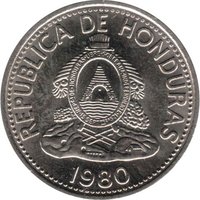
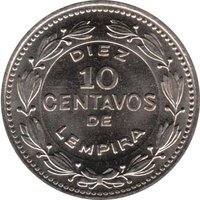
🌱 Fairly Common