

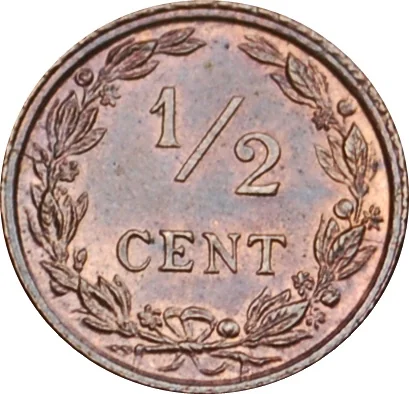
½ cent – Netherlands
Add to wishlist
Netherlands
Context
Years: 1903–1906
Issuer: Netherlands
Ruler: Wilhelmina
Currency:
(1817—2001)
Demonetized: Yes
Total mintage: 20,000,000
Material
References
KM: #
Numista: #5047
Value
Exchange value: 0.005 NLG
Obverse
Description:
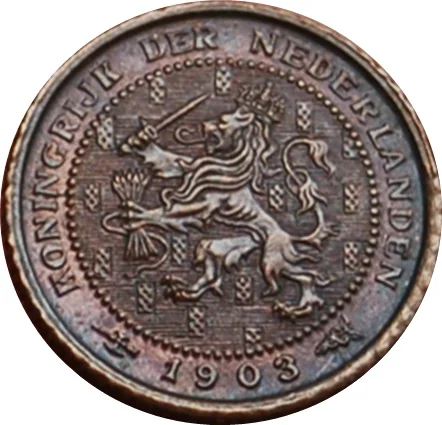
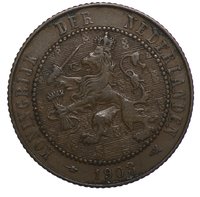
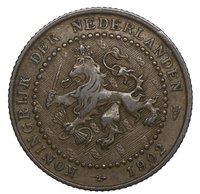
A crowned lion left, holding a sword and seven arrows, within a beaded circle. Lettering above, date below, with privy mark left and mint mark right of the date.
Inscription:
KONINGRIJK DER NEDERLANDEN
1903
1903
Translation:
KINGDOM OF THE NETHERLANDS
1903
1903
Script: Latin
Language: Dutch
Engraver: Johan Philip Matthias Menger
Reverse
Edge
Reeded
Categories
| Symbols> Coat of Arms |
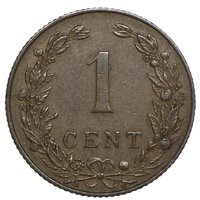
| Symbol> Wreath |
Mints
| Name | Mark |
|---|---|
| Royal Dutch Mint | — |
Mintings
| Year | Mint Mark | Mintage | Quality | Collection |
|---|---|---|---|---|
| 1903 | — | 10,000,000 | ||
| 1906 | — | 10,000,000 |
Historical background
In 1903, the Netherlands operated under the classical gold standard, a monetary system it had adhered to since 1875. The Dutch guilder (florin) was legally defined as a fixed quantity of gold, and the central bank, De Nederlandsche Bank, was obligated to exchange banknotes for gold on demand. This system ensured stable exchange rates with other major gold-standard nations like Great Britain, Germany, and the United States, which facilitated the Netherlands' significant international trade. The currency was thus considered strong and reliable, backed by substantial gold reserves held by the central bank.
However, this stability existed within a context of broader European monetary debate. The global economy of the late 19th century had seen prolonged periods of deflation, leading to discussions about bimetallism (using both gold and silver). By 1903, the "battle of the standards" was largely over in favour of gold, but the Netherlands maintained a unique historical link to silver through its East Indian colony. While the metropolitan guilder was firmly on gold, the Netherlands Indies continued to use a silver-based currency system, creating complex exchange dynamics for Dutch businesses and colonial administration.
Economically, the year 1903 fell within a period of steady growth and industrialization for the Netherlands. The fixed currency under the gold standard provided a predictable environment for investment and long-term contracts, crucial for its banking and shipping sectors. There was little domestic controversy over the currency itself; public and political confidence in the gold guilder was high. The primary monetary concerns were managerial, focusing on maintaining sufficient gold reserves and navigating international capital flows to uphold the gold convertibility pledge, which was the cornerstone of financial credibility at the time.
However, this stability existed within a context of broader European monetary debate. The global economy of the late 19th century had seen prolonged periods of deflation, leading to discussions about bimetallism (using both gold and silver). By 1903, the "battle of the standards" was largely over in favour of gold, but the Netherlands maintained a unique historical link to silver through its East Indian colony. While the metropolitan guilder was firmly on gold, the Netherlands Indies continued to use a silver-based currency system, creating complex exchange dynamics for Dutch businesses and colonial administration.
Economically, the year 1903 fell within a period of steady growth and industrialization for the Netherlands. The fixed currency under the gold standard provided a predictable environment for investment and long-term contracts, crucial for its banking and shipping sectors. There was little domestic controversy over the currency itself; public and political confidence in the gold guilder was high. The primary monetary concerns were managerial, focusing on maintaining sufficient gold reserves and navigating international capital flows to uphold the gold convertibility pledge, which was the cornerstone of financial credibility at the time.
🌱 Common