

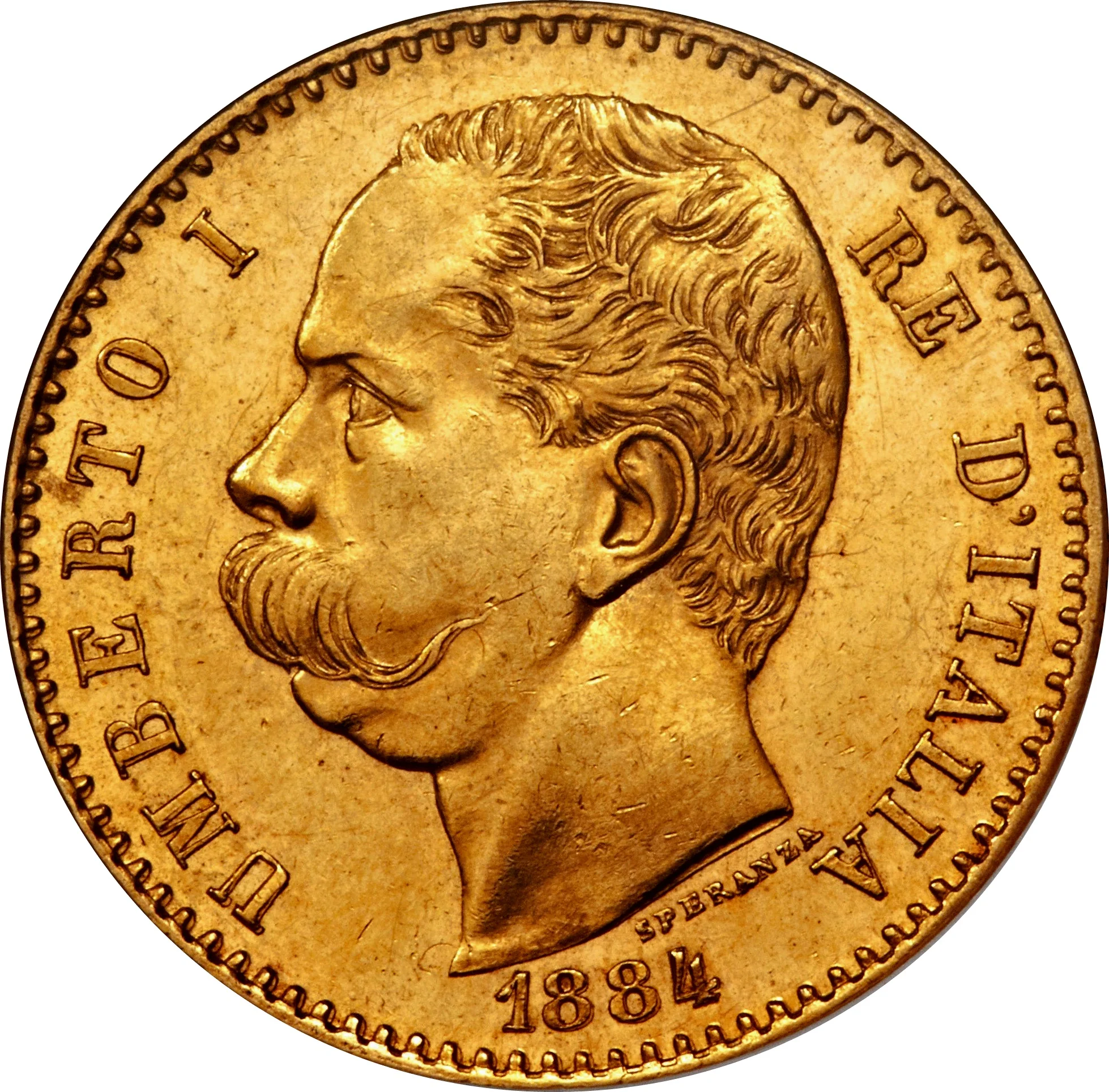

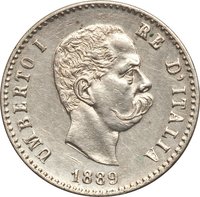
Obverse
Description:
King Umberto I facing left, with the date below and engraver's name near the neckline.
Inscription:
UMBERTO I RE D'ITALIA
SPERANZA
1884
SPERANZA
1884
Script: Latin
Engraver: Filippo Speranza
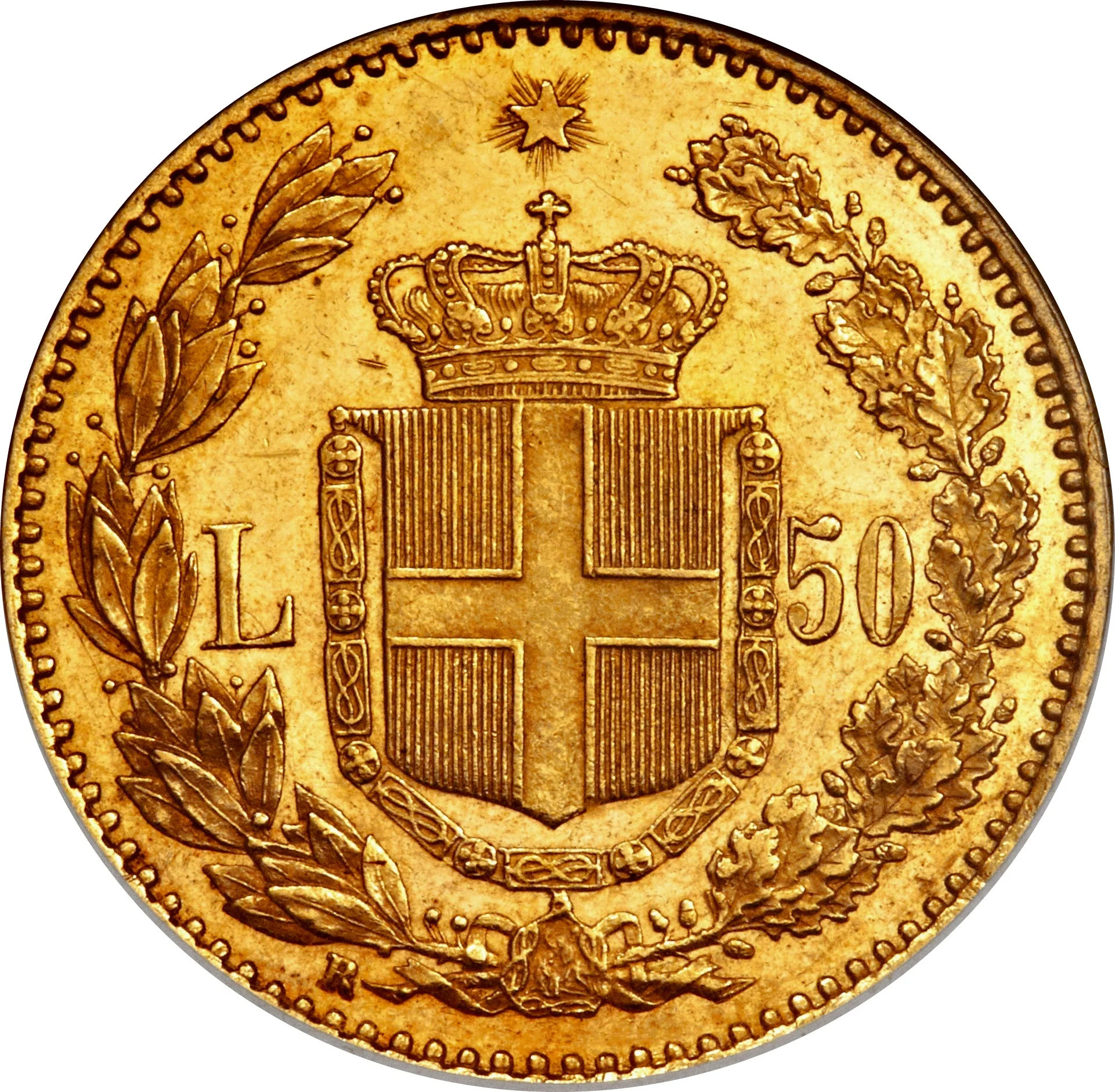
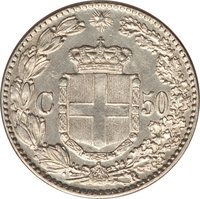
Reverse
Description:
Crowned Savoy coat of arms with the Annunziata collar, flanked by the value and encircled by a laurel and oak wreath. The Star of Italy is above the shield; the mintmark is below the wreath on the right.
Inscription:
L. 50
R
R
Script: Latin
Engraver: Filippo Speranza
Edge
Reeded
Mintings
| Year | Mint Mark | Mintage | Quality | Collection |
|---|---|---|---|---|
| 1884 | — | 2,532 | ||
| 1888 | — | 2,125 | ||
| 1891 | — | 414 |
Historical background
In 1884, Italy was in the midst of a prolonged and complex monetary realignment, navigating the aftermath of its political unification. The country operated under a de facto bimetallic system, but was legally part of the Latin Monetary Union (LMU), an international treaty attempting to standardize gold and silver coinage across several European nations. However, Italy's fiscal situation was precarious, burdened by heavy public debt and chronic budget deficits. This led to the over-issuance of paper money (carta moneta) by the Banca Nazionale and other banks of issue, which was convertible into metal only in theory. In practice, the suspension of convertibility since 1866 had created a significant gap between the value of the paper lira and its metallic equivalent, a situation known as the corso forzoso (forced currency).
The year 1884 fell within a critical period of attempted stabilization. The government, led by Agostino Depretis, was under pressure to resume convertibility and restore fiscal order to align with its LMU partners, particularly France. The lira's value on international exchanges was unstable and generally below its nominal parity. Economic policy was fiercely debated between "monometallists" (advocating for a gold standard) and "bimetallists," with the latter arguing that a fixed gold-silver ratio would ease deflationary pressures and help the agrarian sector. The global decline in the price of silver further complicated Italy's position within the bimetallic LMU, putting strain on the system and making a clear commitment to gold increasingly attractive for international credibility.
Consequently, the currency situation in 1884 was one of transitional uncertainty. While the ultimate goal of joining the gold standard was becoming clearer to policymakers, immediate realities were dominated by inconvertible paper money, a fluctuating exchange rate, and political contention over the path forward. This period of monetary ambiguity would persist until the final crisis of the LMU and Italy's eventual, and painful, adoption of the gold standard in the 1890s, following a period of severe deflation and banking crises.
The year 1884 fell within a critical period of attempted stabilization. The government, led by Agostino Depretis, was under pressure to resume convertibility and restore fiscal order to align with its LMU partners, particularly France. The lira's value on international exchanges was unstable and generally below its nominal parity. Economic policy was fiercely debated between "monometallists" (advocating for a gold standard) and "bimetallists," with the latter arguing that a fixed gold-silver ratio would ease deflationary pressures and help the agrarian sector. The global decline in the price of silver further complicated Italy's position within the bimetallic LMU, putting strain on the system and making a clear commitment to gold increasingly attractive for international credibility.
Consequently, the currency situation in 1884 was one of transitional uncertainty. While the ultimate goal of joining the gold standard was becoming clearer to policymakers, immediate realities were dominated by inconvertible paper money, a fluctuating exchange rate, and political contention over the path forward. This period of monetary ambiguity would persist until the final crisis of the LMU and Italy's eventual, and painful, adoption of the gold standard in the 1890s, following a period of severe deflation and banking crises.
✨ Legendary