

½ Franc – France
France

Obverse
Description:
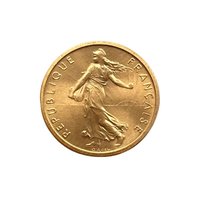
The Sower, by Oscar Roty (1900): a French national emblem.
Inscription:
REPUBLIQUE FRANÇAISE
O. Roty
O. Roty
Translation:
French Republic
O. Roty
O. Roty
Script: Latin
Language: French
Engraver: Louis-Oscar Roty
Reverse
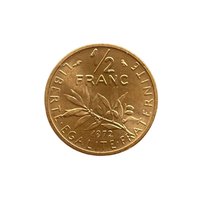
Description:
An olive branch encircles the motto "LIBERTE - EGALITE - FRATERNITE."
Inscription:
LIBERTE·EGALITE·FRATERNITE
1/2
FRANC
2000
1/2
FRANC
2000
Translation:
LIBERTY EQUALITY FRATERNITY
1/2
FRANC
2000
1/2
FRANC
2000
Script: Latin
Language: French
Engraver: Louis-Oscar Roty
Edge
Reeded
Categories
| Symbol> Allegory |
| Symbol> Phrygian cap |
Mints
| Name | Mark |
|---|---|
| Monnaie de Paris | — |
Mintings
| Year | Mint Mark | Mintage | Quality | Collection |
|---|---|---|---|---|
| 1964 | — | 515 | ||
| 1965 | — | 4,700 | ||
| 1966 | — | 88,897,571 | ||
| 1967 | — | 28,394,305 | ||
| 1968 | — | 57,551,000 | ||
| 1969 | — | 47,150,050 | ||
| 1970 | — | 42,308,000 | ||
| 1971 | — | 36,080,000 | ||
| 1972 | — | — | ||
| 1973 | — | 48,451,000 | ||
| 1974 | — | 37,170,800 | ||
| 1975 | — | 22,804,000 | ||
| 1976 | — | 115,349,700 | ||
| 1977 | — | 131,669,000 | ||
| 1978 | — | 63,384,000 | ||
| 1979 | — | 50,500 | ||
| 1980 | — | 60,000 | In sets | |
| 1981 | — | 50,000 | ||
| 1982 | — | 77,900 | ||
| 1983 | — | 50,000,961 | ||
| 1984 | — | 80,001,436 | ||
| 1985 | — | 50,000,500 | ||
| 1986 | — | 110,003,011 | ||
| 1987 | — | 49,995,967 | ||
| 1988 | — | 96,176 | ||
| 1989 | — | 94,649 | ||
| 1990 | — | 15,011 | ||
| 1991 | — | 49,988,011 | ||
| 1992 | — | 29,968,011 | ||
| 1993 | — | 3,095 | ||
| 1994 | — | 29,975,818 | ||
| 1995 | — | 29,980,013 | ||
| 1996 | — | 55,982,513 | ||
| 1997 | — | 99,991,013 | ||
| 1998 | — | 25,000 | In sets | |
| 1999 | — | — | BU | |
| 1999 | — | 25,500 | In sets | |
| 2000 | — | 100,000 | BU | |
| 2000 | — | 75,100,513 | ||
| 2001 | — | 100,000 | BU | |
| 2001 | — | 125,000 |
Historical background
In 1964, France's currency situation was defined by the ongoing stability and international prominence of the French franc (FRF), operating within the Bretton Woods system of fixed exchange rates. The franc was pegged to the US dollar, which was itself convertible to gold, providing a framework for monetary stability. This period followed the difficult years of post-war reconstruction and the inflationary pressures of the late 1950s, which had been decisively addressed by President Charles de Gaulle's government through the 1958 "Pinay-Rueff reforms". These reforms, including a devaluation and the introduction of the "heavy franc" (nouveau franc), had successfully restored confidence and set the stage for the economic growth of the Trente Glorieuses.
A dominant theme of the era was France's growing criticism of the US dollar's hegemony within the Bretton Woods system. President de Gaulle and his economic advisor, Jacques Rueff, were vocal advocates for a return to a stricter gold standard, viewing the dollar's "exorbitant privilege" as a source of global imbalance. In a famous press conference in February 1965, de Gaulle would explicitly call for a return to gold, but the sentiment was already policy in 1964, as France began systematically converting its dollar reserves into gold from the US Treasury, a move that placed pressure on the international monetary order.
Domestically, the Banque de France maintained a tight monetary policy to safeguard the franc's parity and control inflation, which remained relatively low. The currency's stability underpinned strong economic growth and rising living standards. However, this fixed-rate regime also required significant foreign exchange interventions to maintain the peg, limiting independent monetary policy. The situation of 1964 thus represents a period of apparent national strength and stability for the franc, but one that was actively contributing to the underlying strains that would eventually lead to the breakdown of the Bretton Woods system later in the decade.
A dominant theme of the era was France's growing criticism of the US dollar's hegemony within the Bretton Woods system. President de Gaulle and his economic advisor, Jacques Rueff, were vocal advocates for a return to a stricter gold standard, viewing the dollar's "exorbitant privilege" as a source of global imbalance. In a famous press conference in February 1965, de Gaulle would explicitly call for a return to gold, but the sentiment was already policy in 1964, as France began systematically converting its dollar reserves into gold from the US Treasury, a move that placed pressure on the international monetary order.
Domestically, the Banque de France maintained a tight monetary policy to safeguard the franc's parity and control inflation, which remained relatively low. The currency's stability underpinned strong economic growth and rising living standards. However, this fixed-rate regime also required significant foreign exchange interventions to maintain the peg, limiting independent monetary policy. The situation of 1964 thus represents a period of apparent national strength and stability for the franc, but one that was actively contributing to the underlying strains that would eventually lead to the breakdown of the Bretton Woods system later in the decade.

🌱 Very Common