

½ franc – France
Add to wishlist
Non-circulating coins
Series: ½ franc semeuse
France
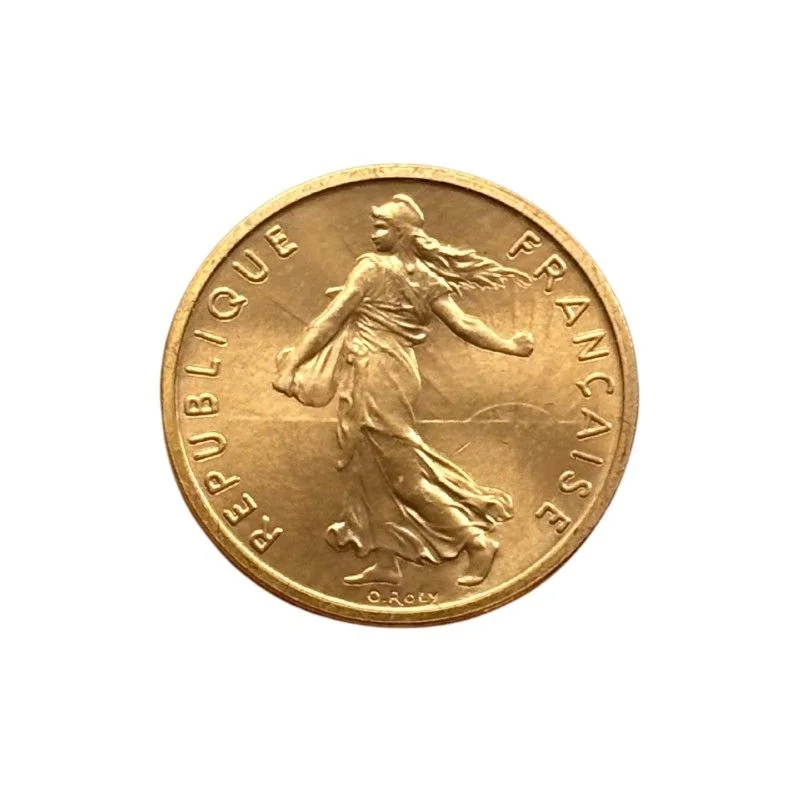
Obverse
Description:
A sower in a Phrygian cap, draped and walking against the wind, sows before a rising sun. Signed O. ROTY below.
Inscription:
REPUBLIQUE FRANÇAISE.
O. ROTY.
O. ROTY.
Translation:
FRENCH REPUBLIC.
O. ROTY.
O. ROTY.
Script: Latin
Language: French
Engraver: Louis-Oscar Roty
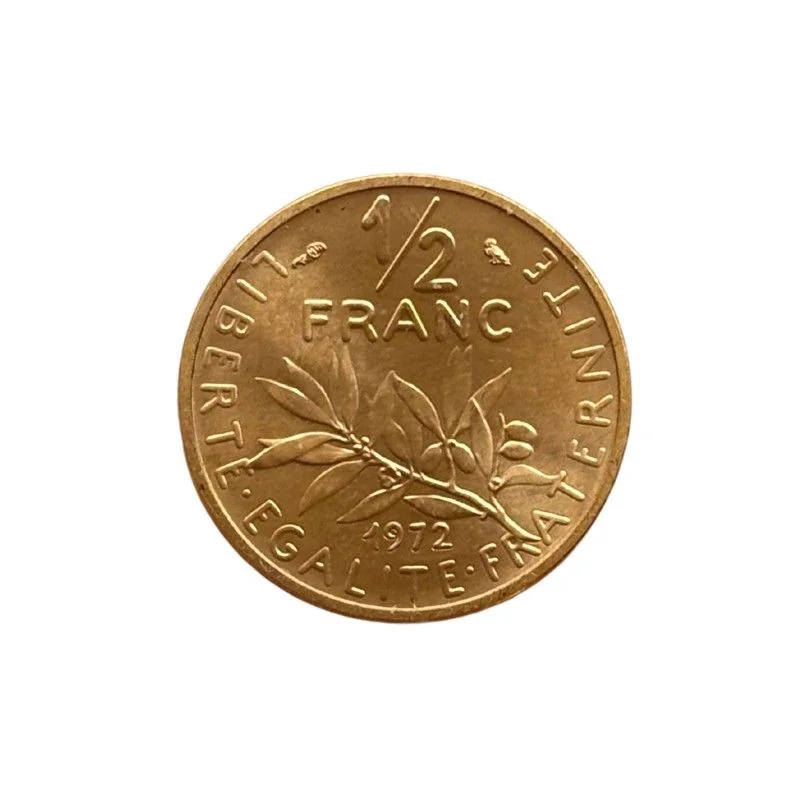
Reverse
Description:
FRANC above an olive branch;
1973 below.
1973 below.
Inscription:
LIBERTE. EGALITE. FRATERNITE..
1/2
FRANC
1973
1/2
FRANC
1973
Script: Latin
Engraver: Louis-Oscar Roty
Edge
Plain
Mints
| Name | Mark |
|---|---|
| Monnaie de Paris | — |
Mintings
| Year | Mint Mark | Mintage | Quality | Collection |
|---|---|---|---|---|
| 1965 | — | 20 | ||
| 1968 | — | 20 | ||
| 1971 | — | 100 | ||
| 1972 | — | 75 | ||
| 1973 | — | 75 | ||
| 1974 | — | 100 | ||
| 1975 | — | 100 | ||
| 1976 | — | 100 | ||
| 1977 | — | 100 | ||
| 1978 | — | 150 | ||
| 1979 | — | 300 | ||
| 1980 | — | 400 | ||
| 1981 | — | 200 | ||
| 1982 | — | 250 | ||
| 1983 | — | 75 | ||
| 1984 | — | 200 | ||
| 1985 | — | 20 |
Historical background
In 1965, France's currency situation was defined by the stability and strength of the French franc, operating within the Bretton Woods system of fixed exchange rates. Under the leadership of President Charles de Gaulle and his Finance Minister, Valéry Giscard d'Estaing, France had achieved a period of remarkable monetary stability following the 1958 introduction of the "nouveau franc," which revalued the currency by a factor of 100 to curb inflation and restore confidence. By the mid-1960s, France was experiencing strong economic growth, substantial gold and foreign exchange reserves, and a consistent balance of payments surplus, allowing it to become a significant creditor nation.
This robust financial position fueled a direct French challenge to the international monetary order, specifically targeting the perceived "exorbitant privilege" of the United States dollar. De Gaulle openly criticized the U.S. for financing its deficits by exporting dollars, which other nations were then compelled to hold as reserves. In a series of dramatic pronouncements, he advocated for a return to the classical gold standard and, beginning in 1965, France systematically converted a large portion of its dollar reserves into gold from the U.S. Treasury, a policy that placed considerable strain on the Bretton Woods system.
Consequently, France's currency policy in 1965 was less about domestic crisis and more about assertive international monetary diplomacy. The nation's strong franc was both a tool and a symbol of de Gaulle's vision for French sovereignty and a challenge to Anglo-American financial hegemony. While successful in the short term, these actions contributed to the growing pressures on the dollar-gold link that would eventually lead to the collapse of the Bretton Woods system in the early 1970s.
This robust financial position fueled a direct French challenge to the international monetary order, specifically targeting the perceived "exorbitant privilege" of the United States dollar. De Gaulle openly criticized the U.S. for financing its deficits by exporting dollars, which other nations were then compelled to hold as reserves. In a series of dramatic pronouncements, he advocated for a return to the classical gold standard and, beginning in 1965, France systematically converted a large portion of its dollar reserves into gold from the U.S. Treasury, a policy that placed considerable strain on the Bretton Woods system.
Consequently, France's currency policy in 1965 was less about domestic crisis and more about assertive international monetary diplomacy. The nation's strong franc was both a tool and a symbol of de Gaulle's vision for French sovereignty and a challenge to Anglo-American financial hegemony. While successful in the short term, these actions contributed to the growing pressures on the dollar-gold link that would eventually lead to the collapse of the Bretton Woods system in the early 1970s.

✨ Legendary