

25 Centimes – Belgium
Belgium
Context

Material
Diameter: 26 mm
Weight: 6.5 g
Thickness: 1.78 mm
Shape: Round with a round hole
Technique: Milled
Alignment: Coin alignment
flip
References
KM: #Click to copy to clipboard68.1
Numista: #499
Value
Exchange value: 0.25 BEF
Obverse
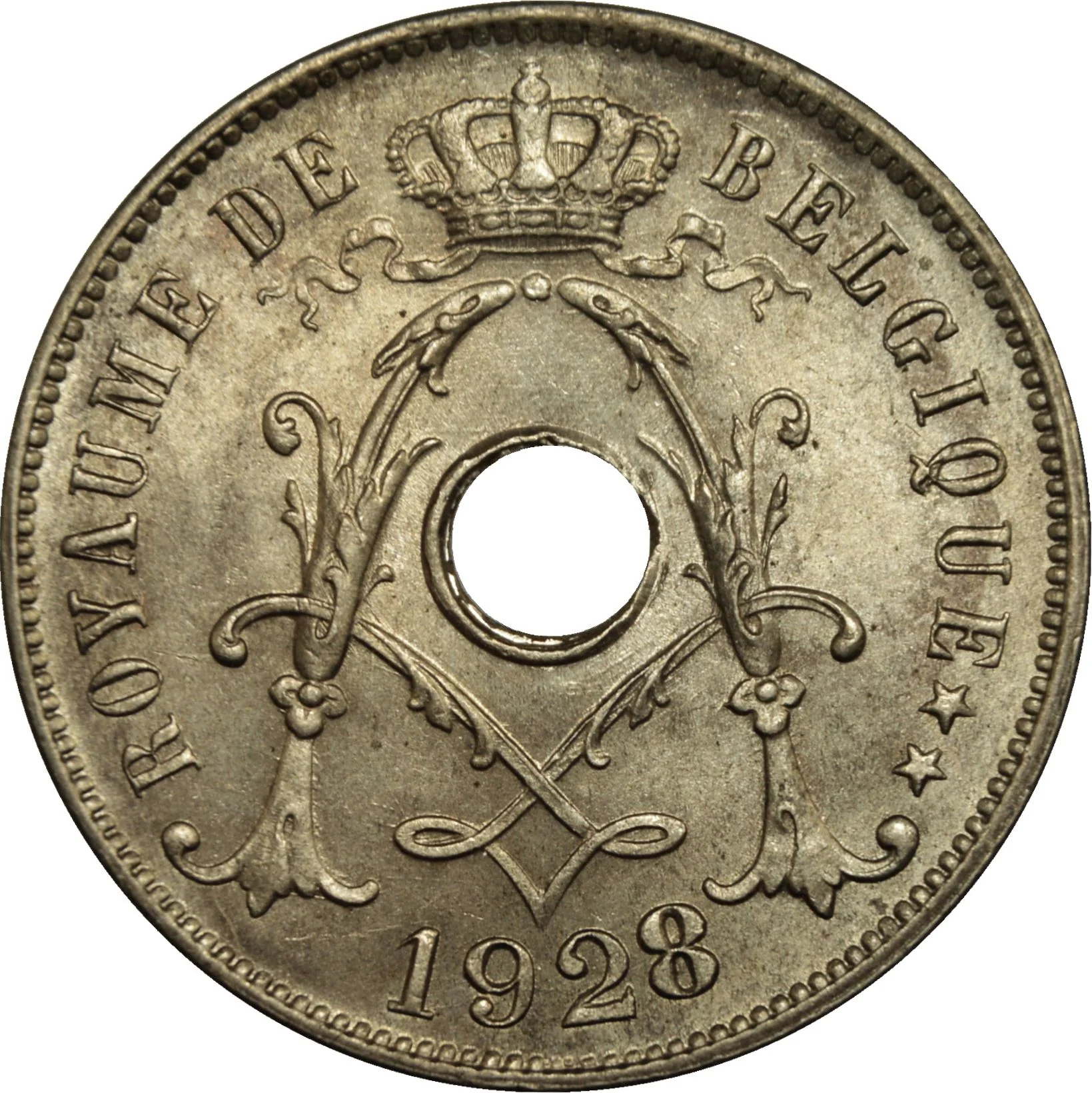
Description:
King Albert I's monogram, French lettering, date below.
Inscription:
ROYAUME DE BELGIQUE ★★
1928
1928
Translation:
Kingdom of Belgium ★★
1928
1928
Script: Latin
Language: French
Engraver: Alphonse Michaux
Reverse
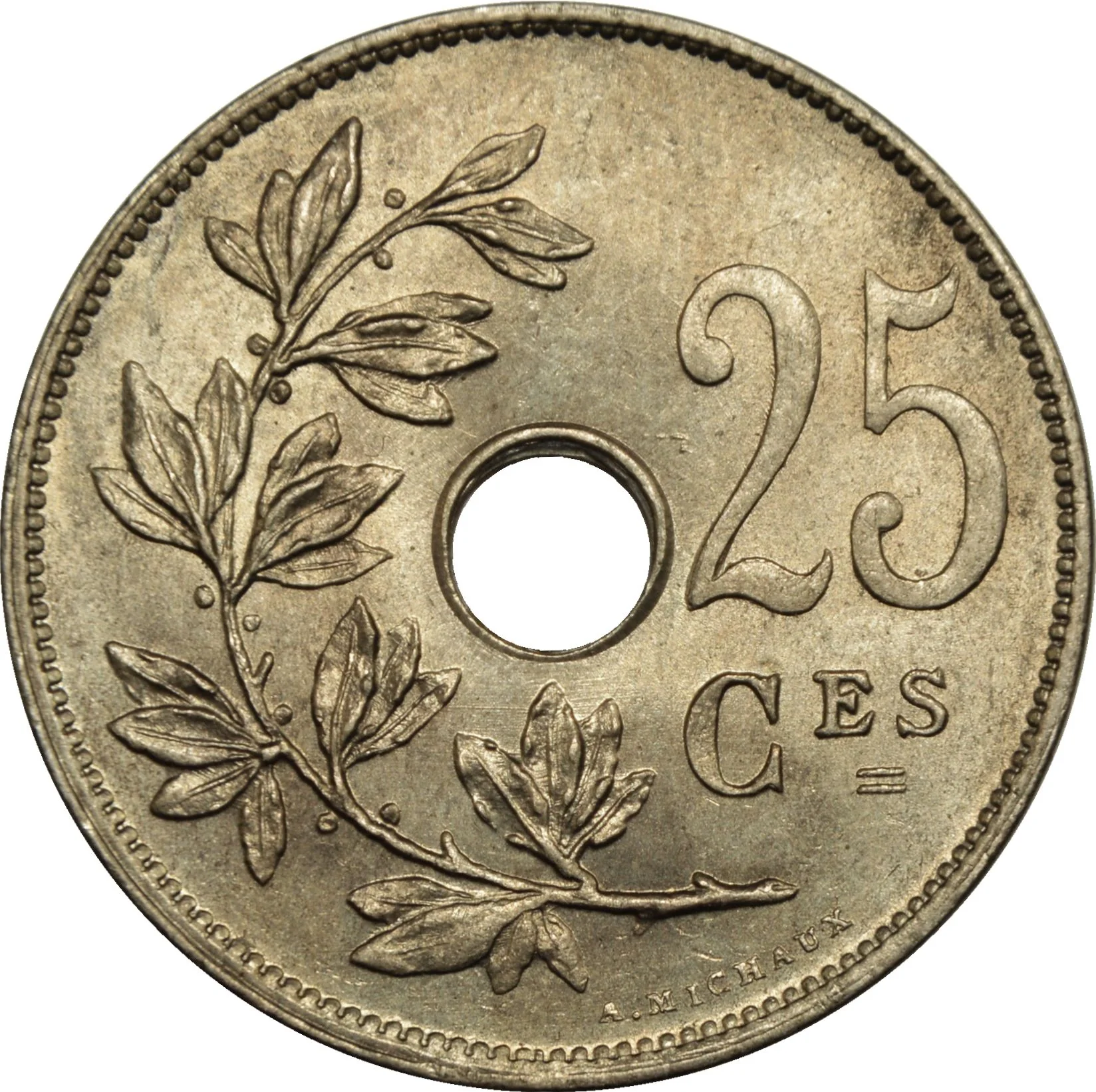
Description:
Center hole flanked by olive sprig and value; designer below.
Inscription:
25
CES
A.MICHAUX
CES
A.MICHAUX
Script: Latin
Engraver: Alphonse Michaux
Edge
Plain
Mints
| Name | Mark |
|---|---|
| Royal Mint of Belgium | — |
Mintings
| Year | Mint Mark | Mintage | Quality | Collection |
|---|---|---|---|---|
| 1913 | — | 2,010,554 | ||
| 1920 | — | 2,844,000 | ||
| 1921 | — | 7,464,000 | ||
| 1922 | — | 7,600,000 | ||
| 1923 | — | 11,356,000 | ||
| 1926 | — | 1,300,000 | ||
| 1927 | — | 8,800,000 | ||
| 1928 | — | 4,351,000 | ||
| 1929 | — | 9,600,000 |
Historical background
In 1913, Belgium's currency was firmly embedded within the Latin Monetary Union (LMU), a multinational agreement it had co-founded in 1865. This system standardized gold and silver coins (the Belgian franc being pegged to the French franc) across member nations, allowing them to circulate freely across borders. Domestically, Belgium operated on a bimetallic standard, but in practice, the gold standard was dominant, with the National Bank of Belgium obligated to exchange banknotes for gold upon demand. This provided the franc with significant stability and international credibility, crucial for a small, trade-dependent industrial nation.
The economy was prosperous, yet the monetary landscape was not without underlying tensions. The LMU was under strain due to the fluctuating relative values of gold and silver, and member states had suspended the free minting of silver coins in the 1870s, effectively creating a "limping gold standard." Furthermore, while gold convertibility was a cornerstone of policy, the actual circulation of gold coins had diminished in everyday use. The public increasingly relied on banknotes and token silver coins issued by the National Bank of Belgium and the state treasury, indicating a growing acceptance of fiduciary money even within a metallic framework.
Overall, on the eve of World War I, Belgium's currency system was sophisticated and stable, but its stability was contingent on international cooperation and the absence of major shocks. The system was designed for peacetime commerce, not for the immense financial pressures of total war. The outbreak of conflict in August 1914 would immediately force the suspension of gold convertibility and the LMU's rules, plunging the country into a new era of managed currency, inflation, and occupation finance that would permanently end the pre-war monetary order.
The economy was prosperous, yet the monetary landscape was not without underlying tensions. The LMU was under strain due to the fluctuating relative values of gold and silver, and member states had suspended the free minting of silver coins in the 1870s, effectively creating a "limping gold standard." Furthermore, while gold convertibility was a cornerstone of policy, the actual circulation of gold coins had diminished in everyday use. The public increasingly relied on banknotes and token silver coins issued by the National Bank of Belgium and the state treasury, indicating a growing acceptance of fiduciary money even within a metallic framework.
Overall, on the eve of World War I, Belgium's currency system was sophisticated and stable, but its stability was contingent on international cooperation and the absence of major shocks. The system was designed for peacetime commerce, not for the immense financial pressures of total war. The outbreak of conflict in August 1914 would immediately force the suspension of gold convertibility and the LMU's rules, plunging the country into a new era of managed currency, inflation, and occupation finance that would permanently end the pre-war monetary order.
🌱 Very Common