


Obverse
Description:
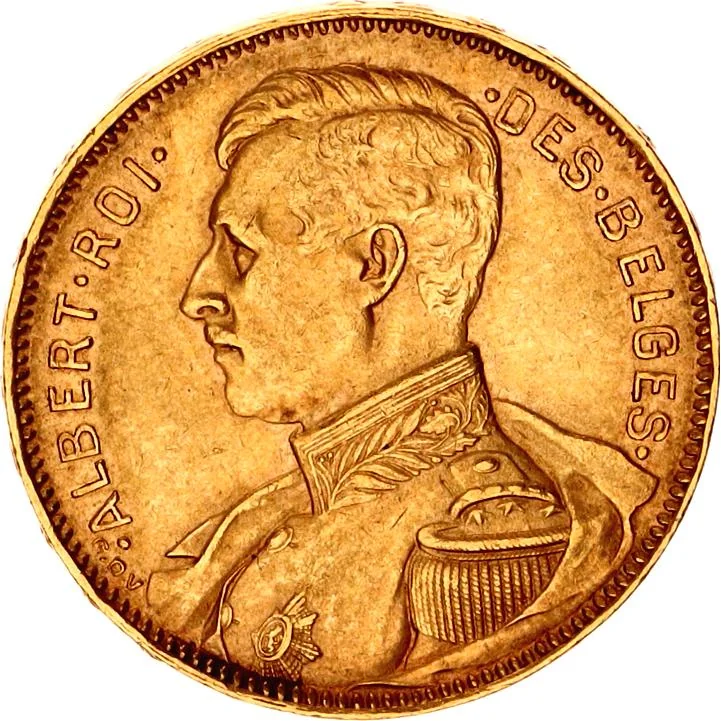
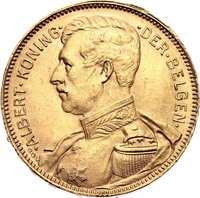
Bust of King Albert I facing left, surrounded by French text. Designer initials at lower left.
Inscription:
·ALBERT·ROI· ·DES·BELGES·
G.D.V
G.D.V
Translation:
Albert King of the Belgians
Grand Duke of Luxembourg
Grand Duke of Luxembourg
Script: Latin
Language: French
Engraver: Godefroid Devreese
Reverse
Description:
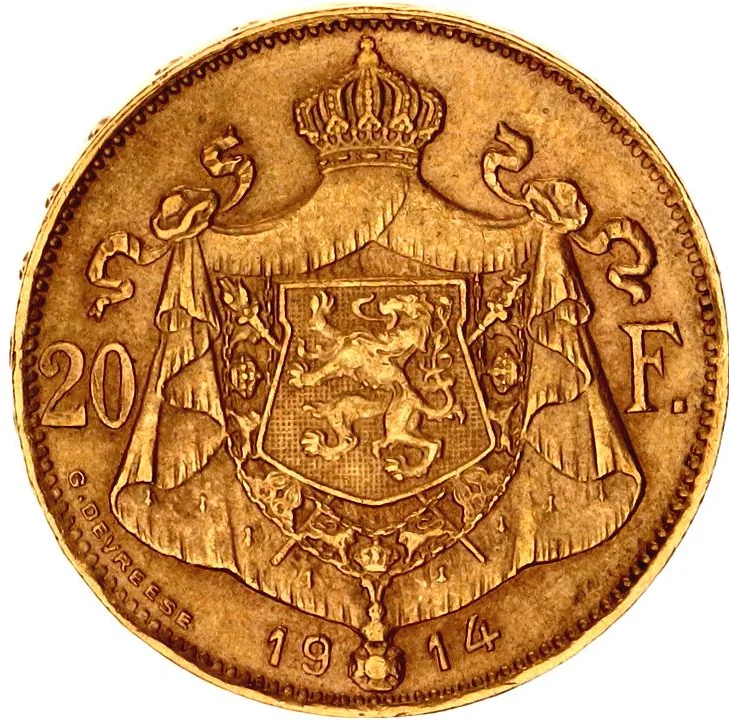
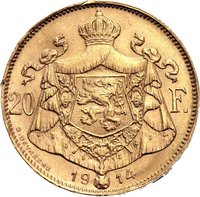
Coat of arms divides value, year below. Designer at left.
Inscription:
20 F.
G.DEVREESE
1914
G.DEVREESE
1914
Script: Latin
Engraver: Godefroid Devreese
Edge
Plain with raised lettering in French
Legend:
* DIEU * PROTÈGE * LA BELGIQUE *****
Translation:
GOD PROTECT BELGIQUE
Language: French
Categories
| Symbol> Crown |
| Symbols> Coat of Arms |
Mints
| Name | Mark |
|---|---|
| Royal Mint of Belgium | — |
Mintings
| Year | Mint Mark | Mintage | Quality | Collection |
|---|---|---|---|---|
| 1914 | — | 125,000 |
Historical background
In 1914, Belgium operated on a sophisticated and stable gold standard monetary system, managed by the National Bank of Belgium (NBB). The Belgian franc, established in 1832, was pegged to gold and fully convertible. The country's monetary landscape was characterized by a mix of banknotes issued by the NBB and a variety of coins (gold, silver, and token), all enjoying strong public confidence. This system was integrated into the broader international gold standard, facilitating trade and investment, and reflected Belgium's status as a prosperous, industrialized nation and a major European financial centre.
The outbreak of World War I in August 1914 triggered an immediate and severe monetary crisis. Fearing a German invasion, there was a massive run on banks as panicked citizens rushed to convert banknotes into gold. To prevent the complete depletion of its gold reserves, the government took emergency measures on August 4th: it suspended the gold convertibility of the franc, granted the NBB the power to issue small-denomination notes, and declared banknotes as compulsory legal tender. This effectively took Belgium off the gold standard, marking a decisive break from its pre-war financial orthodoxy.
Consequently, Belgium entered the war with a new and untested fiat currency regime. The immediate priority was to finance the war effort and maintain economic function under the extreme duress of invasion, which culminated in the German occupation of most of the country. The NBB, following the government into exile in Le Havre, France, continued to issue currency, while occupation authorities later introduced their own currency in occupied territories. This fragmentation laid the groundwork for the severe inflation and complex monetary reconstruction challenges Belgium would face after the Armistice.
The outbreak of World War I in August 1914 triggered an immediate and severe monetary crisis. Fearing a German invasion, there was a massive run on banks as panicked citizens rushed to convert banknotes into gold. To prevent the complete depletion of its gold reserves, the government took emergency measures on August 4th: it suspended the gold convertibility of the franc, granted the NBB the power to issue small-denomination notes, and declared banknotes as compulsory legal tender. This effectively took Belgium off the gold standard, marking a decisive break from its pre-war financial orthodoxy.
Consequently, Belgium entered the war with a new and untested fiat currency regime. The immediate priority was to finance the war effort and maintain economic function under the extreme duress of invasion, which culminated in the German occupation of most of the country. The NBB, following the government into exile in Le Havre, France, continued to issue currency, while occupation authorities later introduced their own currency in occupied territories. This fragmentation laid the groundwork for the severe inflation and complex monetary reconstruction challenges Belgium would face after the Armistice.
🌟 Limited