

5 Hao – North Vietnam
Vietnam
Context
Year: 1946
Country: Vietnam 
Issuer: North Vietnam
Period:
(1945—1976)
Currency:
(1946—1951)
Demonetized: Yes
Material
References
KM: #Click to copy to clipboard2
Numista: #4985
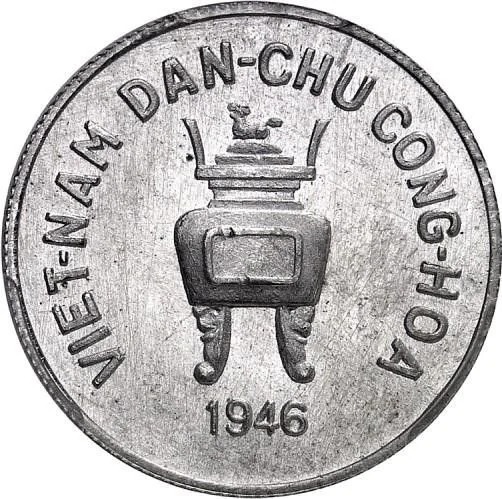
Obverse
Description:
Legends of a tripod cauldron.
Inscription:
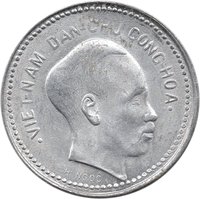
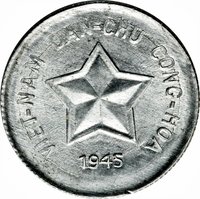
VIET-NAM DAN-CHU CONG-HOA
1946
1946
Translation:
DEMOCRATIC REPUBLIC OF VIETNAM
1946
1946
Script: Latin
Language: Vietnamese
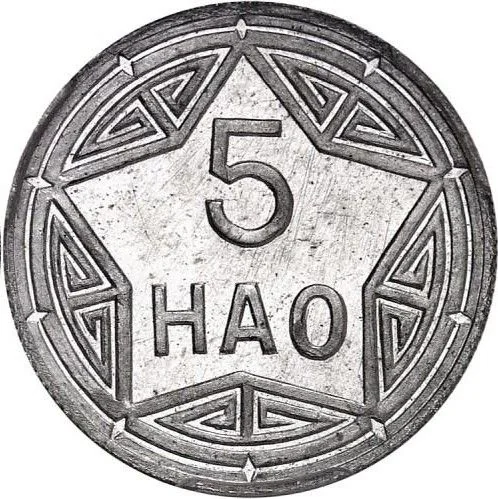
Reverse
Description:
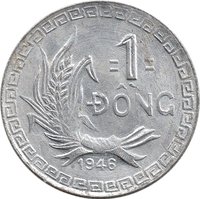
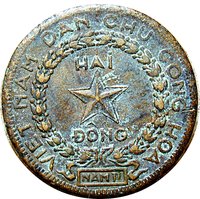
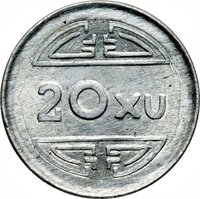
Coin's denomination is in the star, encircled by Chinese lattice.
Inscription:
5
HAO
HAO
Script: Latin
Edge
Reeded
Categories
| Object> Container or tableware |
Mintings
| Year | Mint Mark | Mintage | Quality | Collection |
|---|---|---|---|---|
| 1946 | — | — |
Historical background
In 1946, the currency situation in the Democratic Republic of Vietnam (DRV) was chaotic and critical, reflecting the fragile and contested nature of the nascent state. Following the August Revolution of 1945, the Viet Minh government inherited a monetary system devastated by Japanese occupation and French colonial rule, which had left a complex mix of currencies in circulation. These included French Indochinese piastres, Japanese military yen, and various local notes, leading to severe inflation, public mistrust, and economic dislocation as the country emerged from famine.
To assert sovereignty and stabilize the economy, the DRV government, led by Ho Chi Minh, took the decisive step of issuing its own national currency. On November 23, 1946, the first series of Viet Nam Dong notes were introduced, bearing the image of President Ho Chi Minh. This was a profound political act, symbolizing independence and an attempt to unify the monetary system under state control. However, its circulation was initially limited mostly to Viet Minh-held areas, competing directly with the French piastre still enforced in urban centers and regions under French re-occupation.
This currency issuance occurred on the brink of full-scale war. By December 1946, hostilities with French forces erupted into the First Indochina War, shattering any hope for monetary stability. The war fractured the territory, crippling the DRV's ability to manage a unified economy. Consequently, the 1946 dong quickly became a currency of resistance, its value and utility tied directly to the political and military fortunes of the Viet Minh rather than traditional economic foundations, setting the stage for a protracted period of inflationary finance and multiple currency zones that would persist throughout the conflict.
To assert sovereignty and stabilize the economy, the DRV government, led by Ho Chi Minh, took the decisive step of issuing its own national currency. On November 23, 1946, the first series of Viet Nam Dong notes were introduced, bearing the image of President Ho Chi Minh. This was a profound political act, symbolizing independence and an attempt to unify the monetary system under state control. However, its circulation was initially limited mostly to Viet Minh-held areas, competing directly with the French piastre still enforced in urban centers and regions under French re-occupation.
This currency issuance occurred on the brink of full-scale war. By December 1946, hostilities with French forces erupted into the First Indochina War, shattering any hope for monetary stability. The war fractured the territory, crippling the DRV's ability to manage a unified economy. Consequently, the 1946 dong quickly became a currency of resistance, its value and utility tied directly to the political and military fortunes of the Viet Minh rather than traditional economic foundations, setting the stage for a protracted period of inflationary finance and multiple currency zones that would persist throughout the conflict.
🌱 Common