

20 Xu – North Vietnam
Vietnam
Context
Year: 1945
Country: Vietnam 
Issuer: North Vietnam
Period:
(1945—1976)
Currency:
(1946—1951)
Demonetized: Yes
Material
References
KM: #Click to copy to clipboard1
Numista: #11327
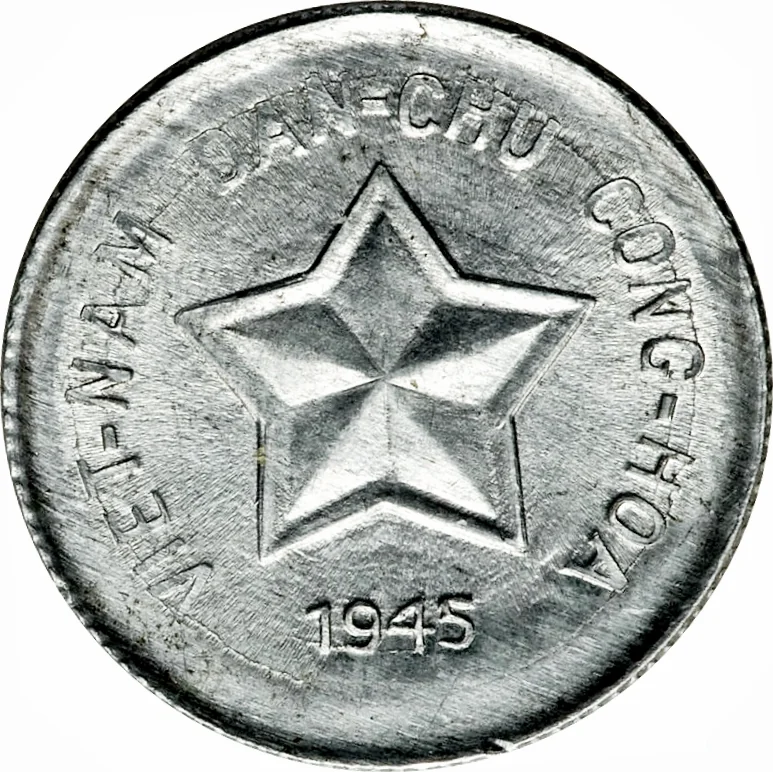
Obverse
Description:
A five-pointed star encircled by text.
Inscription:
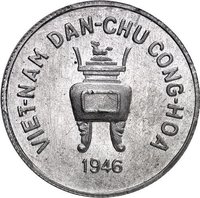
VIET-NAM DAN-CHU CONG-HOA
1945
1945
Translation:
DEMOCRATIC REPUBLIC OF VIETNAM
1945
1945
Script: Latin
Language: Vietnamese
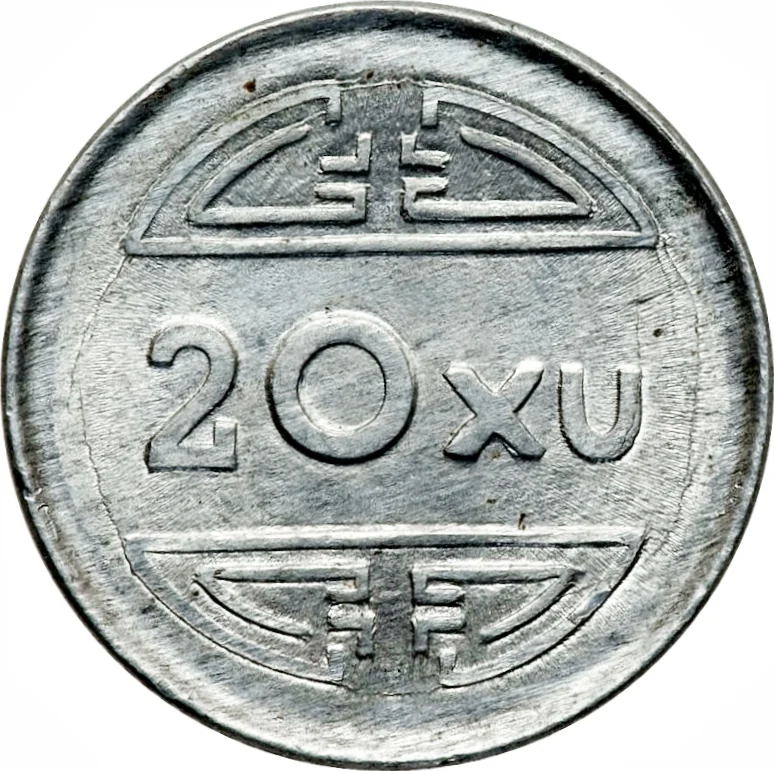
Reverse
Description:
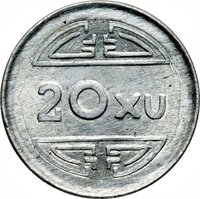
Chinese lattice patterns encircle the coin's denomination.
Inscription:
20 XU
Script: Latin
Edge
Reeded
Mintings
| Year | Mint Mark | Mintage | Quality | Collection |
|---|---|---|---|---|
| 1945 | — | — |
Historical background
Following the August Revolution of 1945, the newly declared Democratic Republic of Vietnam (DRV) inherited a chaotic and multi-layered currency situation. The monetary system was a fragmented legacy of colonial and wartime occupation, consisting of French Indochinese piastres, Japanese military yen, and various local notes. This complex mix created severe economic instability, as the value and legitimacy of each currency were highly contested, and hyperinflation was a looming threat.
The Viet Minh government, led by Ho Chi Minh, recognized that issuing a national currency was a fundamental act of sovereignty and an urgent economic necessity. In late 1945, the first series of DRV banknotes, the dong, were hastily printed and introduced. These initial notes were simple in design, produced on poor-quality paper, but carried powerful nationalist symbols. Their issuance was as much a political statement—asserting independence from French and Japanese authority—as an economic measure.
However, the currency's circulation was initially limited to Viet Minh-held areas, competing directly with the continued use of the French piastre, especially in urban centers. The outbreak of full-scale war with France in December 1946 further complicated the financial landscape, pushing the DRV to use currency as a tool of resistance. The government would continue to refine and reissue its money throughout the First Indochina War, using it to fund the war effort and build administrative legitimacy in the territories it controlled.
The Viet Minh government, led by Ho Chi Minh, recognized that issuing a national currency was a fundamental act of sovereignty and an urgent economic necessity. In late 1945, the first series of DRV banknotes, the dong, were hastily printed and introduced. These initial notes were simple in design, produced on poor-quality paper, but carried powerful nationalist symbols. Their issuance was as much a political statement—asserting independence from French and Japanese authority—as an economic measure.
However, the currency's circulation was initially limited to Viet Minh-held areas, competing directly with the continued use of the French piastre, especially in urban centers. The outbreak of full-scale war with France in December 1946 further complicated the financial landscape, pushing the DRV to use currency as a tool of resistance. The government would continue to refine and reissue its money throughout the First Indochina War, using it to fund the war effort and build administrative legitimacy in the territories it controlled.
⭐ Somewhat Rare