

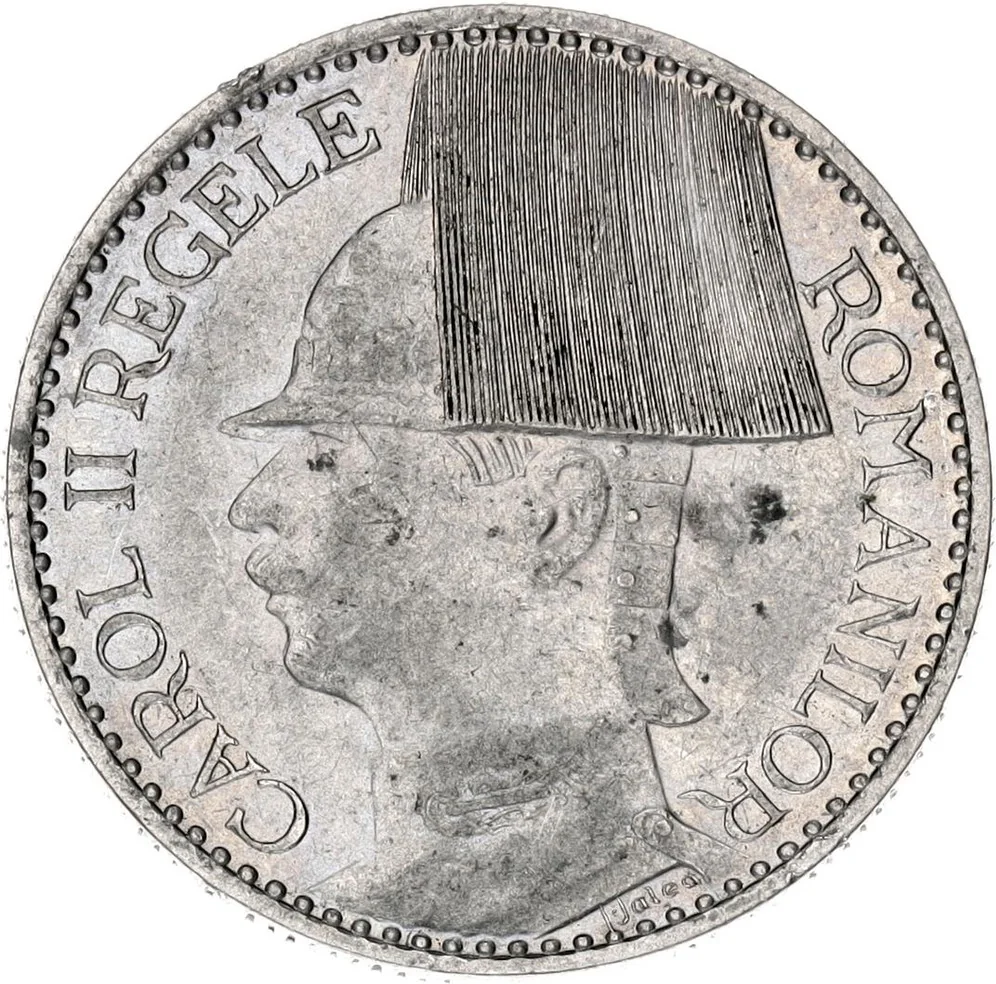

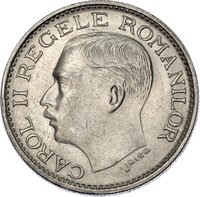
Obverse
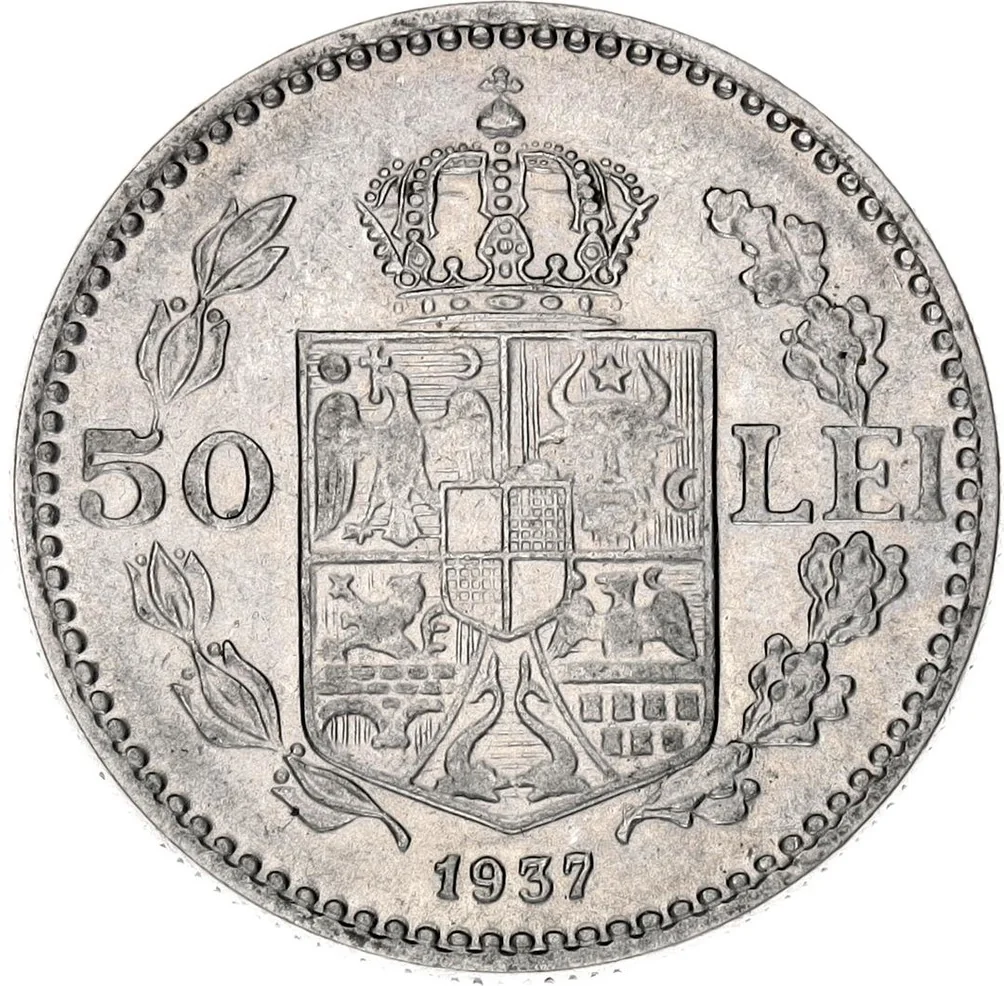
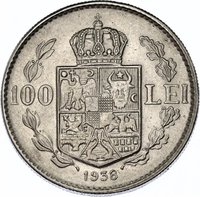
Reverse
Description:
Romanian royal shield flanked by branches, with denomination and date below.
Inscription:
50 LEI
1937
1937
Script: Latin
Edge
Reeded
Categories
| Symbols> Coat of Arms |
| Person> Monarch |
Mints
| Name | Mark |
|---|---|
| State Mint | — |
Mintings
| Year | Mint Mark | Mintage | Quality | Collection |
|---|---|---|---|---|
| 1937 | — | 12,000,000 | ||
| 1938 | — | 8,000,000 |
Historical background
In 1937, Romania's currency, the leu, operated under a managed system heavily influenced by the global economic climate and domestic pressures. The country had nominally returned to the gold standard in 1929, but in practice maintained a "gold exchange standard" managed by the National Bank of Romania (BNR). The BNR pegged the leu to a gold value and used a currency stabilization fund, supported by foreign loans from France and Britain, to defend its exchange rate. However, this stability was precarious, reliant on continuous foreign credit and the health of Romania's primary exports: oil and agricultural products.
The economy faced significant strain from the Great Depression, which had drastically reduced global demand and prices for Romanian exports. This led to persistent trade deficits and a steady drain on foreign currency reserves. By 1937, the political landscape was also becoming increasingly volatile with the rise of the fascist Iron Guard and the weakening of democratic governance under King Carol II. This political instability further undermined international confidence, making it difficult to secure the foreign loans essential for propping up the leu's fixed exchange rate.
Consequently, the currency situation was one of fragile and artificial stability, masking underlying vulnerabilities. The BNR was engaged in a continuous struggle to maintain the peg, imposing strict exchange controls and rationing foreign currency to prioritize essential imports. This period represented the final phase of the interwar gold standard in Romania, setting the stage for the monetary collapse and sweeping autarkic policies that would follow in the wake of World War II and the shift towards a command economy.
The economy faced significant strain from the Great Depression, which had drastically reduced global demand and prices for Romanian exports. This led to persistent trade deficits and a steady drain on foreign currency reserves. By 1937, the political landscape was also becoming increasingly volatile with the rise of the fascist Iron Guard and the weakening of democratic governance under King Carol II. This political instability further undermined international confidence, making it difficult to secure the foreign loans essential for propping up the leu's fixed exchange rate.
Consequently, the currency situation was one of fragile and artificial stability, masking underlying vulnerabilities. The BNR was engaged in a continuous struggle to maintain the peg, imposing strict exchange controls and rationing foreign currency to prioritize essential imports. This period represented the final phase of the interwar gold standard in Romania, setting the stage for the monetary collapse and sweeping autarkic policies that would follow in the wake of World War II and the shift towards a command economy.
🌱 Common