

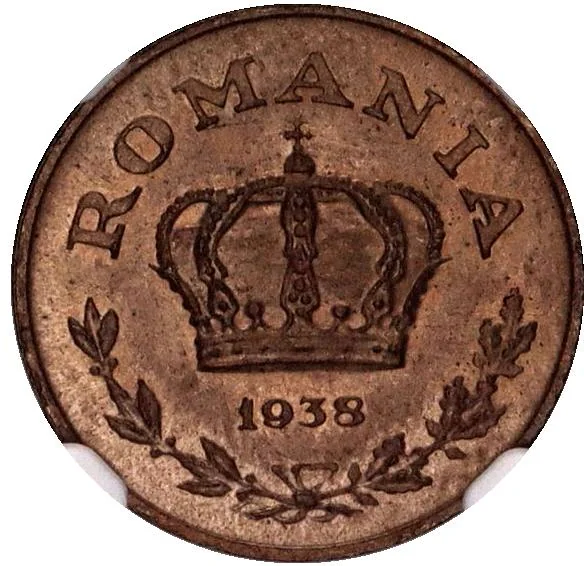
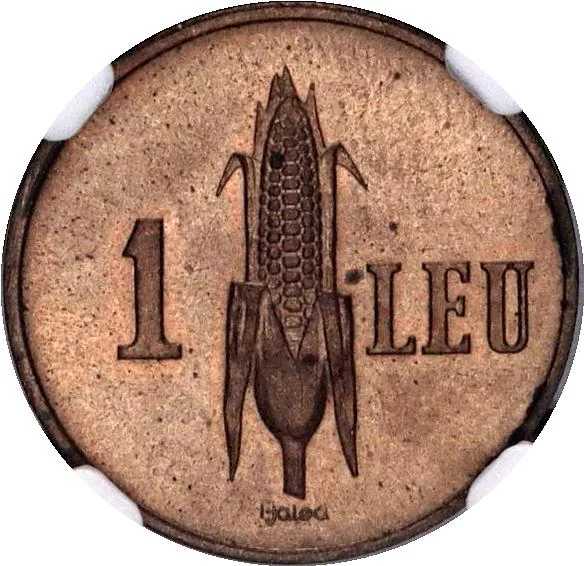
1 Leu – Romania
Romania
Context

Material
Diameter: 18 mm
Weight: 2.75 g
Thickness: 1.4 mm
Shape: Round
Composition: Nickel brass
Magnetic: No
Technique: Milled
Alignment: Coin alignment
flip
References
KM: #Click to copy to clipboard56
Numista: #2773
Obverse
Reverse
Edge
Plain
Mints
| Name | Mark |
|---|---|
| State Mint | — |
Mintings
| Year | Mint Mark | Mintage | Quality | Collection |
|---|---|---|---|---|
| 1938 | — | 36,000,000 | ||
| 1939 | — | 21,620,000 | ||
| 1940 | — | 22,230,000 | ||
| 1941 | — | 20,250,000 |
Historical background
In 1938, Romania’s currency, the leu, was under severe strain, operating within a complex framework of exchange controls and economic nationalism. The global context of the Great Depression and the rise of autarkic policies in Europe had pushed the country, like many others, away from free convertibility. Since 1934, Romania had maintained a multiple exchange rate system, administratively set by the National Bank of Romania. Different rates applied to various transactions (e.g., essential imports, debt servicing, travel) in an attempt to conserve scarce foreign currency reserves, control capital flight, and protect domestic industry.
The economy was heavily dependent on oil and agricultural exports, particularly wheat, but falling global commodity prices throughout the 1930s had drastically reduced the inflow of hard currency. This scarcity was compounded by the need to service substantial foreign debts held by French, British, and American creditors. Internally, the authoritarian regime of King Carol II, which solidified power in 1938 through a new constitution, pursued a policy of economic dirigisme, closely aligning major industries with state interests. This further entrenched the controlled currency regime as a tool for managing the planned economy and financing rearmament.
Ultimately, the currency situation was fragile and artificially sustained by regulation rather than market confidence. The political landscape was increasingly unstable, with the rise of the fascist Iron Guard and the looming threat of war in Europe. This uncertainty exacerbated capital flight, putting continuous pressure on the leu. The system would prove untenable; within a year, World War II would begin, and Romania’s economic and currency policies would become fully subordinated to German influence and wartime exigencies, leading to significant devaluation and inflation in the early 1940s.
The economy was heavily dependent on oil and agricultural exports, particularly wheat, but falling global commodity prices throughout the 1930s had drastically reduced the inflow of hard currency. This scarcity was compounded by the need to service substantial foreign debts held by French, British, and American creditors. Internally, the authoritarian regime of King Carol II, which solidified power in 1938 through a new constitution, pursued a policy of economic dirigisme, closely aligning major industries with state interests. This further entrenched the controlled currency regime as a tool for managing the planned economy and financing rearmament.
Ultimately, the currency situation was fragile and artificially sustained by regulation rather than market confidence. The political landscape was increasingly unstable, with the rise of the fascist Iron Guard and the looming threat of war in Europe. This uncertainty exacerbated capital flight, putting continuous pressure on the leu. The system would prove untenable; within a year, World War II would begin, and Romania’s economic and currency policies would become fully subordinated to German influence and wartime exigencies, leading to significant devaluation and inflation in the early 1940s.
🌱 Very Common