

1 Skilling – Norway
Norway
Context
Year: 1816
Issuer: Norway 
Ruler: Charles II
Currency:
(1816—1875)
Demonetized: Yes
Total mintage: 1,659,100
Material
References
KM: #Click to copy to clipboard284
Numista: #49457
Obverse
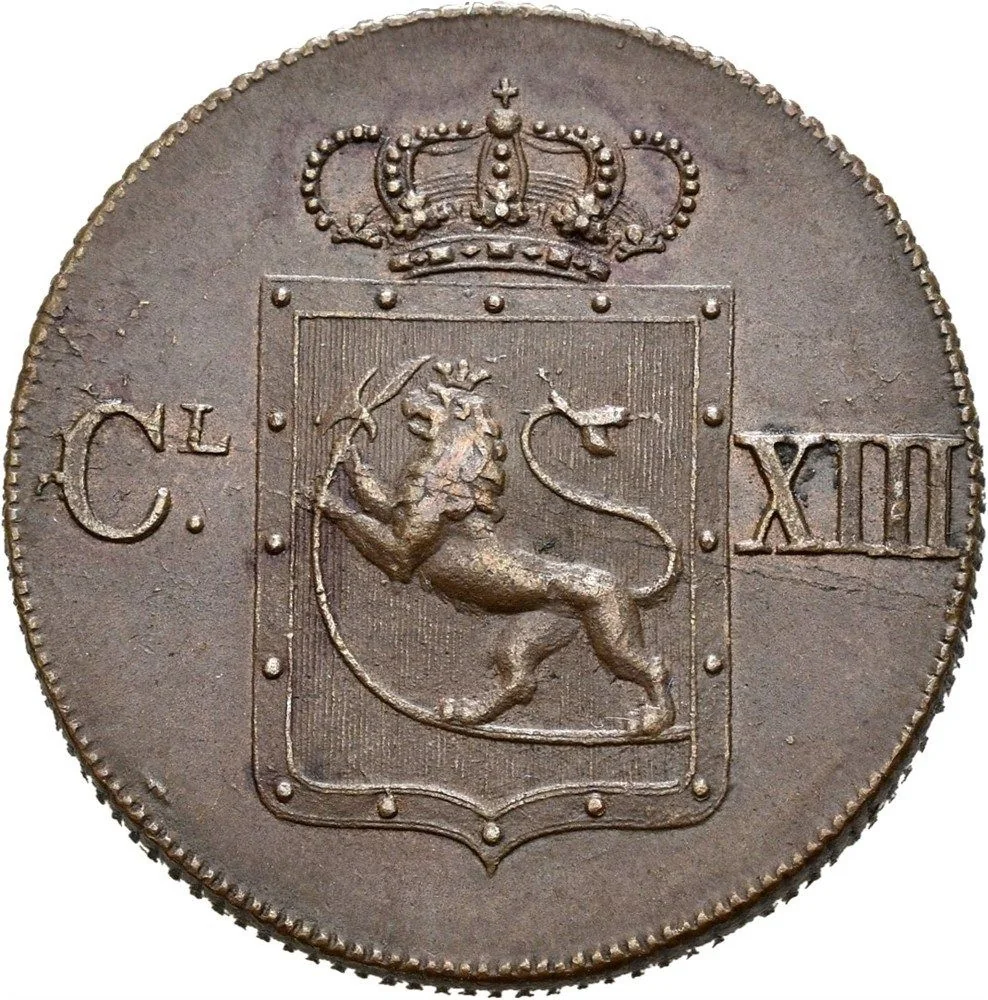
Description:
Crowned rectangular shield with beaded border, containing a crowned Norwegian lion facing left and holding a halberd on a vertically lined field. The inscription is divided by the shield, and a toothed ring is on the rim.
Inscription:
C.L | XIII
Translation:
C(aius) L(entulus) | Tribunicia Potestas XIII
Script: Latin
Language: Latin
Reverse
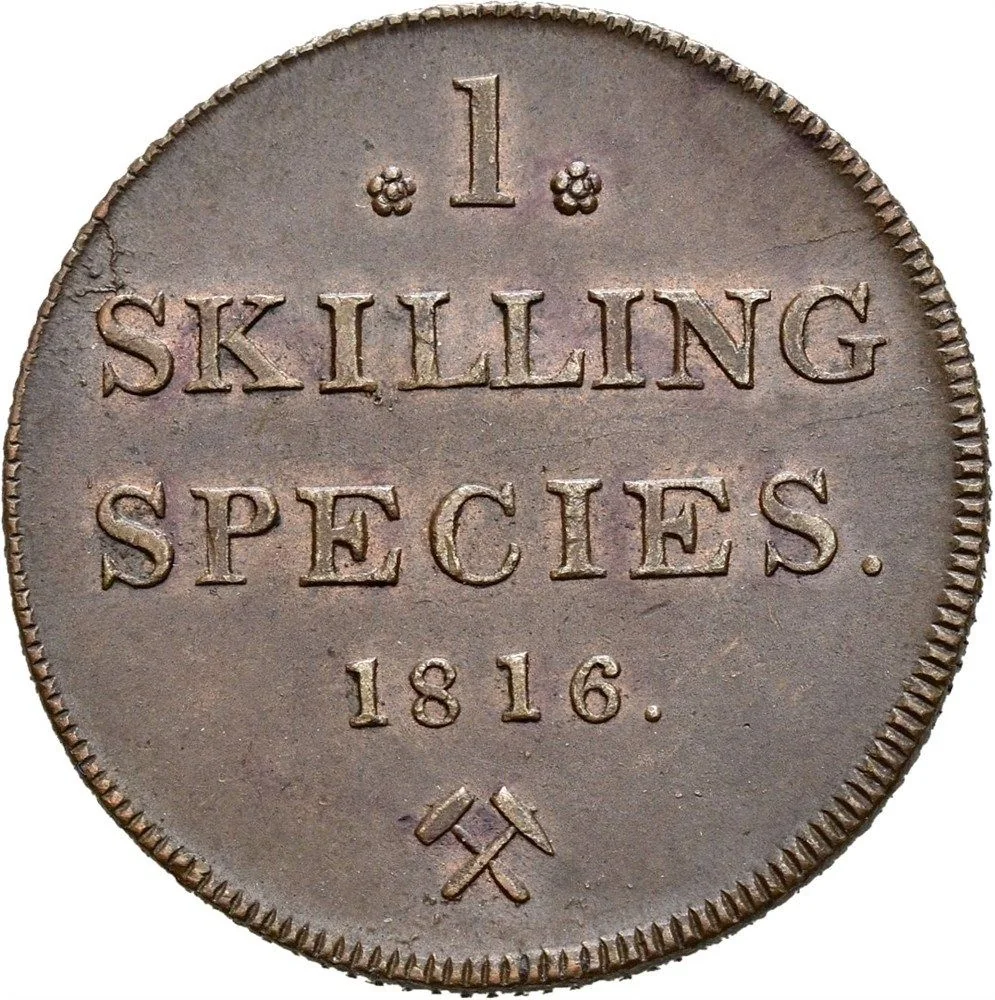
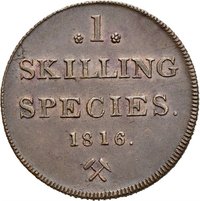
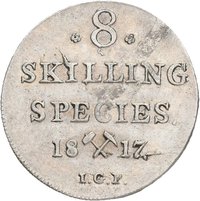
Description:
Value and date
on four lines.
Mintmark below.
Toothed rim.
on four lines.
Mintmark below.
Toothed rim.
Inscription:
⁕ I ⁕
SKILLING
SPECIES.
1816.
⚒
SKILLING
SPECIES.
1816.
⚒
Script: Latin
Edge
Reeded
Categories
| Symbols> Coat of Arms |
Mints
| Name | Mark |
|---|---|
| Norwegian Mint | — |
Mintings
| Year | Mint Mark | Mintage | Quality | Collection |
|---|---|---|---|---|
| 1816 | — | 1,659,100 |
Historical background
In 1816, Norway faced a profound currency crisis rooted in the political and economic upheaval following the Napoleonic Wars. Having been forced into a union with Sweden after the Treaty of Kiel (1814), the newly independent Norwegian state inherited a dire financial situation. The country's previous currency, the rigsdaler, issued by the defunct Danish-Norwegian kingdom, was severely depreciated due to years of war financing, blockade-induced isolation, and excessive note-printing by the first independent Norwegian government to cover its deficits. Public confidence in the paper money had collapsed, leading to rampant inflation and a crippling lack of a stable medium of exchange.
To resolve this crisis and assert economic sovereignty, the Norwegian Parliament (Stortinget) took decisive action. On April 14, 1816, it passed the law establishing Norges Bank as the country's first independent central bank, endowed with the sole right to issue banknotes. Simultaneously, it introduced a new monetary unit, the speciedaler, which was defined in terms of silver to restore trust through a metallic standard. The intention was to replace the old, discredited paper money with new, reliable notes backed by the bank's silver reserves, thereby stabilizing prices and facilitating economic recovery.
The transition, however, was arduous and prolonged. A severe shortage of actual silver meant the new banknotes could not be fully convertible for decades, leading them to trade at a significant discount against hard currency. It was not until the 1840s, following stricter monetary laws and the accumulation of sufficient silver reserves, that the speciedaler achieved true stability and parity. Thus, the 1816 reforms laid the essential institutional foundation for Norway's modern financial system, even though their success required years of fiscal discipline to fully realize.
To resolve this crisis and assert economic sovereignty, the Norwegian Parliament (Stortinget) took decisive action. On April 14, 1816, it passed the law establishing Norges Bank as the country's first independent central bank, endowed with the sole right to issue banknotes. Simultaneously, it introduced a new monetary unit, the speciedaler, which was defined in terms of silver to restore trust through a metallic standard. The intention was to replace the old, discredited paper money with new, reliable notes backed by the bank's silver reserves, thereby stabilizing prices and facilitating economic recovery.
The transition, however, was arduous and prolonged. A severe shortage of actual silver meant the new banknotes could not be fully convertible for decades, leading them to trade at a significant discount against hard currency. It was not until the 1840s, following stricter monetary laws and the accumulation of sufficient silver reserves, that the speciedaler achieved true stability and parity. Thus, the 1816 reforms laid the essential institutional foundation for Norway's modern financial system, even though their success required years of fiscal discipline to fully realize.
🌟 Uncommon