

Obverse
Description:
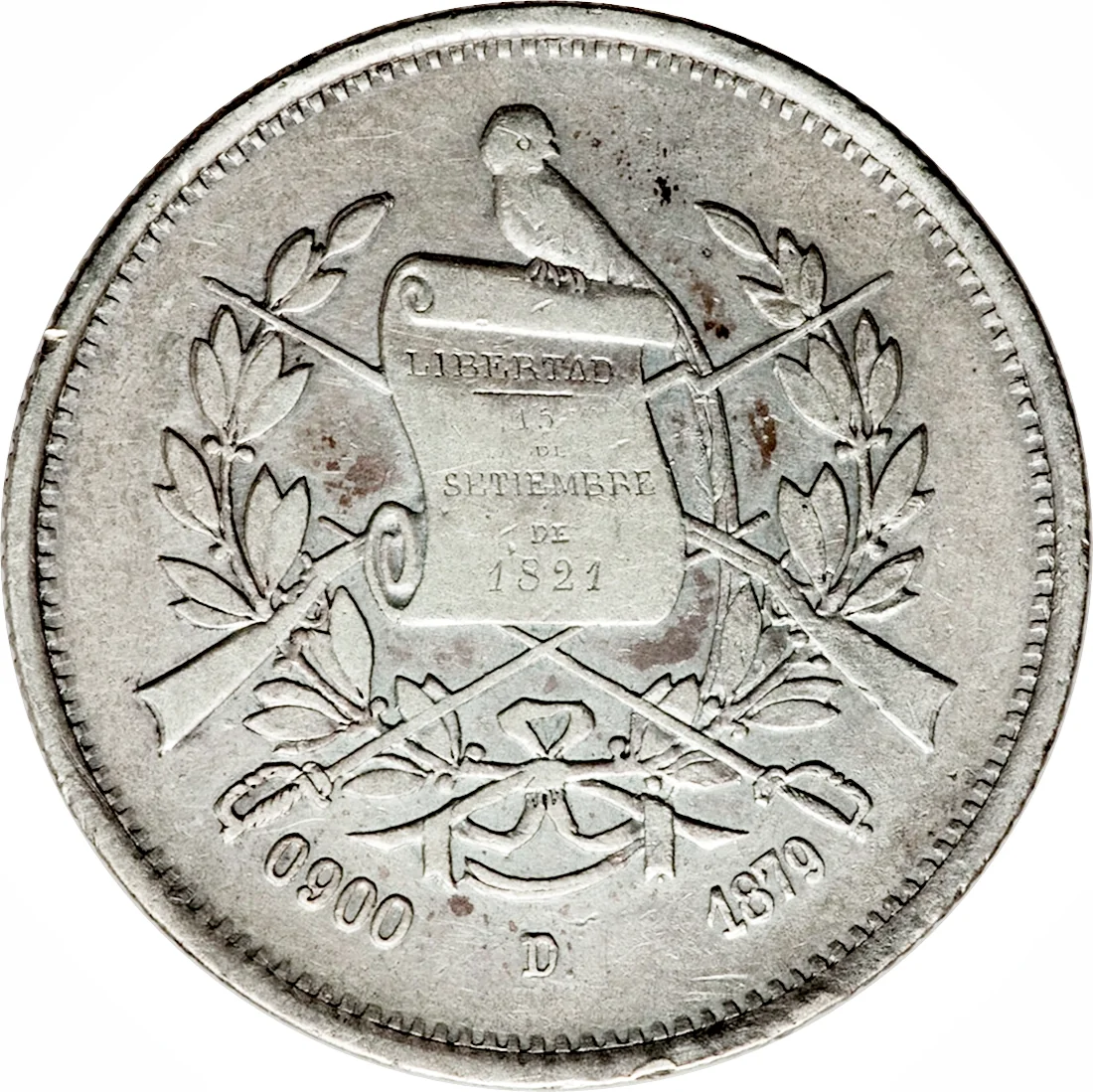
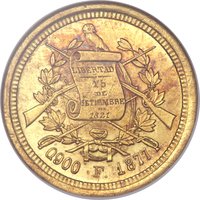
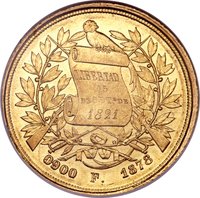
Coat of arms. Initial, date, and fineness below.
Inscription:
LIBERTAD
15
DE
SETIEMBRE
DE
1821
0900 D. 1879
15
DE
SETIEMBRE
DE
1821
0900 D. 1879
Translation:
LIBERTY
15
OF
SEPTEMBER
OF
1821
900 D. 1879
15
OF
SEPTEMBER
OF
1821
900 D. 1879
Script: Latin
Language: Spanish
Engraver: Johann-Baptist Frener
Reverse
Description:
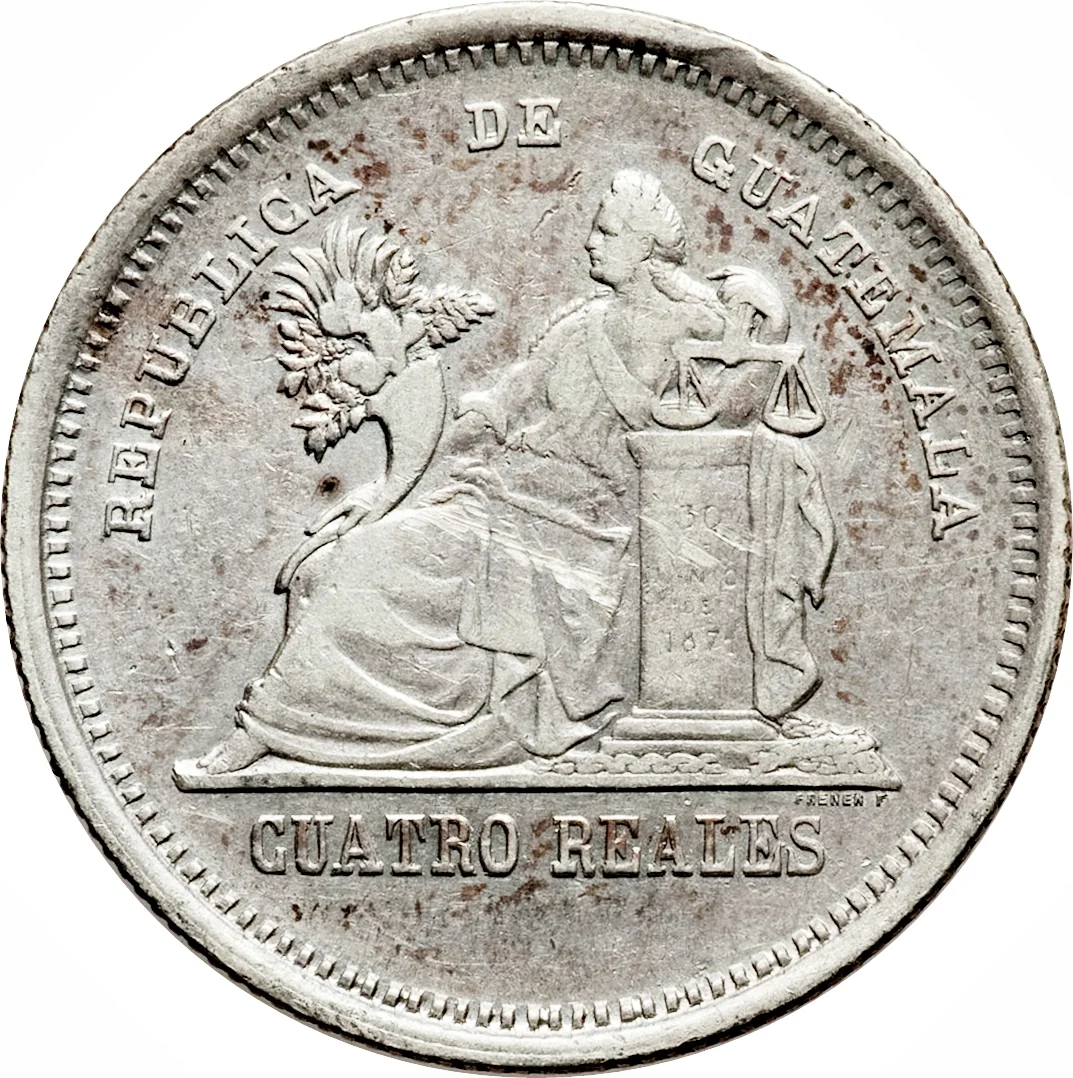
Seated Justice holds scales and a cornucopia, her arm resting on a constitution. Legend encircles the design, with the value below and the engraver's name small at right.
Inscription:
REPUBLICA DE GUATEMALA
30
DE
JUNIO
DE
1871
FRENER F.
CUATRO REALES
30
DE
JUNIO
DE
1871
FRENER F.
CUATRO REALES
Translation:
REPUBLIC OF GUATEMALA
30
OF
JUNE
OF
1871
FRENER F.
FOUR REALES
30
OF
JUNE
OF
1871
FRENER F.
FOUR REALES
Script: Latin
Language: Spanish
Engraver: Johann-Baptist Frener
Edge
Categories
| Symbol> Allegory |
| Symbols> Coat of Arms |
Mints
| Name | Mark |
|---|---|
| Casa de Moneda de Guatemala | — |
Mintings
| Year | Mint Mark | Mintage | Quality | Collection |
|---|---|---|---|---|
| 1873 | — | 23,535 | ||
| 1878 | D | 10,466 | ||
| 1879 | — | — | ||
| 1879 | D | 7,664 | ||
| 1892 | R.G. | 1,300 | ||
| 1893 | — | — | ||
| 1893 | R.G. | — |
Historical background
In 1873, Guatemala’s currency system was in a state of transition and disarray, caught between the legacy of the Spanish colonial monetary system and the pressures of a newly liberalizing economy. The country operated on a bimetallic standard in theory, but in practice, it suffered from a severe shortage of official coinage. The primary circulating coins were the silver peso (often called the peso fuerte or strong peso) and the gold escudo, but their supply was insufficient for daily commerce. This scarcity was exacerbated by the government's chronic fiscal deficits and the outflow of precious metals to pay for imports, leading to widespread use of foreign coins, particularly those from Mexico, Peru, and Bolivia, which circulated at varying and unstable exchange rates.
The situation was further complicated by the policies of the Liberal Revolution of 1871, which brought Justo Rufino Barrios to power. The new liberal government was aggressively promoting coffee exports and infrastructure projects, requiring stable credit and currency. However, the existing financial infrastructure was weak, with no central bank. To address the coin shortage and fund modernization, the government heavily relied on borrowing from foreign banks and issuing paper money. These banknotes, issued by private banks like the Banco de Guatemala (chartered in 1874 but planned earlier), began to circulate more prominently around this time, though they faced public skepticism and were not yet legal tender for all transactions.
Consequently, 1873 represents a pivotal moment just before significant monetary reforms. The economy was a patchwork of foreign and domestic silver, limited gold, and emerging paper currency, all with fluctuating values. This instability hindered internal trade and state revenue collection. Recognizing this, the Barrios administration was on the cusp of more decisive actions, which would soon include the official adoption of the Gold Standard in 1875 and the establishment of a decimal currency system (the quetzal division), aiming to unify the currency, attract foreign investment, and integrate Guatemala more fully into the global capitalist system.
The situation was further complicated by the policies of the Liberal Revolution of 1871, which brought Justo Rufino Barrios to power. The new liberal government was aggressively promoting coffee exports and infrastructure projects, requiring stable credit and currency. However, the existing financial infrastructure was weak, with no central bank. To address the coin shortage and fund modernization, the government heavily relied on borrowing from foreign banks and issuing paper money. These banknotes, issued by private banks like the Banco de Guatemala (chartered in 1874 but planned earlier), began to circulate more prominently around this time, though they faced public skepticism and were not yet legal tender for all transactions.
Consequently, 1873 represents a pivotal moment just before significant monetary reforms. The economy was a patchwork of foreign and domestic silver, limited gold, and emerging paper currency, all with fluctuating values. This instability hindered internal trade and state revenue collection. Recognizing this, the Barrios administration was on the cusp of more decisive actions, which would soon include the official adoption of the Gold Standard in 1875 and the establishment of a decimal currency system (the quetzal division), aiming to unify the currency, attract foreign investment, and integrate Guatemala more fully into the global capitalist system.
💎 Extremely Rare