

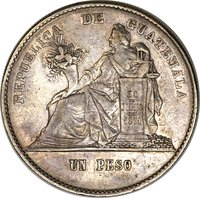
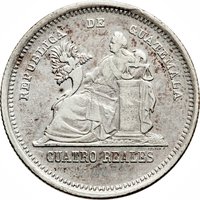
Obverse
Description:
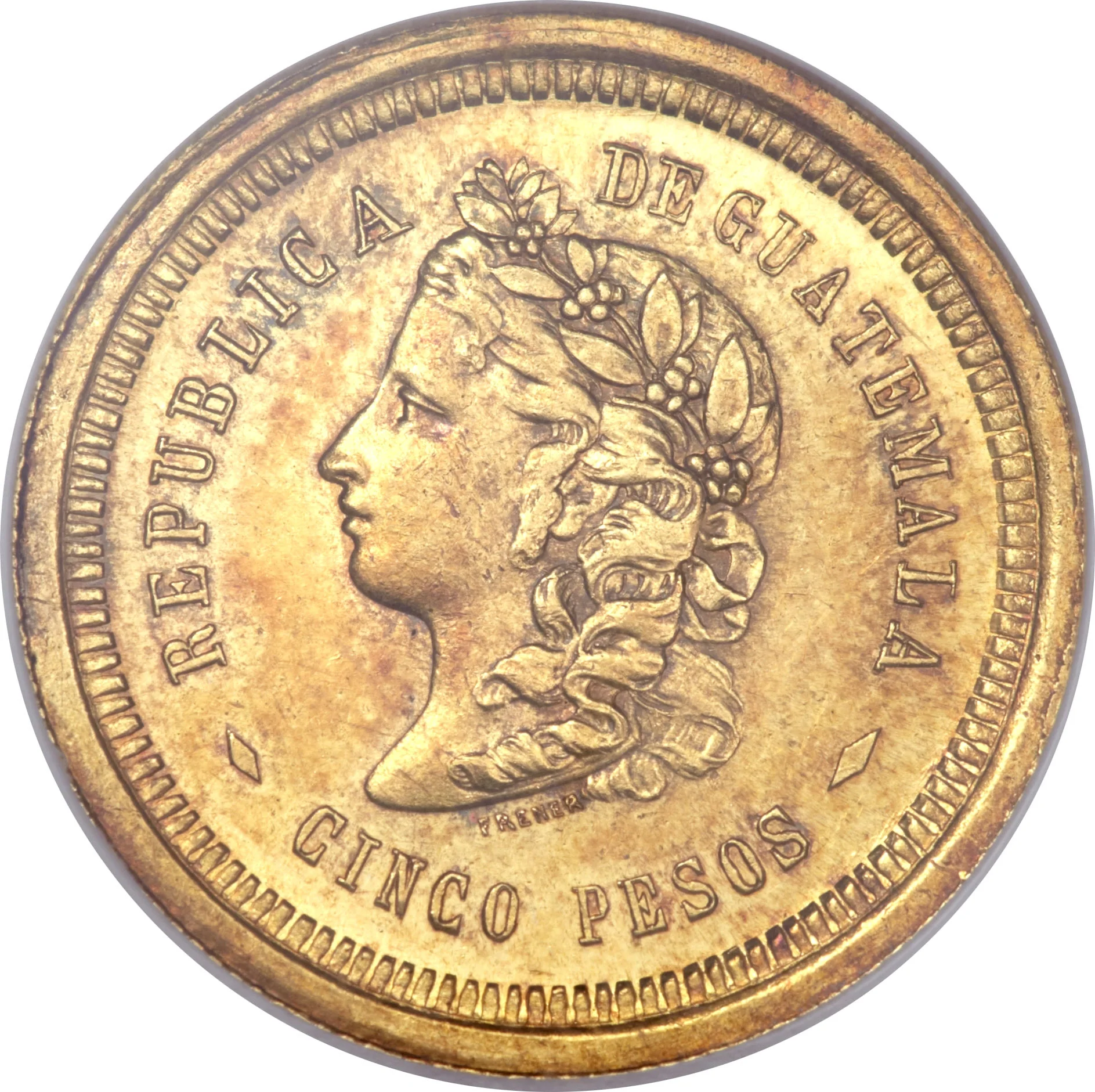
Liberty bust left, legend above, value below.
Inscription:
REPUBLICA DE GUATEMALA
-CINCO PESOS-
-CINCO PESOS-
Translation:
REPUBLIC OF GUATEMALA
-FIVE PESOS-
-FIVE PESOS-
Script: Latin
Language: Spanish
Engraver: Johann-Baptist Frener
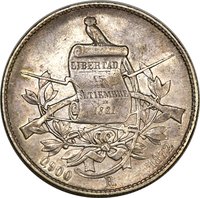
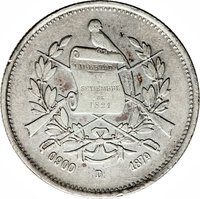
Reverse
Description:
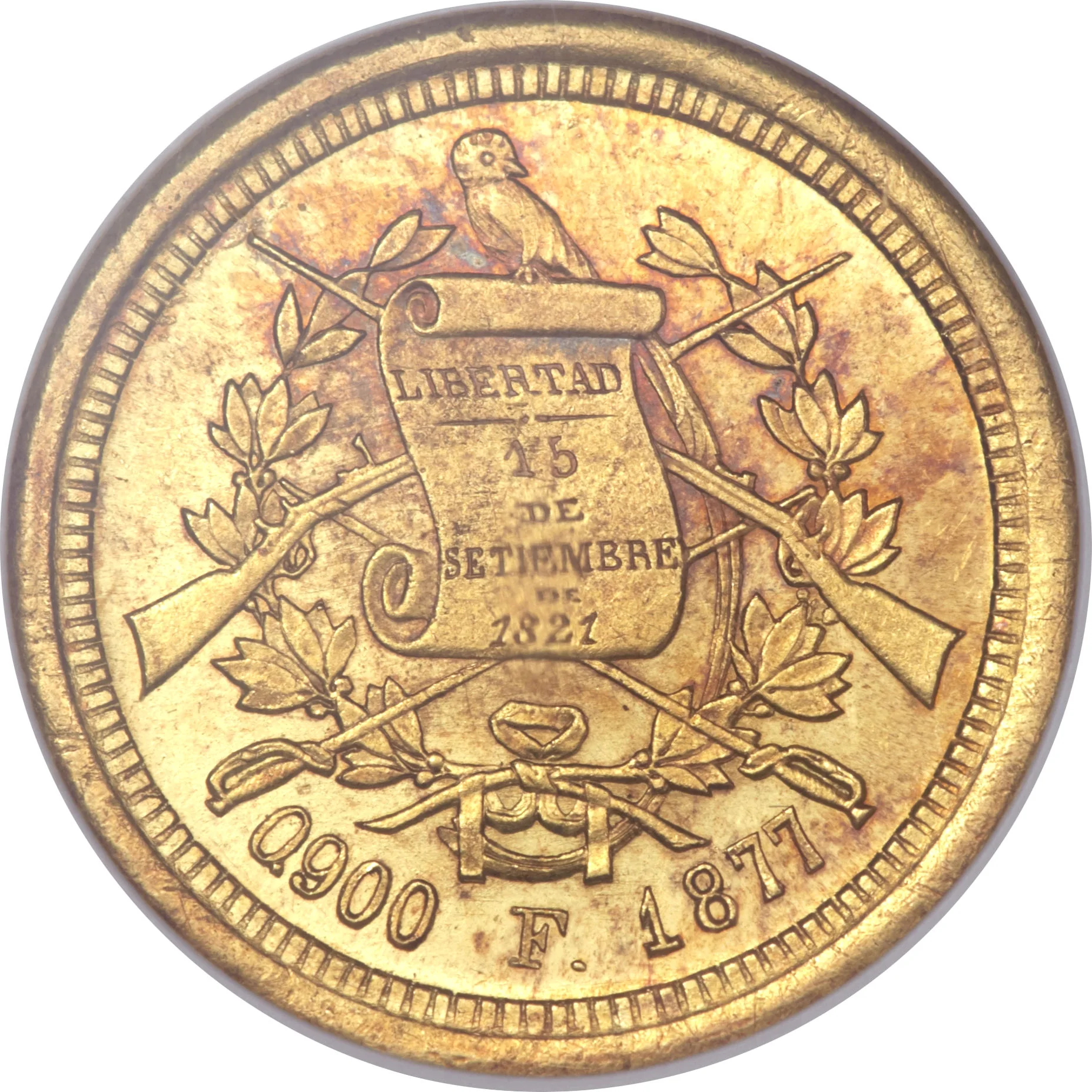
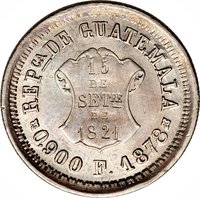
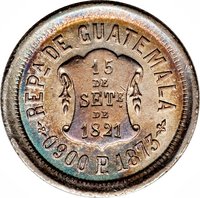
Coat of arms with fineness, initial, and date below.
Inscription:
LIBERTAD
15
DE
SETIEMBRE
DE
1821
0.900 F. 1877
15
DE
SETIEMBRE
DE
1821
0.900 F. 1877
Translation:
LIBERTY
15
OF
SEPTEMBER
OF
1821
0.900 F. 1877
15
OF
SEPTEMBER
OF
1821
0.900 F. 1877
Script: Latin
Language: Spanish
Engraver: Johann-Baptist Frener
Edge
Categories
| Symbol> Allegory |
| Symbols> Coat of Arms |
Mints
| Name | Mark |
|---|---|
| Casa de Moneda de Guatemala | — |
Mintings
| Year | Mint Mark | Mintage | Quality | Collection |
|---|---|---|---|---|
| 1872 | — | — | ||
| 1874 | — | — | ||
| 1877 | — | — | ||
| 1878 | D | 820 |
Historical background
In 1872, Guatemala’s currency situation was characterized by profound instability and transition, rooted in the economic policies of the Conservative regime that had ruled for decades. The country operated on a bimetallic standard in law, but in practice, the circulating medium was dominated by debased silver coinage, particularly the real. Years of fiscal shortfalls, often addressed by cutting the silver content in coins, had led to a severe loss of public confidence in the currency. This erosion of value created a complex system where old, higher-content coins traded at a premium over newer, lighter ones, complicating all commercial transactions and hindering economic growth.
This monetary confusion occurred within a specific political context. The liberal Reforma under President Miguel García Granados, which began in 1871, was actively dismantling the structures of the former Conservative government. While 1872 was a year of ongoing civil war and consolidation of liberal power, the new regime recognized the chaotic currency as a major obstacle to its modernizing project and to attracting foreign investment. The financial system was also strained by the government's issuance of vales (promissory notes) to fund its military campaigns, further flooding the market with instruments of uncertain value.
Consequently, 1872 stands as the immediate prelude to a major monetary reform. The liberal government, laying the groundwork for the changes fully implemented by Granados's successor, Justo Rufino Barrios, was already planning a fundamental overhaul. This would culminate in the 1874 adoption of the peso as the new unit of currency, a decisive shift toward a decimal system, and the establishment of a gold standard in an effort to stabilize the economy, integrate Guatemala into global trade, and symbolize the break with the conservative past. Thus, the currency situation of 1872 was one of endemic disorder, directly prompting the transformative reforms that defined the late 19th century.
This monetary confusion occurred within a specific political context. The liberal Reforma under President Miguel García Granados, which began in 1871, was actively dismantling the structures of the former Conservative government. While 1872 was a year of ongoing civil war and consolidation of liberal power, the new regime recognized the chaotic currency as a major obstacle to its modernizing project and to attracting foreign investment. The financial system was also strained by the government's issuance of vales (promissory notes) to fund its military campaigns, further flooding the market with instruments of uncertain value.
Consequently, 1872 stands as the immediate prelude to a major monetary reform. The liberal government, laying the groundwork for the changes fully implemented by Granados's successor, Justo Rufino Barrios, was already planning a fundamental overhaul. This would culminate in the 1874 adoption of the peso as the new unit of currency, a decisive shift toward a decimal system, and the establishment of a gold standard in an effort to stabilize the economy, integrate Guatemala into global trade, and symbolize the break with the conservative past. Thus, the currency situation of 1872 was one of endemic disorder, directly prompting the transformative reforms that defined the late 19th century.
Series: 1872 Guatemala circulation coins
✨ Legendary