

Obverse
Description:
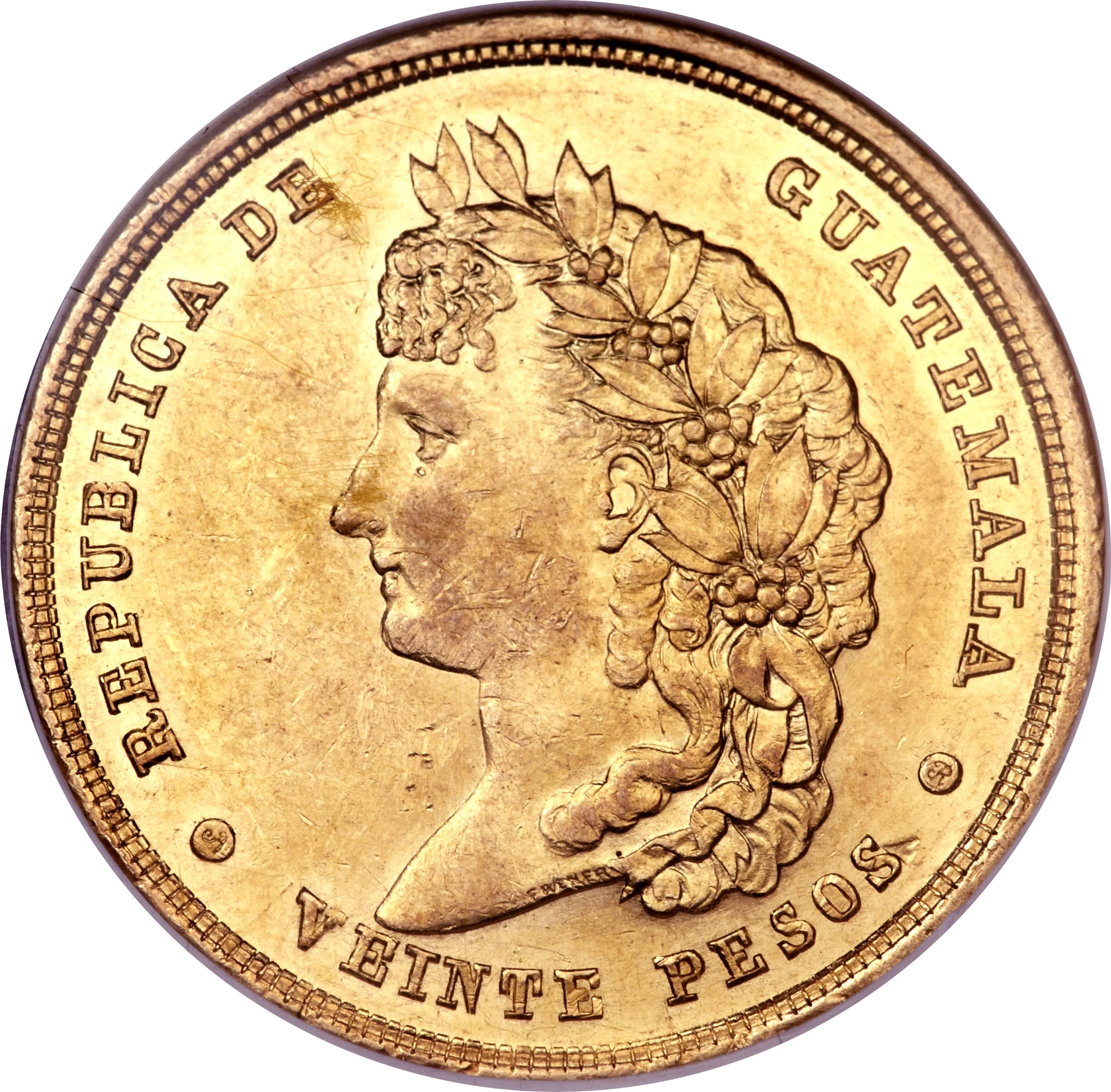
Liberty bust left, legend above, value below.
Inscription:
REPUBLICA DE GUATEMALA
•VEINTE PESOS•
•VEINTE PESOS•
Translation:
REPUBLIC OF GUATEMALA
•TWENTY PESOS•
•TWENTY PESOS•
Script: Latin
Language: Spanish
Engraver: Johann-Baptist Frener
Reverse
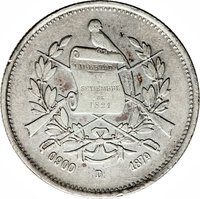
Description:
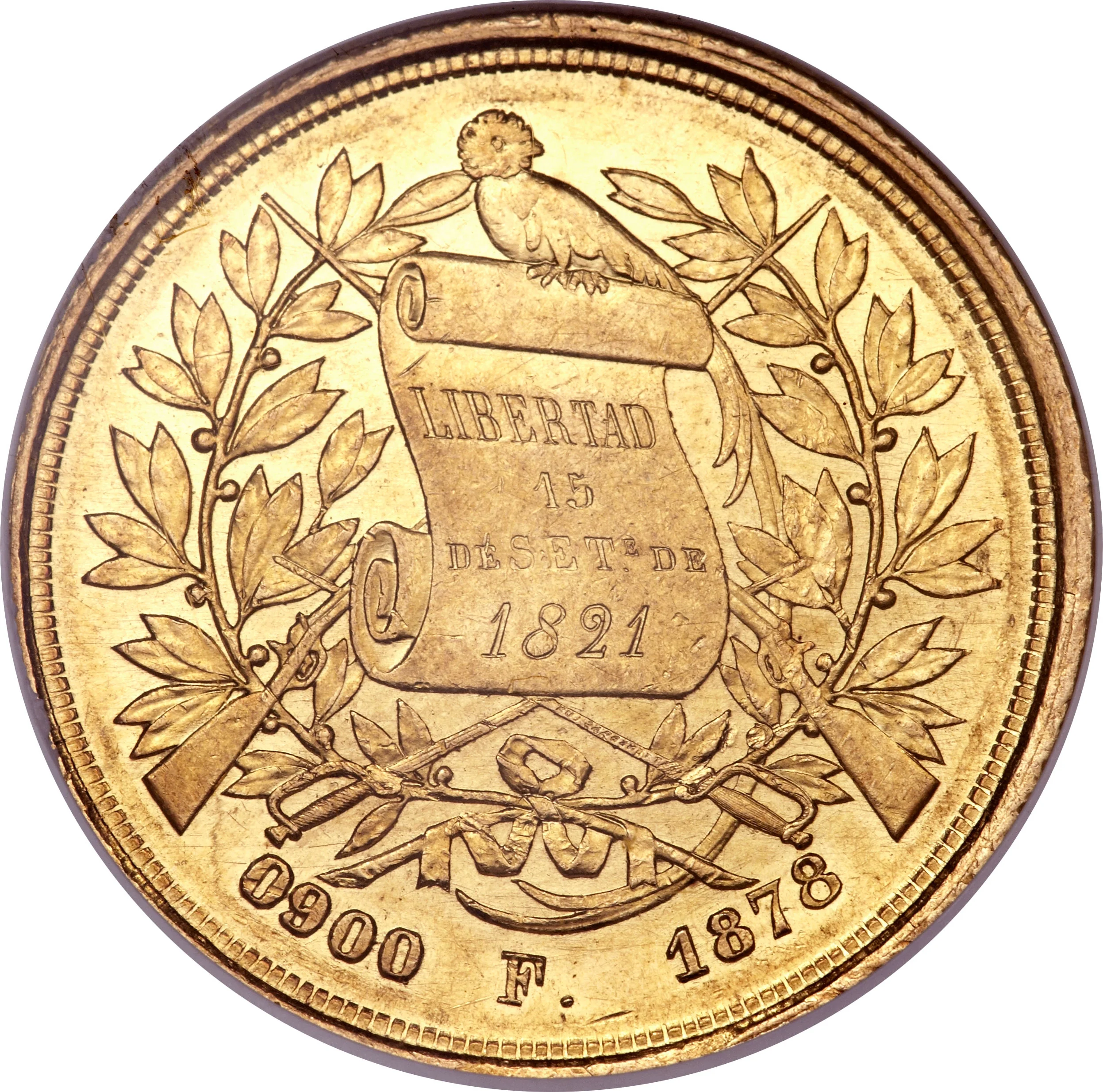
Coat of arms with fineness, initial, and date below.
Inscription:
LIBERTAD
15
DE SET DE
1821
0.900 F. 1878
15
DE SET DE
1821
0.900 F. 1878
Translation:
LIBERTY
15
OF SEPTEMBER OF
1821
0.900 F. 1878
15
OF SEPTEMBER OF
1821
0.900 F. 1878
Script: Latin
Language: Spanish
Engraver: Johann-Baptist Frener
Edge
Categories
| Symbol> Allegory |
| Symbols> Coat of Arms |
Mints
| Name | Mark |
|---|---|
| Casa de Moneda de Guatemala | — |
Mintings
| Year | Mint Mark | Mintage | Quality | Collection |
|---|---|---|---|---|
| 1877 | — | — | ||
| 1878 | — | — |
Historical background
In 1877, Guatemala’s currency situation was characterized by a complex and chaotic system of multiple, competing monies, a legacy of the colonial era and post-independence instability. The primary circulating medium was the peso, but its value was not uniform. The country operated on a bimetallic standard in theory, but in practice, coins of varying metallic content and origin—including Spanish colonial reales, Peruvian and Bolivian coins, and locally minted currency—all circulated simultaneously. This led to significant confusion in commerce, as the intrinsic silver content of a coin often determined its actual value, creating a disconnect between its face value and its worth in transactions.
The administration of President Justo Rufino Barrios (1873-1885), part of the Liberal Reform, was actively working to modernize the economy and centralize state power, which included reforming the monetary system. A key step had been the establishment of the Banco Nacional de Guatemala in 1874, which held the exclusive right to issue paper money. However, by 1877, these banknotes still struggled to gain public trust and widespread acceptance. A deep-seated preference for hard silver and gold coins persisted among the population, who were skeptical of paper currency due to past experiences with devaluation and instability.
Therefore, the currency situation in 1877 was one of transition and friction. The government aimed to impose order through a national bank and a standardized currency to facilitate coffee export revenue and foreign investment, which were central to Barrios’s economic model. Yet, the reality in markets across Guatemala remained a tangled system of metal coins, with the new paper money not yet fully established as a reliable medium of exchange. This duality reflected the broader challenges of modernizing a traditional economy during the Liberal Reform era.
The administration of President Justo Rufino Barrios (1873-1885), part of the Liberal Reform, was actively working to modernize the economy and centralize state power, which included reforming the monetary system. A key step had been the establishment of the Banco Nacional de Guatemala in 1874, which held the exclusive right to issue paper money. However, by 1877, these banknotes still struggled to gain public trust and widespread acceptance. A deep-seated preference for hard silver and gold coins persisted among the population, who were skeptical of paper currency due to past experiences with devaluation and instability.
Therefore, the currency situation in 1877 was one of transition and friction. The government aimed to impose order through a national bank and a standardized currency to facilitate coffee export revenue and foreign investment, which were central to Barrios’s economic model. Yet, the reality in markets across Guatemala remained a tangled system of metal coins, with the new paper money not yet fully established as a reliable medium of exchange. This duality reflected the broader challenges of modernizing a traditional economy during the Liberal Reform era.
✨ Legendary