

2 pesos – Costa Rica
Add to wishlist
Costa Rica
Context
Years: 1866–1868
Issuer: Costa Rica
Period:
(1848—1948)
Currency:
(1863—1896)
Demonetization: 14 August 1900
Total mintage: 13,055
Material
References
KM: #
Numista: #49162
Value
Bullion value: $394.94
Obverse
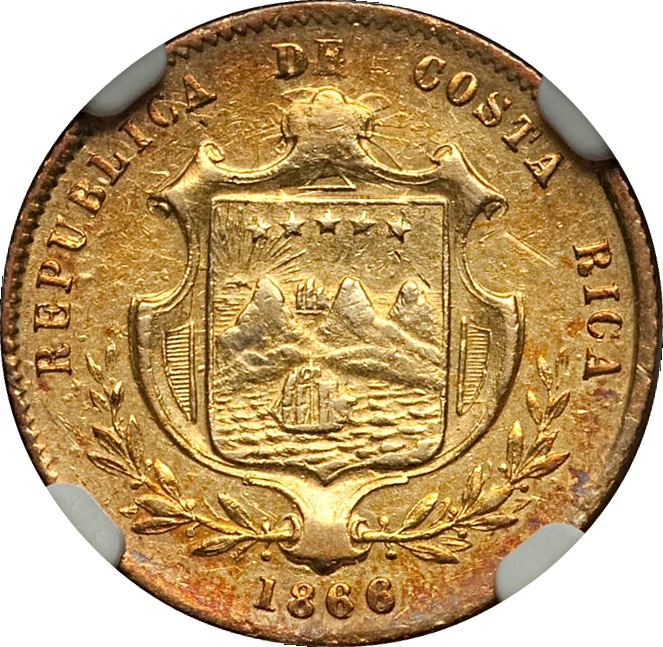
Description:
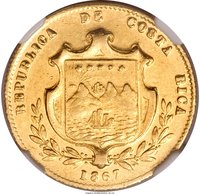
Coat of arms, legend above, date below.
Inscription:
REPUBLICA DE COSTA RICA
1866
1866
Translation:
REPUBLIC OF COSTA RICA
1866
1866
Script: Latin
Language: Spanish
Engraver: Guillermo Witting
Reverse
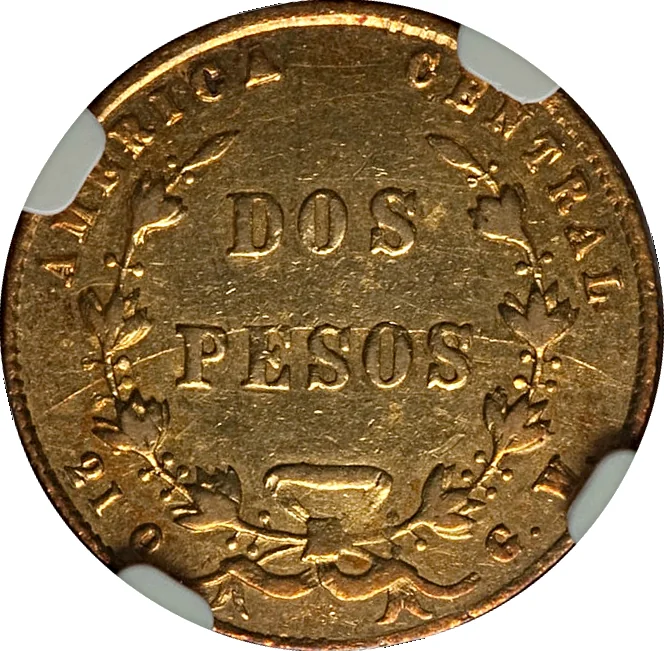
Description:
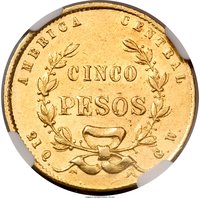
Wreath with value. Top: legend. Bottom: fineness and assayer's initials.
Inscription:
AMERICA CENTRAL
DOS
PESOS
21 Q G. W.
DOS
PESOS
21 Q G. W.
Translation:
Central America
Two
Pesos
21 Q G. W.
Two
Pesos
21 Q G. W.
Script: Latin
Language: Spanish
Engraver: Guillermo Witting
Edge
Categories
| Symbols> Coat of Arms |
| Symbol> Wreath |
Mints
| Name | Mark |
|---|---|
| Casa Nacional de Moneda de Costa Rica | — |
Mintings
| Year | Mint Mark | Mintage | Quality | Collection |
|---|---|---|---|---|
| 1866 | — | 13,055 | ||
| 1867 | — | — | ||
| 1868 | — | — |
Historical background
In 1866, Costa Rica’s currency situation was characterized by significant disorder and a complex mix of circulating mediums. The country lacked a unified national coinage, leading to a chaotic system where foreign coins—primarily Peruvian, Bolivian, Chilean, and Colombian silver pesos—circulated alongside locally minted low-denomination coins. The value of these foreign coins was not based on their intrinsic metal content but on an officially decreed tasa (rate), which often differed from their market value, causing confusion and facilitating arbitrage. This system was inefficient and hindered both domestic commerce and international trade, as merchants had to constantly calculate conversions between various coin types and their assigned legal values.
The instability was exacerbated by a chronic shortage of fractional currency for everyday transactions. To address this, the government had authorized the minting of low-denomination silver reales and copper medios and cuartillos at the San José Mint. However, these small coins were often hoarded or exported, as their metal value could exceed their face value, leading to recurring shortages in the local economy. Consequently, private tokens and promissory notes, sometimes issued by merchants or municipal authorities, filled the void, further complicating the monetary landscape with instruments of uncertain reliability.
This fragmented monetary environment reflected broader challenges of state-building and economic integration during the mid-19th century. The government's attempts to impose order through decreed rates were largely ineffective against market forces and the practical realities of a small, open economy. The situation in 1866 thus set the stage for future monetary reforms, most notably the contract signed with the Paris Mint in 1869, which would eventually lead to the introduction of a modern, decimal-based national coinage—the Costa Rican peso—in the 1870s, aiming to finally consolidate and stabilize the country's currency.
The instability was exacerbated by a chronic shortage of fractional currency for everyday transactions. To address this, the government had authorized the minting of low-denomination silver reales and copper medios and cuartillos at the San José Mint. However, these small coins were often hoarded or exported, as their metal value could exceed their face value, leading to recurring shortages in the local economy. Consequently, private tokens and promissory notes, sometimes issued by merchants or municipal authorities, filled the void, further complicating the monetary landscape with instruments of uncertain reliability.
This fragmented monetary environment reflected broader challenges of state-building and economic integration during the mid-19th century. The government's attempts to impose order through decreed rates were largely ineffective against market forces and the practical realities of a small, open economy. The situation in 1866 thus set the stage for future monetary reforms, most notably the contract signed with the Paris Mint in 1869, which would eventually lead to the introduction of a modern, decimal-based national coinage—the Costa Rican peso—in the 1870s, aiming to finally consolidate and stabilize the country's currency.
✨ Legendary