

5 Pesos – Costa Rica
Costa Rica
Context
Years: 1867–1870
Issuer: Costa Rica 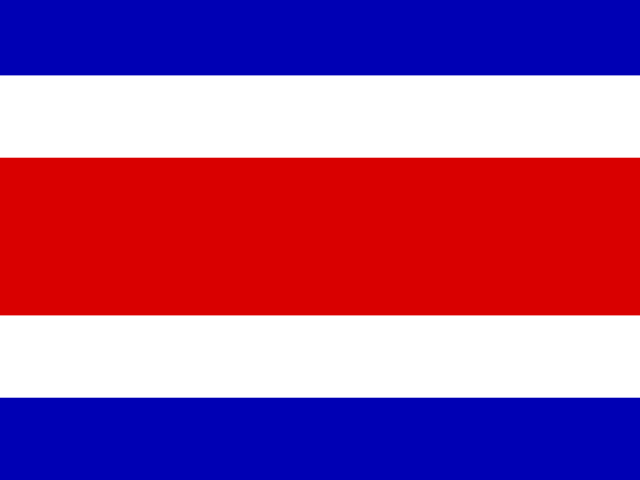
Period:
(1848—1948)
Currency:
(1863—1896)
Demonetization: 14 August 1900
Total mintage: 71,921
Material
References
KM: #Click to copy to clipboard114
Numista: #17164
Value
Bullion value: $1070.85
Obverse
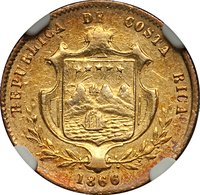
Description:
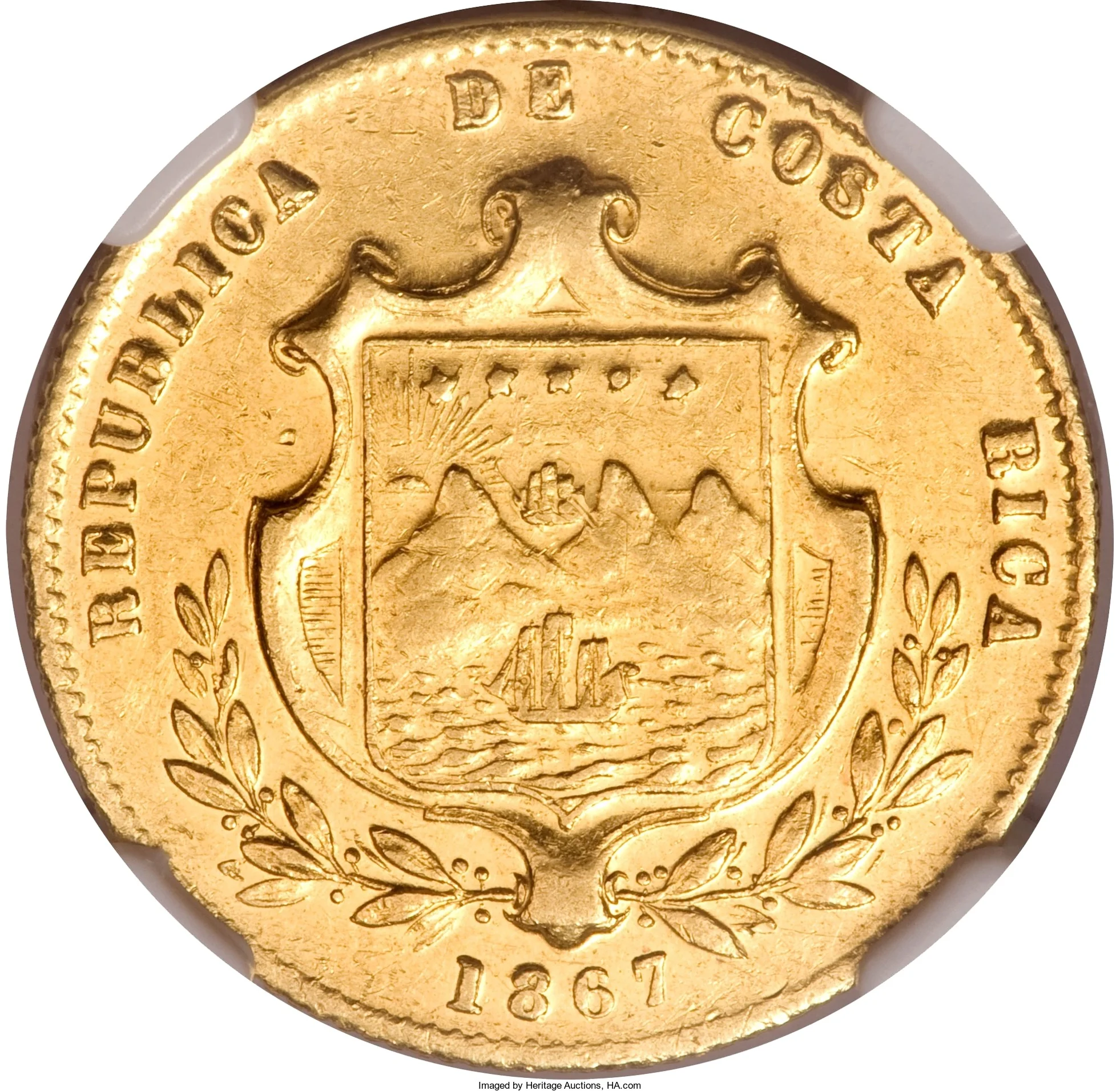
Coat of arms, legend above, date below.
Inscription:
REPUBLICA DE COSTA RICA
1867
1867
Translation:
REPUBLIC OF COSTA RICA
1867
1867
Script: Latin
Language: Spanish
Engraver: Guillermo Witting
Reverse
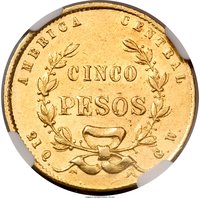
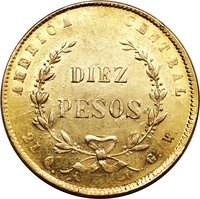
Description:
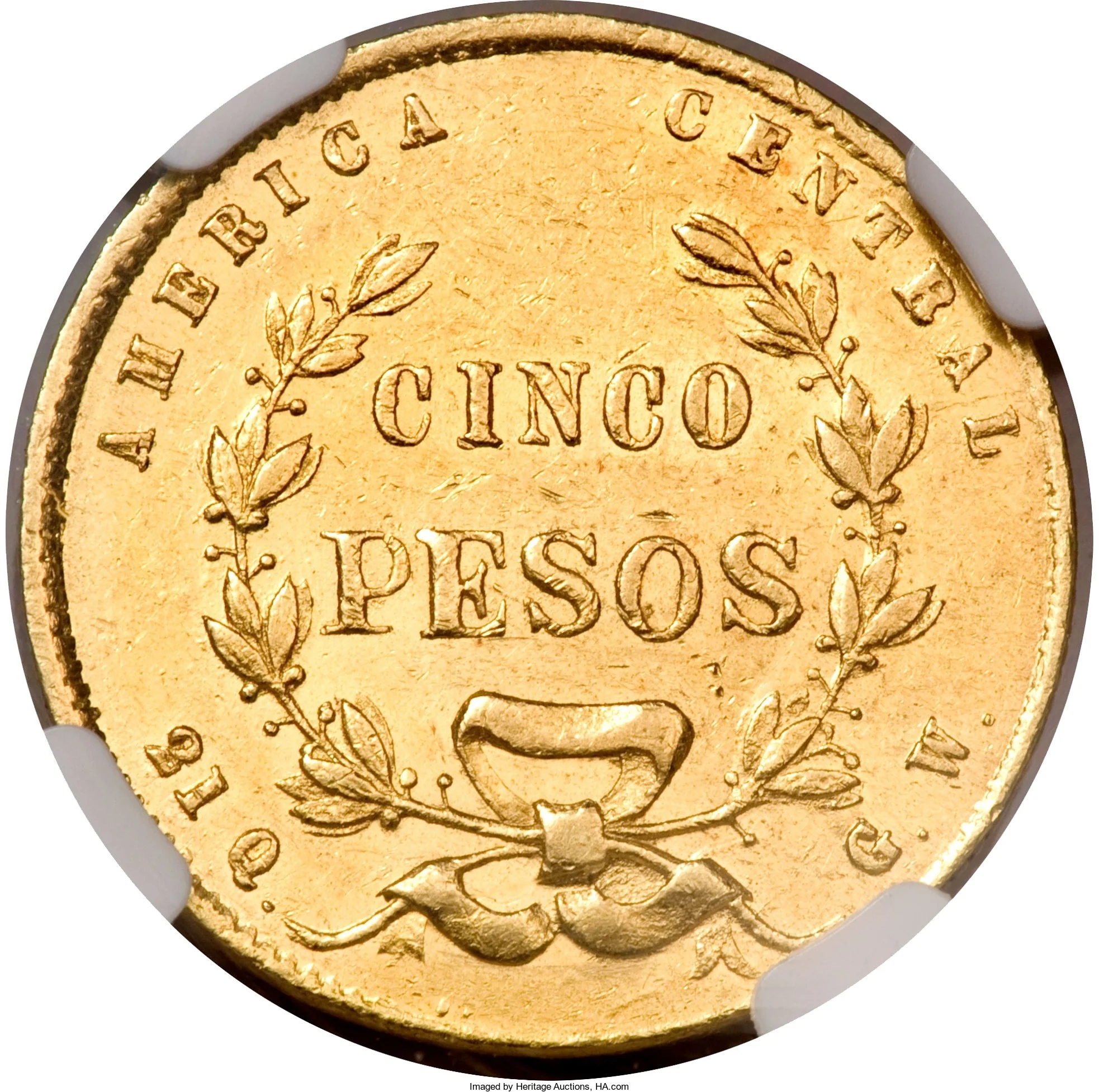
Wreath with value. Top: legend. Bottom: fineness and assayer's initials.
Inscription:
AMERICA CENTRAL
CINCO
PESOS
21 Q G. W.
CINCO
PESOS
21 Q G. W.
Translation:
CENTRAL AMERICA
FIVE
PESOS
21 Q G. W.
FIVE
PESOS
21 Q G. W.
Script: Latin
Language: Spanish
Engraver: Guillermo Witting
Edge
Categories
| Symbols> Coat of Arms |
| Symbol> Wreath |
Mints
| Name | Mark |
|---|---|
| Casa Nacional de Moneda de Costa Rica | — |
Mintings
| Year | Mint Mark | Mintage | Quality | Collection |
|---|---|---|---|---|
| 1867 | — | 38,734 | ||
| 1868 | — | 6,752 | ||
| 1869 | — | 11,004 | ||
| 1870 | — | 15,431 |
Historical background
In 1867, Costa Rica’s currency situation was characterized by significant disorder and fragmentation, a legacy of the colonial era and early independence. The country lacked a unified national coinage and instead operated with a complex mosaic of circulating mediums. These included worn and clipped Spanish colonial coins, coins from other Latin American nations (especially Peruvian and Chilean silver), and even privately issued tokens from local haciendas and merchants. The most common unit of account was the peso, but its actual value in metal content and exchange rate could vary confusingly. This monetary anarchy hindered commerce, facilitated fraud, and reflected the young nation's ongoing struggle to establish strong, centralized economic institutions.
The government of President José María Castro Madriz recognized this problem and was actively seeking reform. Efforts were focused on moving Costa Rica toward the gold standard, following the trend of more economically advanced nations. A pivotal step was the Coinage Law of April 1867, which authorized the creation of a new national currency. The law defined the Costa Rican gold peso (peso de oro) as the standard unit, subdivided into 100 centavos, and planned for the minting of new gold and silver coins in denominations like the 2, 5, 10, and 20 peso pieces. This legislation was a clear attempt to impose order, stabilize value, and foster both domestic confidence and foreign trade.
However, the currency situation in 1867 remained one of transition rather than resolution. The ambitious plans set forth by law faced practical delays; the first new gold coins would not be minted until 1870, and even then, in limited quantities. Consequently, for the remainder of the 1860s, the chaotic circulation of old and foreign coins persisted alongside the gradual and partial introduction of the new system. Thus, 1867 stands as a critical turning point—the year Costa Rica legally defined its modern monetary system, yet still grappled with the tangible realities of a disordered and multi-sourced currency in daily use.
The government of President José María Castro Madriz recognized this problem and was actively seeking reform. Efforts were focused on moving Costa Rica toward the gold standard, following the trend of more economically advanced nations. A pivotal step was the Coinage Law of April 1867, which authorized the creation of a new national currency. The law defined the Costa Rican gold peso (peso de oro) as the standard unit, subdivided into 100 centavos, and planned for the minting of new gold and silver coins in denominations like the 2, 5, 10, and 20 peso pieces. This legislation was a clear attempt to impose order, stabilize value, and foster both domestic confidence and foreign trade.
However, the currency situation in 1867 remained one of transition rather than resolution. The ambitious plans set forth by law faced practical delays; the first new gold coins would not be minted until 1870, and even then, in limited quantities. Consequently, for the remainder of the 1860s, the chaotic circulation of old and foreign coins persisted alongside the gradual and partial introduction of the new system. Thus, 1867 stands as a critical turning point—the year Costa Rica legally defined its modern monetary system, yet still grappled with the tangible realities of a disordered and multi-sourced currency in daily use.
✨ Legendary