

50 Centavos – Costa Rica
Costa Rica
Context
Years: 1865–1875
Issuer: Costa Rica 
Period:
(1848—1948)
Currency:
(1863—1896)
Demonetization: 24 October 1896
Total mintage: 226,289
Material
References
KM: #Click to copy to clipboard112
Numista: #19483
Value
Bullion value: $26.83
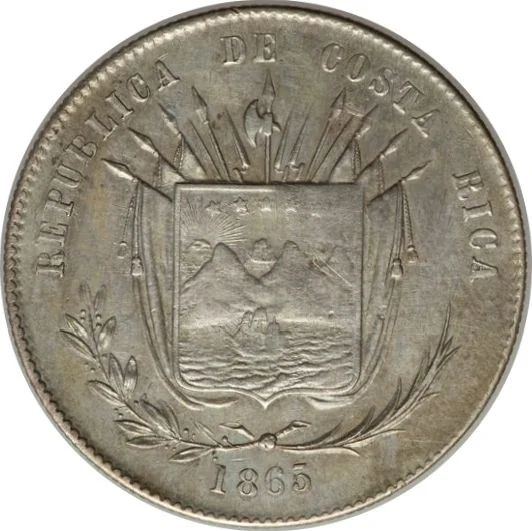
Obverse
Description:
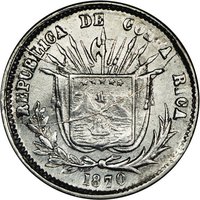
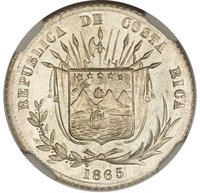
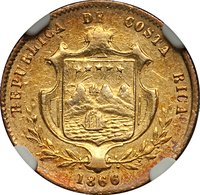
Coat of arms with wreath, legend above and date below.
Inscription:
REPUBLICA DE COSTA RICA
1865
1865
Translation:
REPUBLIC OF COSTA RICA
1865
1865
Script: Latin
Language: Spanish
Engraver: Guillermo Witting
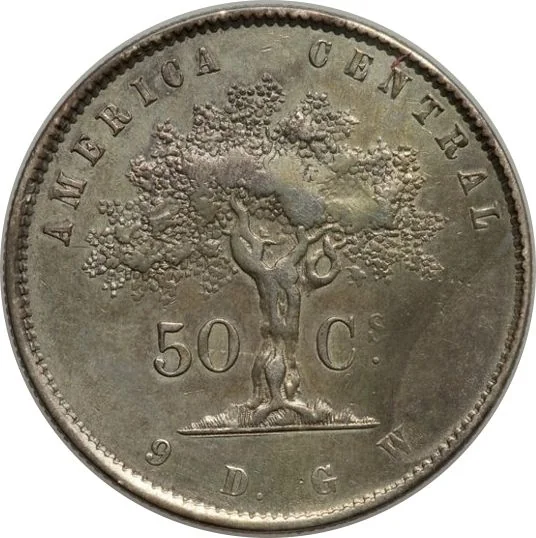
Reverse
Description:
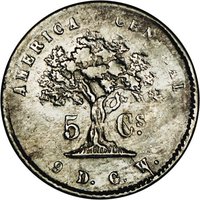
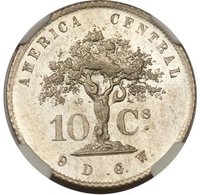
Tree divides value.
Legend above.
Fineness and initials below.
Legend above.
Fineness and initials below.
Inscription:
AMERICA CENTRAL
50 Cs
9 D. G W
50 Cs
9 D. G W
Translation:
Central America
50 Centimos
By the Grace of God, William
50 Centimos
By the Grace of God, William
Script: Latin
Language: Spanish
Engraver: Guillermo Witting
Edge
Reeded
Categories
| Symbols> Coat of Arms |
| Plant> Tree |
Mints
| Name | Mark |
|---|---|
| Casa Nacional de Moneda de Costa Rica | — |
Mintings
| Year | Mint Mark | Mintage | Quality | Collection |
|---|---|---|---|---|
| 1865 | — | 29,005 | ||
| 1866 | — | 116,705 | ||
| 1867 | — | 5,168 | ||
| 1870 | — | 6,267 | ||
| 1872 | — | — | ||
| 1875 | — | 69,144 |
Historical background
In 1865, Costa Rica’s currency situation was characterized by significant instability and complexity, a legacy of the colonial era and early independence. The country lacked a unified national coinage, leading to a chaotic circulation of a wide variety of foreign coins. Spanish colonial reales, Peruvian pesos, Chilean condors, and French francs all circulated simultaneously, their values fluctuating based on metal content and wear. This monetary anarchy created constant difficulties for commerce, as merchants and citizens had to navigate inconsistent exchange rates and verify the authenticity and weight of each coin, hindering economic growth and government revenue collection.
The government, recognizing this problem, had taken a definitive step toward reform just a few years prior. In 1850, under the administration of Juan Rafael Mora Porras, Costa Rica had opened the Casa de la Moneda (the Mint) and begun striking its own national coins, the peso and its subdivision the real. However, by 1865, this new national coinage had not yet displaced the entrenched foreign currencies. The limited minting capacity and the sheer volume of foreign specie in circulation meant that the monetary system remained a hybrid and unreliable one. The state’s finances were further strained by debts from recent infrastructure projects, like the railroad, increasing the urgency for a stable and sovereign currency system.
Consequently, the monetary landscape in 1865 was one of transition and frustration. While the foundational tools for a national currency existed with the establishment of the mint, the practical reality was a disjointed and inefficient multi-currency system. This environment underscored the need for stronger central banking authority and more aggressive withdrawal of foreign coins, a process that would continue to be a central challenge for the Costa Rican state throughout the rest of the 19th century as it sought to achieve true monetary sovereignty and economic modernization.
The government, recognizing this problem, had taken a definitive step toward reform just a few years prior. In 1850, under the administration of Juan Rafael Mora Porras, Costa Rica had opened the Casa de la Moneda (the Mint) and begun striking its own national coins, the peso and its subdivision the real. However, by 1865, this new national coinage had not yet displaced the entrenched foreign currencies. The limited minting capacity and the sheer volume of foreign specie in circulation meant that the monetary system remained a hybrid and unreliable one. The state’s finances were further strained by debts from recent infrastructure projects, like the railroad, increasing the urgency for a stable and sovereign currency system.
Consequently, the monetary landscape in 1865 was one of transition and frustration. While the foundational tools for a national currency existed with the establishment of the mint, the practical reality was a disjointed and inefficient multi-currency system. This environment underscored the need for stronger central banking authority and more aggressive withdrawal of foreign coins, a process that would continue to be a central challenge for the Costa Rican state throughout the rest of the 19th century as it sought to achieve true monetary sovereignty and economic modernization.
⭐ Rare