

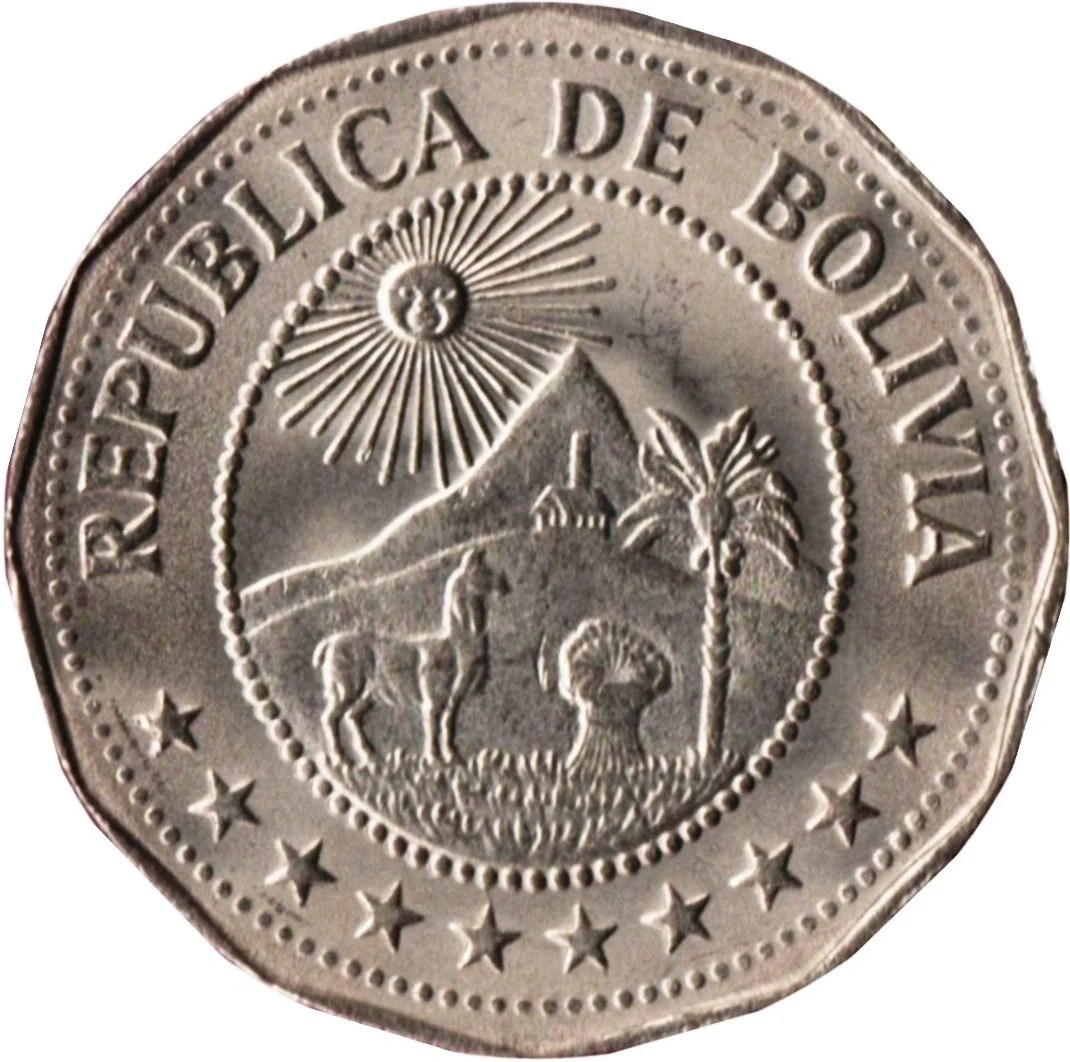
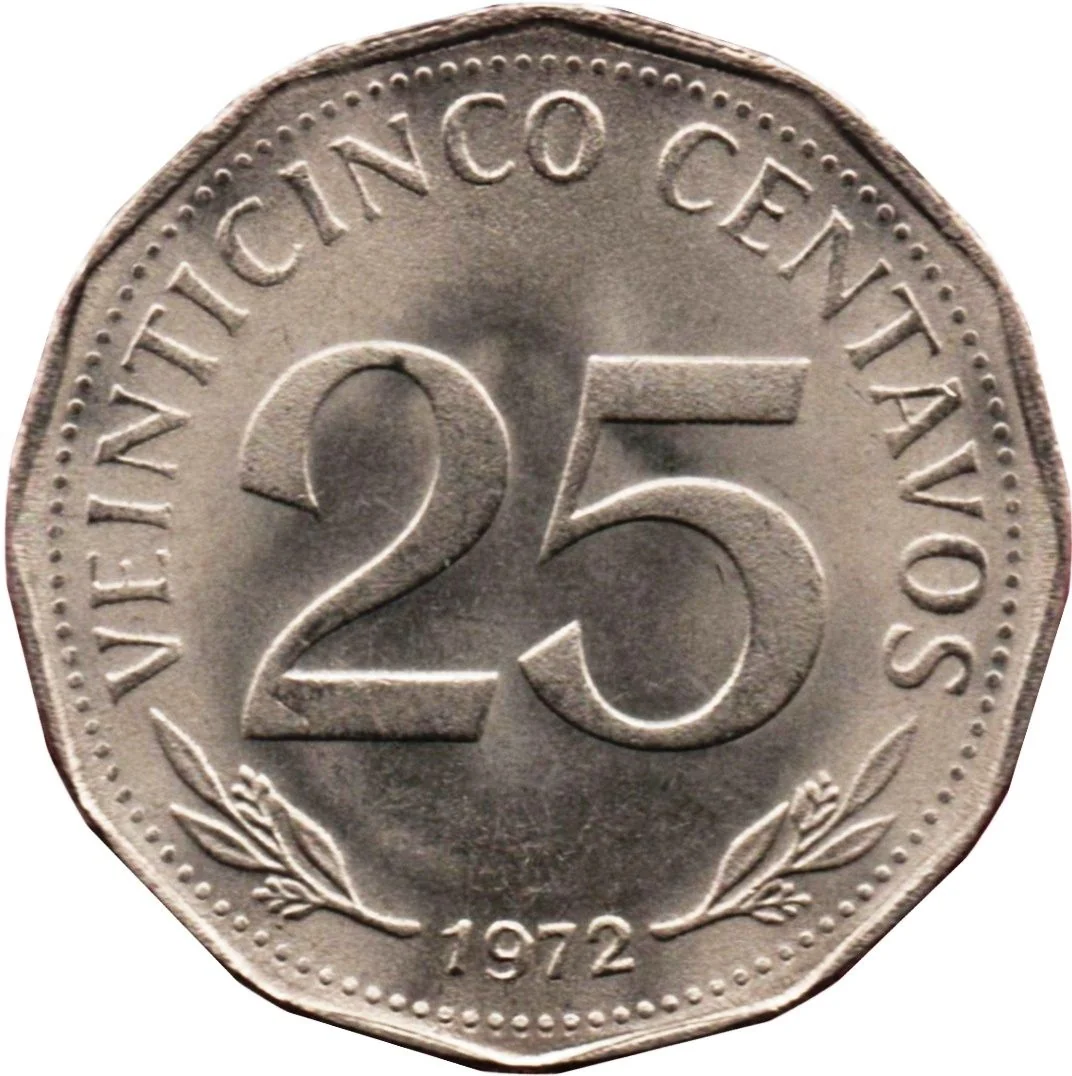
25 centavos – Bolivia
Add to wishlist
Bolivia
Context
Years: 1971–1972
Issuer: Bolivia
Period:
(1825—2009)
Currency:
(1963—1986)
Demonetization: 1987
Total mintage: 9,998,000
Material
Diameter: 23 mm
Weight: 3.5 g
Thickness: 2 mm
Shape: Dodecagonal
Technique: Milled
Alignment: Medal alignment
flip
References
KM: #
Numista: #4906
Value
Exchange value: 0.25 BOP
Obverse
Reverse
Edge
Plain
Mints
| Name | Mark |
|---|---|
| VDM Metals / Vereinigte Deutsche Metallwerke | — |
Mintings
| Year | Mint Mark | Mintage | Quality | Collection |
|---|---|---|---|---|
| 1971 | — | — | ||
| 1972 | — | 9,998,000 |
Historical background
In 1971, Bolivia's currency situation was characterized by chronic instability and inflationary pressures, rooted in decades of political turbulence and economic mismanagement. The country operated under the Bolivian peso (BOB), which had been devalued repeatedly since the 1950s. The economy was heavily dependent on tin exports, and fiscal deficits were routinely financed by money creation from the Central Bank, leading to a persistent erosion of purchasing power. This environment of "stagflation"—stagnant production coupled with rising prices—created severe hardship for the population and undermined confidence in the national currency.
The political upheaval of August 1971, which saw the overthrow of left-leaning President Juan José Torres by the right-wing military coup of Colonel Hugo Banzer Suárez, directly impacted monetary policy. The Torres government had pursued populist measures, including wage increases and subsidies, which further strained public finances and exacerbated inflationary pressures. Upon taking power, the Banzer regime immediately sought to stabilize the economy and attract foreign investment, aligning itself with the United States and Brazil. A key early focus was on curbing hyperinflationary tendencies and securing international loans, which required attempts to impose greater fiscal and monetary discipline.
Ultimately, the structural weaknesses of Bolivia's mono-export economy and deep-seated fiscal problems proved insurmountable in the short term. While the Banzer administration initially slowed inflation, the fundamental practice of deficit financing continued. The peso remained fragile throughout the year, setting the stage for the even more severe economic crises and hyperinflation that would cripple the country in the early-to-mid-1980s, necessitating the dramatic currency reform that introduced the boliviano in 1987.
The political upheaval of August 1971, which saw the overthrow of left-leaning President Juan José Torres by the right-wing military coup of Colonel Hugo Banzer Suárez, directly impacted monetary policy. The Torres government had pursued populist measures, including wage increases and subsidies, which further strained public finances and exacerbated inflationary pressures. Upon taking power, the Banzer regime immediately sought to stabilize the economy and attract foreign investment, aligning itself with the United States and Brazil. A key early focus was on curbing hyperinflationary tendencies and securing international loans, which required attempts to impose greater fiscal and monetary discipline.
Ultimately, the structural weaknesses of Bolivia's mono-export economy and deep-seated fiscal problems proved insurmountable in the short term. While the Banzer administration initially slowed inflation, the fundamental practice of deficit financing continued. The peso remained fragile throughout the year, setting the stage for the even more severe economic crises and hyperinflation that would cripple the country in the early-to-mid-1980s, necessitating the dramatic currency reform that introduced the boliviano in 1987.
🌱 Common