

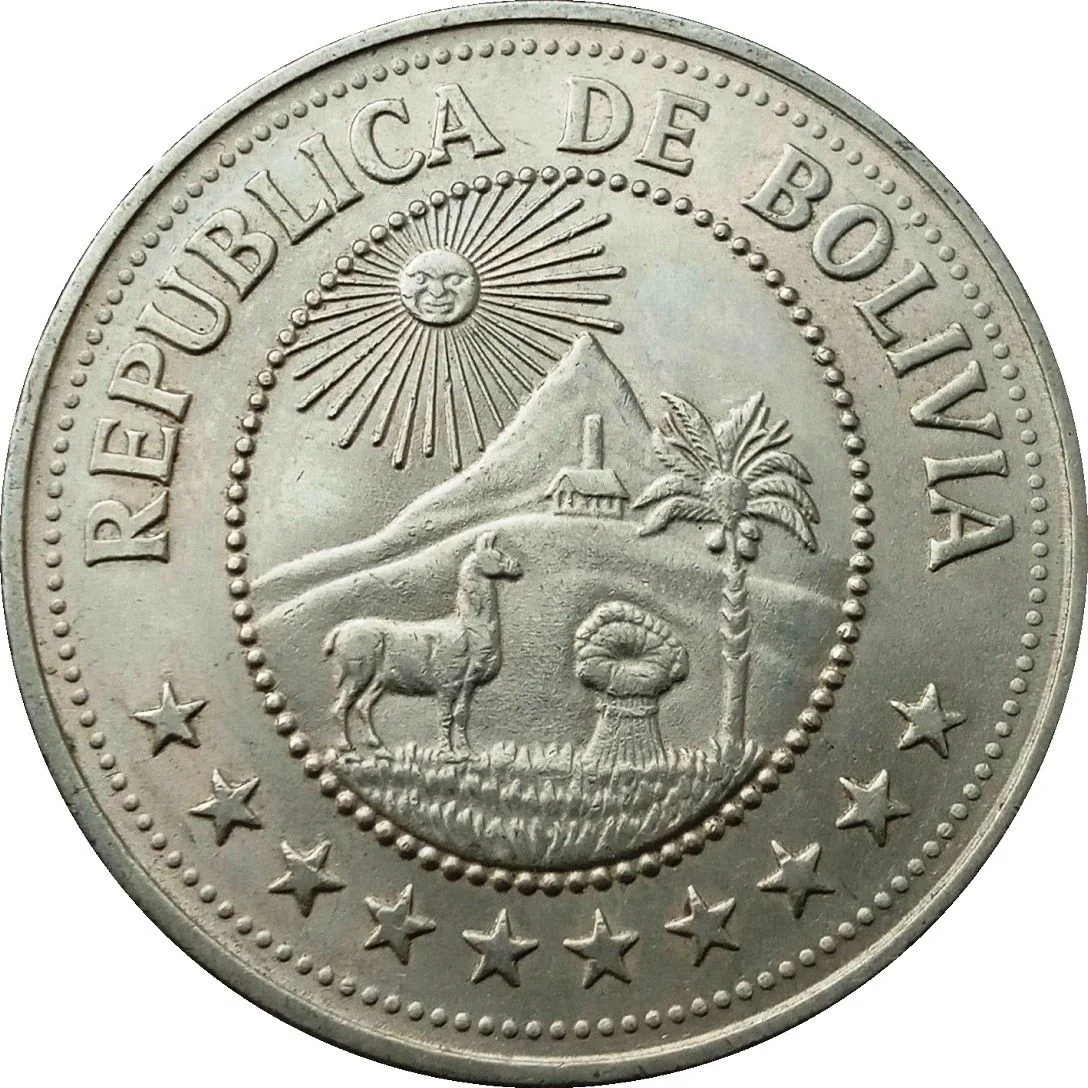
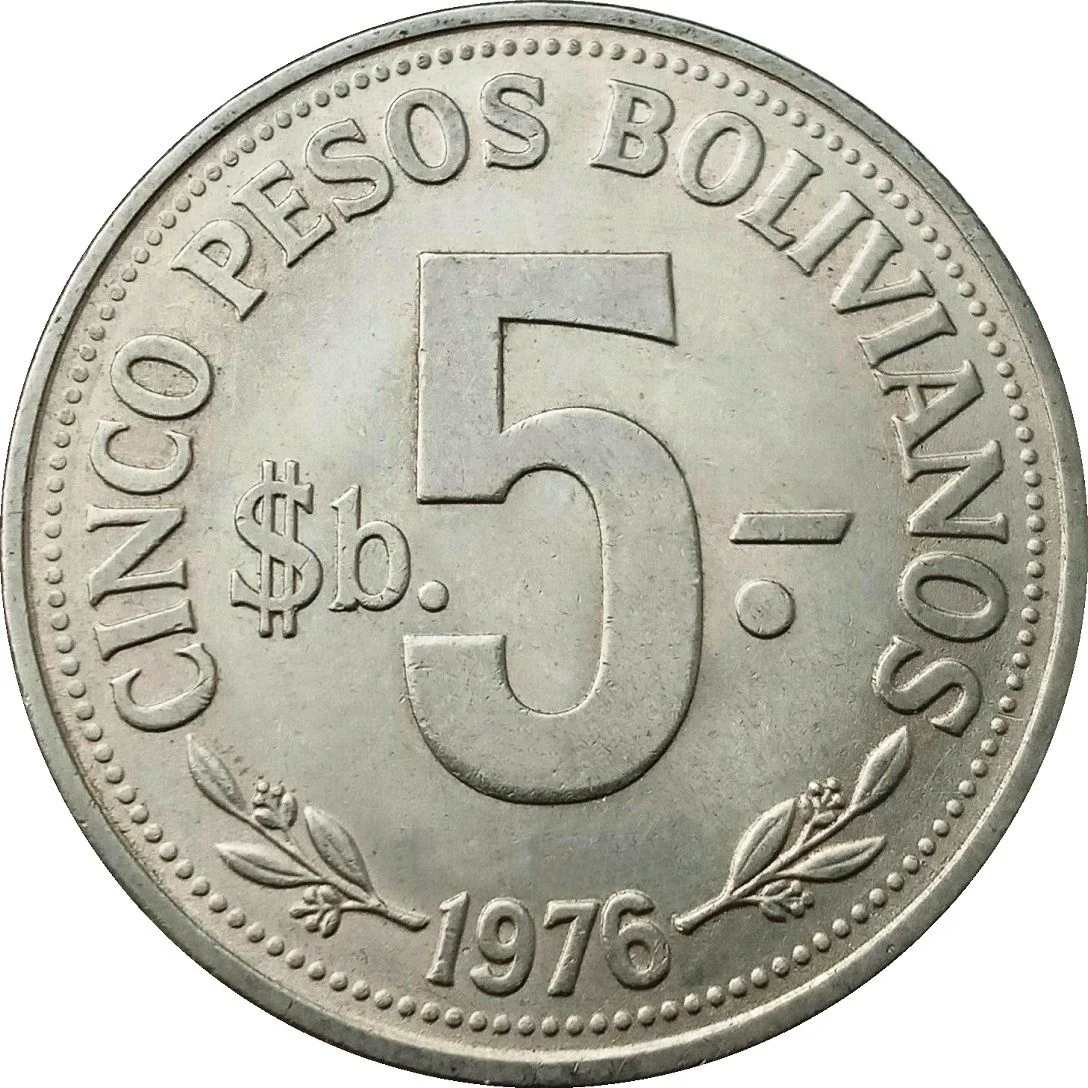
5 pesos bolivianos – Bolivia
Add to wishlist
Bolivia
Obverse
Reverse
Edge
Milled
Mints
| Name | Mark |
|---|---|
| VDM Metals / Vereinigte Deutsche Metallwerke | — |
Mintings
| Year | Mint Mark | Mintage | Quality | Collection |
|---|---|---|---|---|
| 1976 | — | 20,000,000 | ||
| 1978 | — | 10,000,000 | ||
| 1980 | — | 5,231,295 |
Historical background
In 1976, Bolivia's currency situation was characterized by the dominance of the peso boliviano (BOB), which was experiencing significant inflationary pressures and economic instability. The country was under the military dictatorship of Hugo Banzer Suárez, who had seized power in 1971. His regime pursued a state-led development model heavily reliant on external borrowing and a boom in commodity exports, particularly natural gas, tin, and other minerals. However, this growth was uneven and masked underlying structural weaknesses, including a large fiscal deficit and a growing external debt.
The peso boliviano, while officially pegged to the U.S. dollar, was subject to a complex system of multiple exchange rates. This system created a distorted economy where a preferential official rate was available for essential imports and debt servicing, while a less favorable "financial" or parallel market rate applied to other transactions. This duality encouraged corruption and black-market activities, as those with access to the preferential dollar rate could profit significantly. Despite the peg, persistent inflation—fueled by deficit spending and global oil crisis impacts—eroded the currency's real value, creating a constant pressure on the fixed exchange regime.
Overall, the currency scenario in 1976 was one of controlled fragility. The Banzer government maintained a superficial stability through capital controls and borrowing, but the economic foundations were unsound. The overvalued official exchange rate hurt non-hydrocarbon exports and drained foreign reserves, setting the stage for the profound economic crises that would engulf Bolivia in the early 1980s, culminating in hyperinflation and the eventual replacement of the peso boliviano with the boliviano (BOB) in 1987 after a period of dramatic devaluation.
The peso boliviano, while officially pegged to the U.S. dollar, was subject to a complex system of multiple exchange rates. This system created a distorted economy where a preferential official rate was available for essential imports and debt servicing, while a less favorable "financial" or parallel market rate applied to other transactions. This duality encouraged corruption and black-market activities, as those with access to the preferential dollar rate could profit significantly. Despite the peg, persistent inflation—fueled by deficit spending and global oil crisis impacts—eroded the currency's real value, creating a constant pressure on the fixed exchange regime.
Overall, the currency scenario in 1976 was one of controlled fragility. The Banzer government maintained a superficial stability through capital controls and borrowing, but the economic foundations were unsound. The overvalued official exchange rate hurt non-hydrocarbon exports and drained foreign reserves, setting the stage for the profound economic crises that would engulf Bolivia in the early 1980s, culminating in hyperinflation and the eventual replacement of the peso boliviano with the boliviano (BOB) in 1987 after a period of dramatic devaluation.
🌱 Very Common