

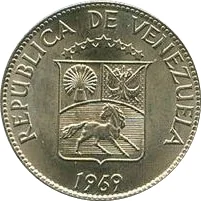
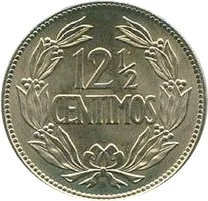
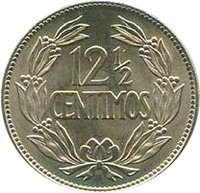
12½ Centimos – Venezuela
Venezuela
Context
Year: 1969
Issuer: Venezuela 
Period:
(1953—1999)
Currency:
(1879—2007)
Demonetized: Yes
Total mintage: 2,000,000
Material
Diameter: 23 mm
Weight: 5 g
Thickness: 1.4 mm
Shape: Round
Composition: Copper-nickel
Technique: Milled
Alignment: Coin alignment
flip
References
Y: #Click to copy to clipboardA39
Numista: #48673
Value
Exchange value: 0.125 VEB
Obverse
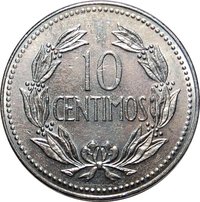
Reverse
Edge
Plain
Mints
| Name | Mark |
|---|---|
| Royal Mint of Madrid | — |
Mintings
| Year | Mint Mark | Mintage | Quality | Collection |
|---|---|---|---|---|
| 1969 | — | 2,000,000 |
Historical background
In 1969, Venezuela's currency, the bolívar, was a symbol of national pride and economic stability, standing in stark contrast to the hyperinflation and crisis that would define the country decades later. This period fell within the era of the "Punto Fijo" democracy, following the 1958 pact that ushered in a stable two-party system. The economy was robust, fueled by historically high and stable oil prices, which provided the government with substantial foreign exchange reserves. The bolívar was not only strong domestically but was internationally respected, with a fixed exchange rate of 4.30 bolívares to the US dollar—a rate that had remained unchanged since 1964 and would hold until 1983.
This monetary stability was directly managed by the Central Bank of Venezuela (BCV), which operated under a system of exchange controls established in 1960 via the Regime of Differential Exchange Rates (RECADI). This system created a tiered currency market: a preferential rate for essential imports and government debt, and a free market rate for other transactions. In 1969, this mechanism effectively managed the influx of petrodollars, prevented excessive currency appreciation that could harm non-oil exports, and helped control inflation. The economy was so dollar-rich that Venezuela was a creditor nation and a regional financial hub, with the bolívar often used as a de facto reserve currency in parts of the Caribbean.
Therefore, the currency situation in 1969 was one of managed strength and confidence. The bolívar's value was underpinned by booming oil revenues and conservative fiscal management, which allowed the BCV to maintain ample international reserves. There was no concept of a "currency crisis"; instead, the primary challenges were related to managing the wealth from the oil boom (a phenomenon known as "Dutch Disease") and ensuring that economic growth translated into broader development. This era represents the peak of the bolívar's historic strength, a benchmark against which all subsequent Venezuelan currency turmoil would be measured.
This monetary stability was directly managed by the Central Bank of Venezuela (BCV), which operated under a system of exchange controls established in 1960 via the Regime of Differential Exchange Rates (RECADI). This system created a tiered currency market: a preferential rate for essential imports and government debt, and a free market rate for other transactions. In 1969, this mechanism effectively managed the influx of petrodollars, prevented excessive currency appreciation that could harm non-oil exports, and helped control inflation. The economy was so dollar-rich that Venezuela was a creditor nation and a regional financial hub, with the bolívar often used as a de facto reserve currency in parts of the Caribbean.
Therefore, the currency situation in 1969 was one of managed strength and confidence. The bolívar's value was underpinned by booming oil revenues and conservative fiscal management, which allowed the BCV to maintain ample international reserves. There was no concept of a "currency crisis"; instead, the primary challenges were related to managing the wealth from the oil boom (a phenomenon known as "Dutch Disease") and ensuring that economic growth translated into broader development. This era represents the peak of the bolívar's historic strength, a benchmark against which all subsequent Venezuelan currency turmoil would be measured.
💎 Extremely Rare