

2 Bolivars – Venezuela
Venezuela
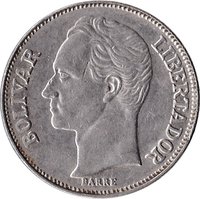
Obverse
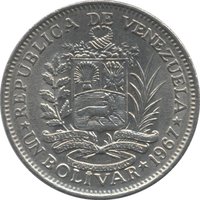
Description:
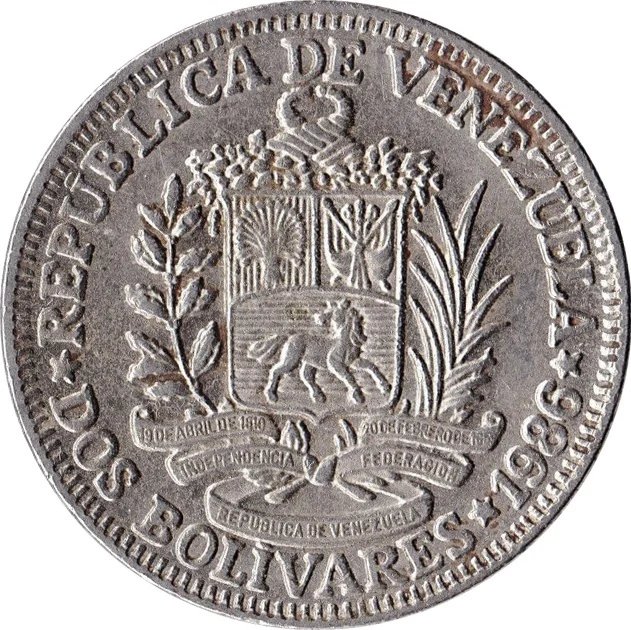
Coat of arms with legend above, value and date below.
Inscription:
★ REPÚBLICA DE VENEZUELA ★
19 DE ABRIL DE 1810
INDEPENDENCIA
20 DE FEBRERO DE 1859
FEDERACIÓN
REPÚBLICA DE VENEZUELA
DOS BOLÍVARES ★ 1986
19 DE ABRIL DE 1810
INDEPENDENCIA
20 DE FEBRERO DE 1859
FEDERACIÓN
REPÚBLICA DE VENEZUELA
DOS BOLÍVARES ★ 1986
Translation:
★ REPUBLIC OF VENEZUELA ★
APRIL 19, 1810
INDEPENDENCE
FEBRUARY 20, 1859
FEDERATION
REPUBLIC OF VENEZUELA
TWO BOLIVARES ★ 1986
APRIL 19, 1810
INDEPENDENCE
FEBRUARY 20, 1859
FEDERATION
REPUBLIC OF VENEZUELA
TWO BOLIVARES ★ 1986
Script: Latin
Language: Spanish
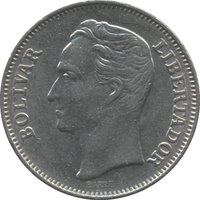
Reverse
Edge
Reeded
Categories
| Symbol> Cornucopia |
| Animal> Horse |
| Person> Politician |
| Symbols> Coat of Arms |
| Person> Military leader |
Mints
| Name | Mark |
|---|---|
| Caracas | — |
| Royal Mint (Tower Hill) | — |
| Vereinigte Deutsche Nickelwerke | — |
Mintings
| Year | Mint Mark | Mintage | Quality | Collection |
|---|---|---|---|---|
| 1967 | — | 50,000,000 | ||
| 1986 | — | 50,000,000 | ||
| 1986 | — | — | Prooflike | |
| 1988 | — | 80,000,000 |
Historical background
In 1967, Venezuela's currency, the bolívar, was a symbol of national stability and economic strength, standing in stark contrast to the hyperinflation and crisis that would define the country decades later. This period fell within the "Punto Fijo" democratic era, a time of relative political stability following the 1958 overthrow of the military dictatorship. The bolívar was not only strong domestically but was also internationally respected, with a fixed exchange rate pegged to the US dollar at 4.30 bolívares per dollar, a rate established in 1964 and maintained with considerable foreign exchange reserves.
This monetary stability was fundamentally underpinned by the nation's booming oil industry. Venezuela was a global petroleum powerhouse and a founding member of OPEC, with oil revenues fueling massive public works, industrialization, and a growing middle class. The government's fiscal discipline and substantial hard currency inflows from oil exports allowed the Central Bank of Venezuela to confidently back the bolívar's fixed parity. Consequently, the country experienced low inflation and the bolívar was often considered a "hard currency" within Latin America, even circulating in neighboring countries as a preferred medium of exchange.
However, this apparent golden age contained the seeds of future vulnerability. The economy was overwhelmingly dependent on a single commodity, creating a structural weakness. While the fixed exchange rate provided stability, it also masked underlying inflationary pressures from government spending and reduced the competitiveness of non-oil exports. In 1967, these issues were manageable, but the era established a pattern of relying on oil wealth to maintain monetary policy, a dependency that would prove disastrous when oil prices eventually fluctuated and fiscal discipline eroded in later decades.
This monetary stability was fundamentally underpinned by the nation's booming oil industry. Venezuela was a global petroleum powerhouse and a founding member of OPEC, with oil revenues fueling massive public works, industrialization, and a growing middle class. The government's fiscal discipline and substantial hard currency inflows from oil exports allowed the Central Bank of Venezuela to confidently back the bolívar's fixed parity. Consequently, the country experienced low inflation and the bolívar was often considered a "hard currency" within Latin America, even circulating in neighboring countries as a preferred medium of exchange.
However, this apparent golden age contained the seeds of future vulnerability. The economy was overwhelmingly dependent on a single commodity, creating a structural weakness. While the fixed exchange rate provided stability, it also masked underlying inflationary pressures from government spending and reduced the competitiveness of non-oil exports. In 1967, these issues were manageable, but the era established a pattern of relying on oil wealth to maintain monetary policy, a dependency that would prove disastrous when oil prices eventually fluctuated and fiscal discipline eroded in later decades.
🌱 Very Common