

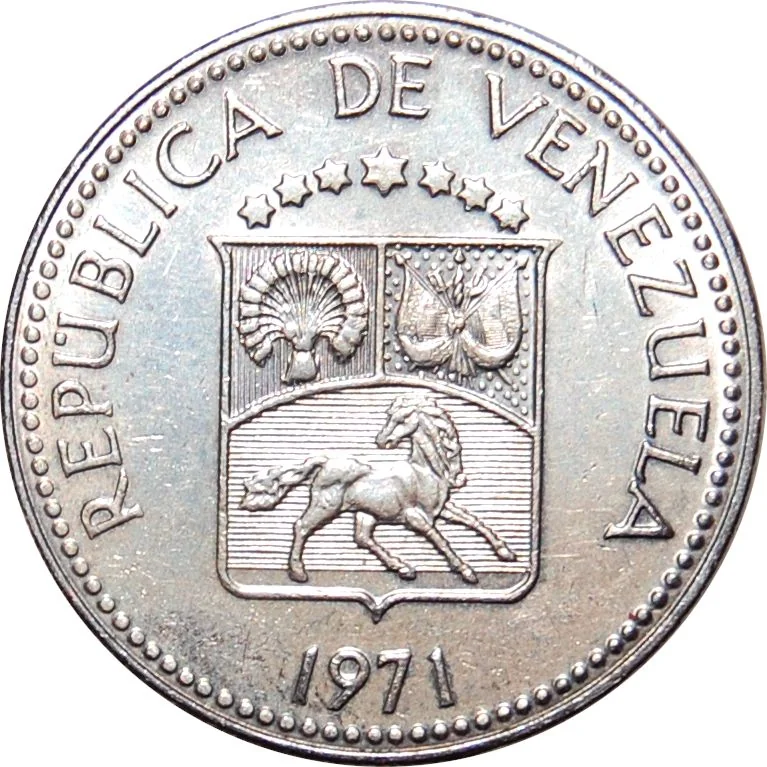
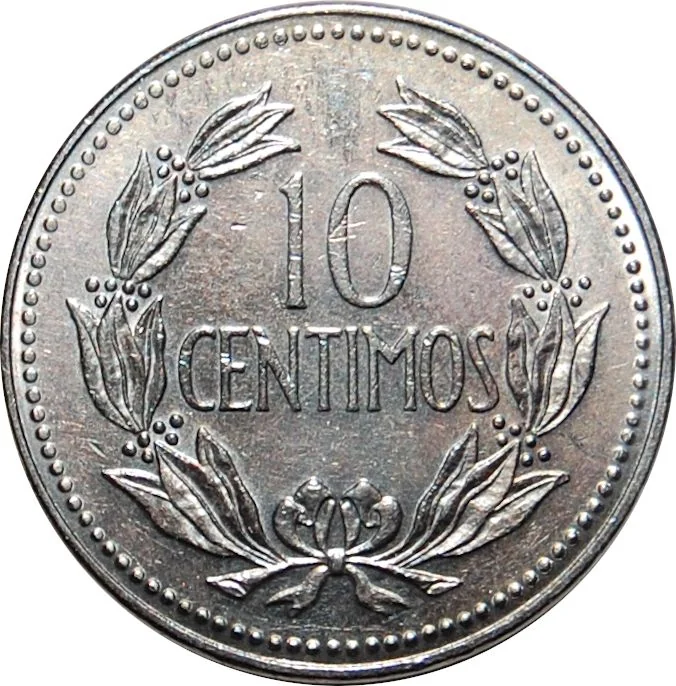
10 centimos – Venezuela
Add to wishlist
Venezuela
Context
Year: 1971
Issuer: Venezuela
Period:
(1953—1999)
Currency:
(1879—2007)
Demonetization: 31 December 2011
Total mintage: 60,000,000
Material
Diameter: 21 mm
Weight: 4 g
Thickness: 1.44 mm
Shape: Round
Composition: Copper-nickel
Technique: Milled
Alignment: Coin alignment
flip
References
Y: #
Numista: #5480
Value
Exchange value: 0.10 VEB
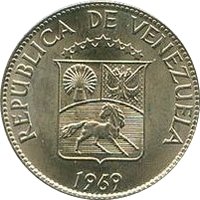
Obverse
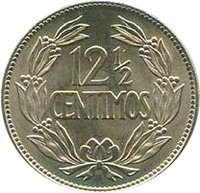
Reverse
Edge
Plain
Mints
| Name | Mark |
|---|---|
| Royal Canadian Mint of Ottawa | — |
Mintings
| Year | Mint Mark | Mintage | Quality | Collection |
|---|---|---|---|---|
| 1971 | — | 60,000,000 |
Historical background
In 1971, Venezuela's currency, the bolívar, was a symbol of national pride and economic stability, firmly pegged to the U.S. dollar at a strong rate of 4.30 bolívares per dollar. This fixed exchange rate, established in 1964, was a cornerstone of the country's economic policy during the Gran Venezuela (Great Venezuela) era, a period of booming prosperity fueled by high oil revenues. The bolívar was not only stable but also internationally respected, even considered a hard currency in some regional transactions, reflecting the country's status as South America's wealthiest and most stable democracy.
This monetary stability was fundamentally underpinned by the nation's vast petroleum wealth. As a founding member of OPEC, Venezuela benefited from steadily rising oil prices and production, which provided the central bank with ample foreign reserves to confidently maintain the dollar peg. The economy was experiencing rapid growth and industrialization, with substantial public investment in infrastructure and social programs. The strong bolívar made imports cheap, fueling a consumer boom and reinforcing a sense of modern prosperity, while strict capital controls were largely unnecessary in this environment of confidence.
However, this enviable position contained the seeds of future vulnerability. The economy was overwhelmingly dependent on a single commodity, making it highly susceptible to global oil price shocks. Furthermore, the fixed exchange rate, while beneficial for stability, began to discourage diversification into non-oil exports by making them more expensive on the global market. While 1971 itself represented the zenith of this stable period, the economic model was already setting the stage for the severe challenges that would follow the oil price collapses and fiscal mismanagement of the coming decades.
This monetary stability was fundamentally underpinned by the nation's vast petroleum wealth. As a founding member of OPEC, Venezuela benefited from steadily rising oil prices and production, which provided the central bank with ample foreign reserves to confidently maintain the dollar peg. The economy was experiencing rapid growth and industrialization, with substantial public investment in infrastructure and social programs. The strong bolívar made imports cheap, fueling a consumer boom and reinforcing a sense of modern prosperity, while strict capital controls were largely unnecessary in this environment of confidence.
However, this enviable position contained the seeds of future vulnerability. The economy was overwhelmingly dependent on a single commodity, making it highly susceptible to global oil price shocks. Furthermore, the fixed exchange rate, while beneficial for stability, began to discourage diversification into non-oil exports by making them more expensive on the global market. While 1971 itself represented the zenith of this stable period, the economic model was already setting the stage for the severe challenges that would follow the oil price collapses and fiscal mismanagement of the coming decades.
🌱 Very Common