

1 venezolano – Venezuela
Add to wishlist
Venezuela
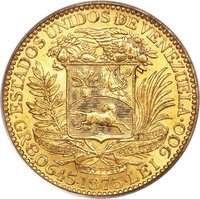
Obverse
Description:
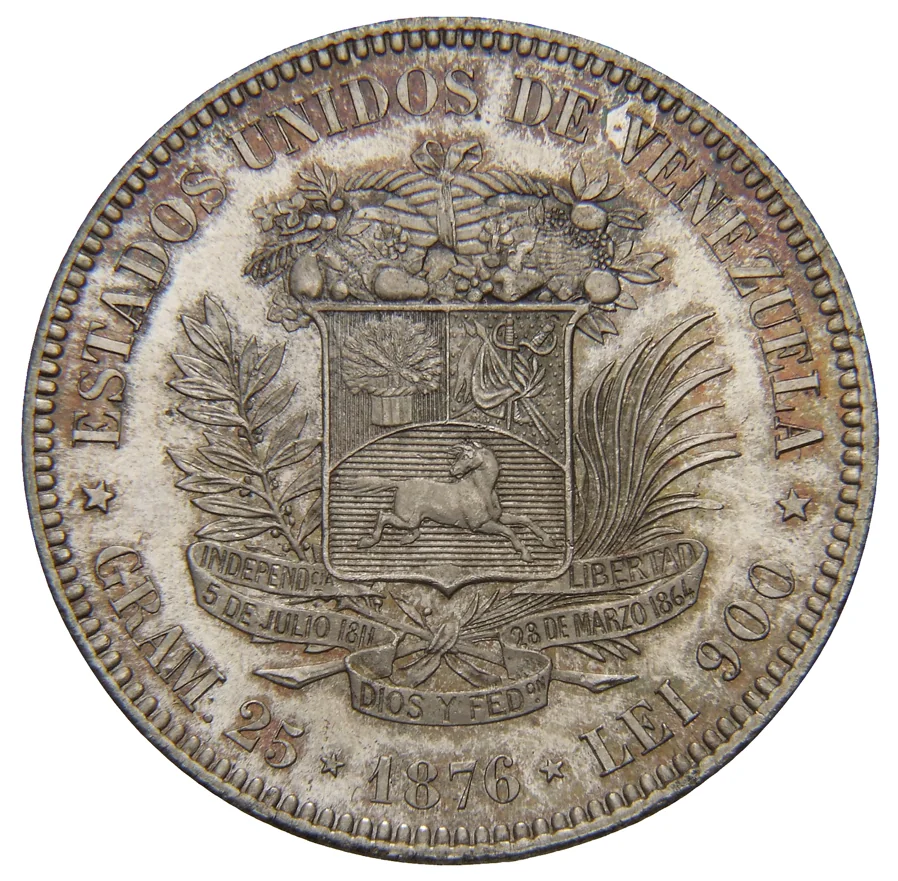
Coat of arms. Legend above. Weight, date, and fineness below.
Inscription:
★ ESTADOS UNIDOS DE VENEZUELA ★
GRAM.25 ★ 1876 ★ LEI 900
GRAM.25 ★ 1876 ★ LEI 900
Translation:
UNITED STATES OF VENEZUELA
25 GRAMS ★ 1876 ★ 900 THOUSANDTHS
25 GRAMS ★ 1876 ★ 900 THOUSANDTHS
Script: Latin
Language: Spanish
Engraver: Désiré-Albert Barre
Reverse
Description:
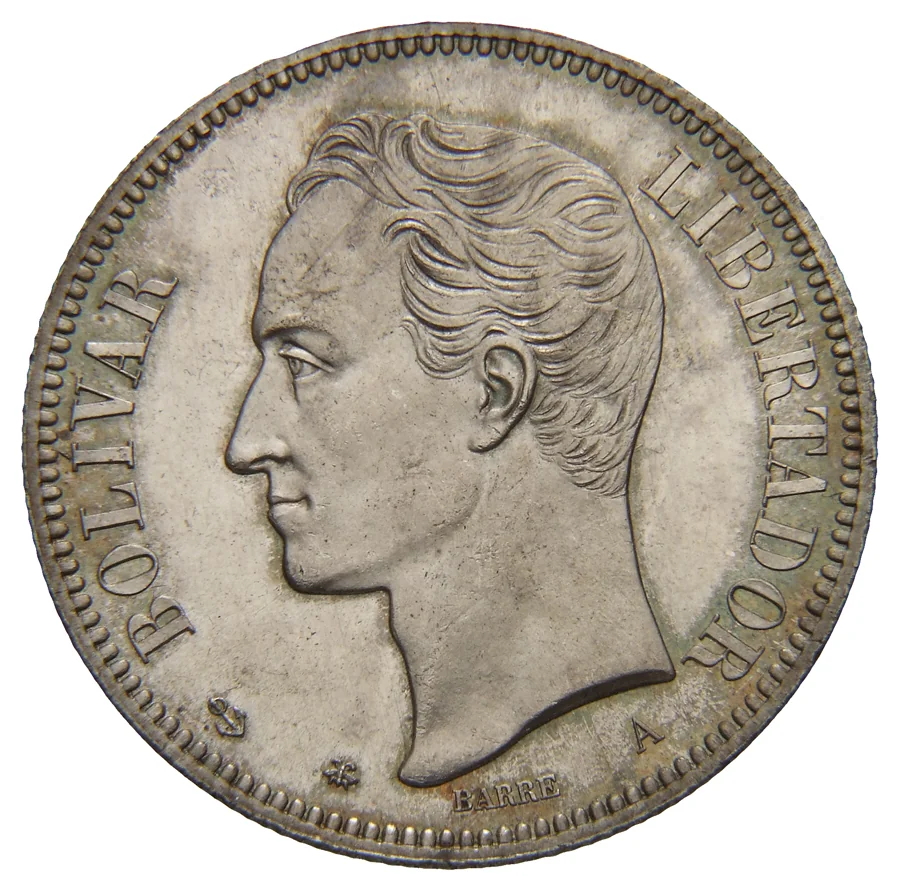
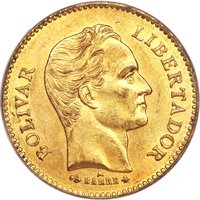
Bust left, flanked by legend. Privy marks, engraver's name, and mint mark below.
Inscription:
BOLÍVAR LIBERTADOR
⚓ * BARRE A
⚓ * BARRE A
Translation:
BOLÍVAR LIBERTADOR
⚓ * BARRE A
⚓ * BARRE A
Script: Latin
Language: Spanish
Engraver: Désiré-Albert Barre
Edge
Reeged
Categories
| Animal> Horse |
| Person> Military leader |
| Person> Politician |
| Symbols> Coat of Arms |
| Symbol> Cornucopia |
Mints
| Name | Mark |
|---|---|
| Monnaie de Paris | A |
Historical background
In 1876, Venezuela's currency situation was characterized by the persistent circulation of a debased silver coinage known as the "venezolano," which had become the de facto standard despite its deteriorating value. Following independence, the nation struggled with a chaotic monetary system inherited from the colonial era, featuring a mix of foreign coins, including Spanish, Colombian, and British currencies. The government of President Antonio Guzmán Blanco, in an effort to modernize and unify the system, had previously enacted the Law of Monetary Reform of 1871. This law aimed to introduce a new decimal-based currency, the "venezolano de oro" (gold venezolano), and establish a bimetallic standard. However, by 1876, the transition was incomplete and problematic.
The core issue was that the promised gold coinage never entered significant circulation due to chronic fiscal deficits and a lack of bullion reserves. Consequently, the silver venezolano, which was minted with a lower intrinsic value than its face value (a form of fiduciary coinage), became overabundant and began to depreciate. This depreciation created a disconnect between the official bimetallic parity and market reality, leading to Gresham's Law in action: "bad money drives out good." Any remaining full-value foreign gold or silver coins were hoarded or exported, leaving the less valuable venezolano as the primary medium of everyday exchange, which eroded public trust in the currency.
This unstable monetary environment in 1876 exacerbated Venezuela's broader economic challenges, hindering both domestic commerce and international trade. The government's inability to enforce its monetary laws or control the money supply reflected its limited fiscal capacity and the economy's dependence on agricultural exports, particularly coffee. The situation underscored the difficulties of nation-building and financial sovereignty in 19th-century Latin America, setting the stage for further monetary experiments and devaluations in the decades to follow under Guzmán Blanco's continued influence.
The core issue was that the promised gold coinage never entered significant circulation due to chronic fiscal deficits and a lack of bullion reserves. Consequently, the silver venezolano, which was minted with a lower intrinsic value than its face value (a form of fiduciary coinage), became overabundant and began to depreciate. This depreciation created a disconnect between the official bimetallic parity and market reality, leading to Gresham's Law in action: "bad money drives out good." Any remaining full-value foreign gold or silver coins were hoarded or exported, leaving the less valuable venezolano as the primary medium of everyday exchange, which eroded public trust in the currency.
This unstable monetary environment in 1876 exacerbated Venezuela's broader economic challenges, hindering both domestic commerce and international trade. The government's inability to enforce its monetary laws or control the money supply reflected its limited fiscal capacity and the economy's dependence on agricultural exports, particularly coffee. The situation underscored the difficulties of nation-building and financial sovereignty in 19th-century Latin America, setting the stage for further monetary experiments and devaluations in the decades to follow under Guzmán Blanco's continued influence.
Series: 1876 Venezuela circulation coins
💎 Very Rare