

5 venezolanos – Venezuela
Add to wishlist
Venezuela
Obverse
Description:
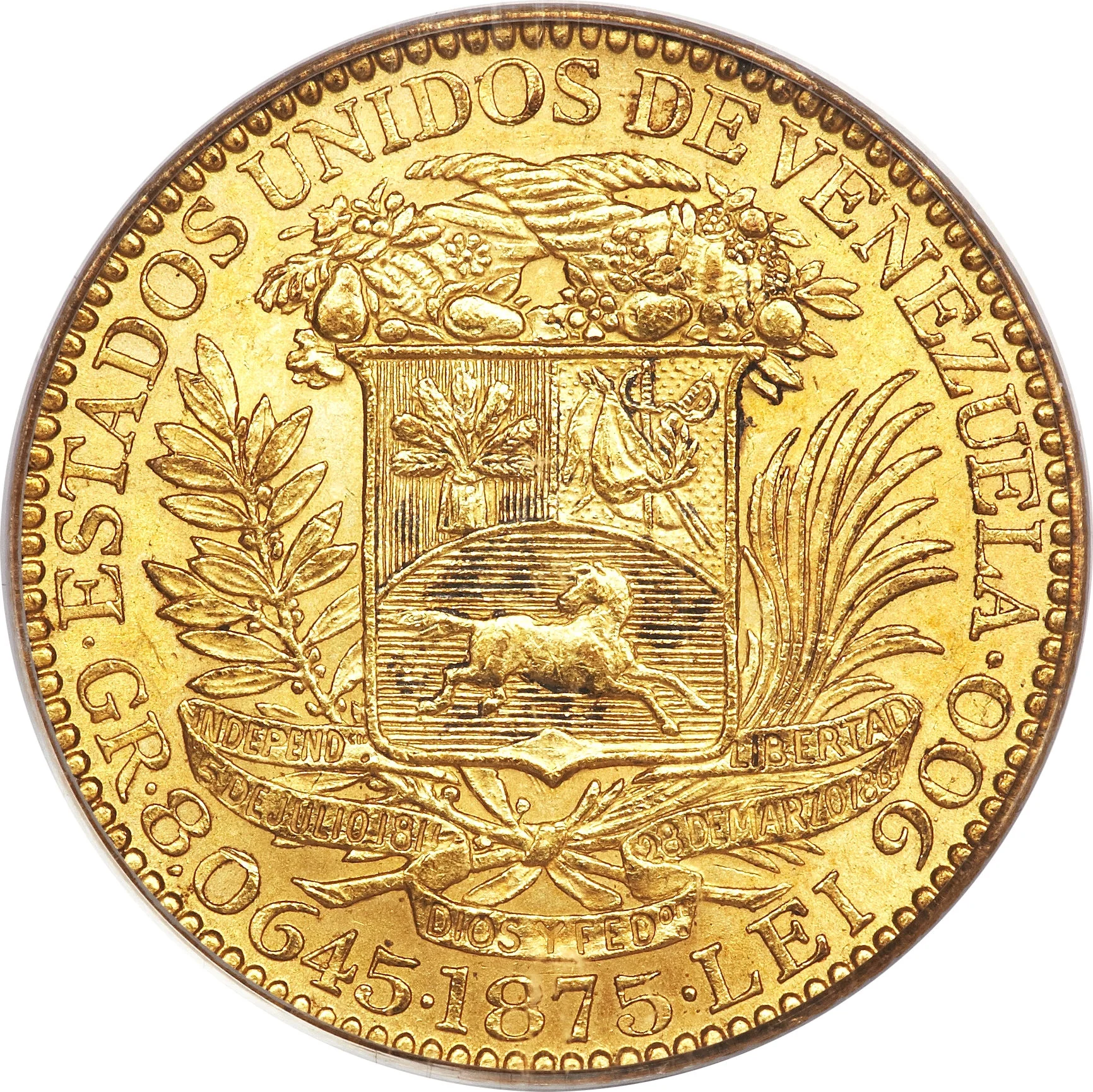
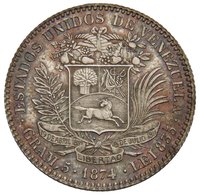
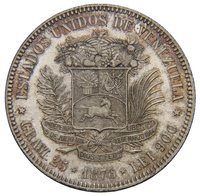
Venezuelan coat of arms flanked by sprigs and cornucopias, with a legend above and mass, date, and purity below.
Inscription:
•ESTADOS UNIDOS DE VENEZUELA•
GR•8.0645•1875•LEI 900
GR•8.0645•1875•LEI 900
Translation:
UNITED STATES OF VENEZUELA
GR•8.0645•1875•LEI 900
GR•8.0645•1875•LEI 900
Script: Latin
Language: Spanish
Engraver: Désiré-Albert Barre
Reverse
Description:
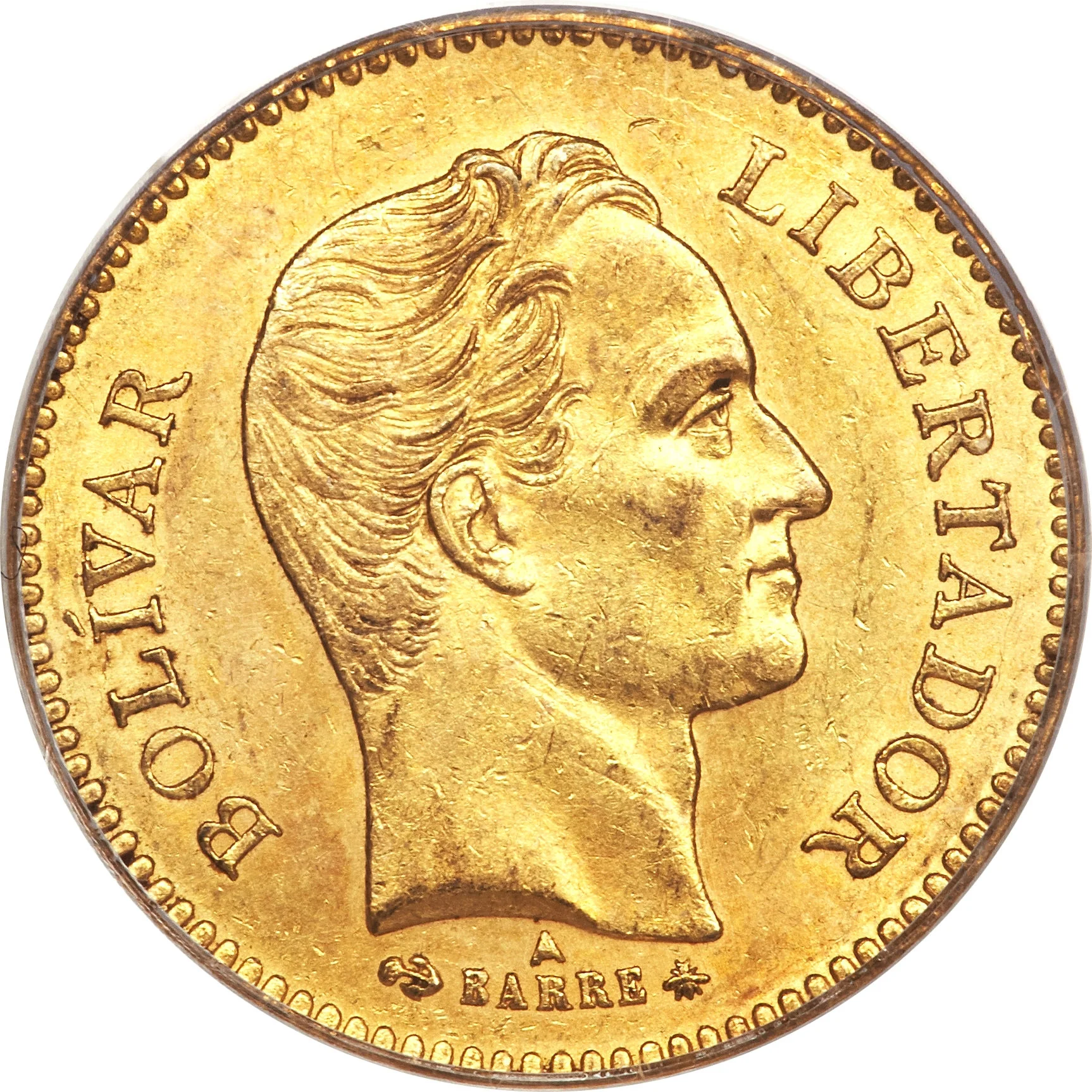
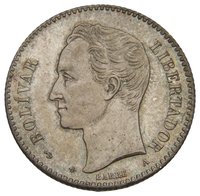
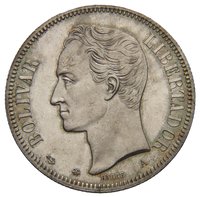
Left-facing bust; legend surrounds, with privy marks, engraver's name, and mintmark below.
Inscription:
BOLÍVAR LIBERTADOR
A
⚓ BARRE *
A
⚓ BARRE *
Translation:
BOLÍVAR LIBERTADOR
ANCHOR BARRE *
ANCHOR BARRE *
Script: Latin
Language: Spanish
Engraver: Désiré-Albert Barre
Edge
Categories
| Symbols> Coat of Arms |
| Symbol> Cornucopia |
| Animal> Horse |
| Person> Military leader |
| Person> Politician |
Mints
| Name | Mark |
|---|---|
| Monnaie de Paris | A |
Mintings
| Year | Mint Mark | Mintage | Quality | Collection |
|---|---|---|---|---|
| 1875 | A | 69,000 |
Historical background
In 1875, Venezuela's currency situation was characterized by the coexistence of multiple coinages and a persistent scarcity of hard money, a legacy of post-independence economic instability. The official currency was the silver Venezolano, introduced in 1843 to replace the old Spanish colonial system, with 1 Venezolano equal to 100 Centavos. However, in practice, a wide variety of foreign coins—particularly French, British, and other Latin American silver pesos—circulated freely alongside domestic coinage. This monetary plurality created constant challenges for commerce, as merchants and officials had to navigate fluctuating exchange rates between different metallic contents and denominations.
The fundamental issue was a chronic shortage of state-issued specie, exacerbated by low domestic mint output and significant outflows of silver to cover imports and foreign debt payments. This scarcity led to the widespread use of moneda feble (weak money), where coins were often accepted below their face value based on wear and tear or dubious origin. The government of President Antonio Guzmán Blanco, who prioritized economic modernization and foreign investment, was acutely aware that this chaotic monetary environment hindered both domestic trade and international credibility. His administration had begun a process of monetary reform, but in 1875 the system remained in a transitional and fragmented state.
Consequently, 1875 fell within a period of preparation for a more decisive reform. Guzmán Blanco's government was laying the groundwork to address these issues, which would culminate in the major monetary reform of 1879. That later reform would demonetize the Venezolano and introduce the Bolívar as the new national currency, based on the gold standard in an explicit effort to simplify the system, attract foreign capital, and integrate Venezuela more firmly into the global economy. Thus, the currency situation in 1875 was one of lingering disorder, immediately preceding a state-driven push for standardization and stability.
The fundamental issue was a chronic shortage of state-issued specie, exacerbated by low domestic mint output and significant outflows of silver to cover imports and foreign debt payments. This scarcity led to the widespread use of moneda feble (weak money), where coins were often accepted below their face value based on wear and tear or dubious origin. The government of President Antonio Guzmán Blanco, who prioritized economic modernization and foreign investment, was acutely aware that this chaotic monetary environment hindered both domestic trade and international credibility. His administration had begun a process of monetary reform, but in 1875 the system remained in a transitional and fragmented state.
Consequently, 1875 fell within a period of preparation for a more decisive reform. Guzmán Blanco's government was laying the groundwork to address these issues, which would culminate in the major monetary reform of 1879. That later reform would demonetize the Venezolano and introduce the Bolívar as the new national currency, based on the gold standard in an explicit effort to simplify the system, attract foreign capital, and integrate Venezuela more firmly into the global economy. Thus, the currency situation in 1875 was one of lingering disorder, immediately preceding a state-driven push for standardization and stability.
💎 Extremely Rare