

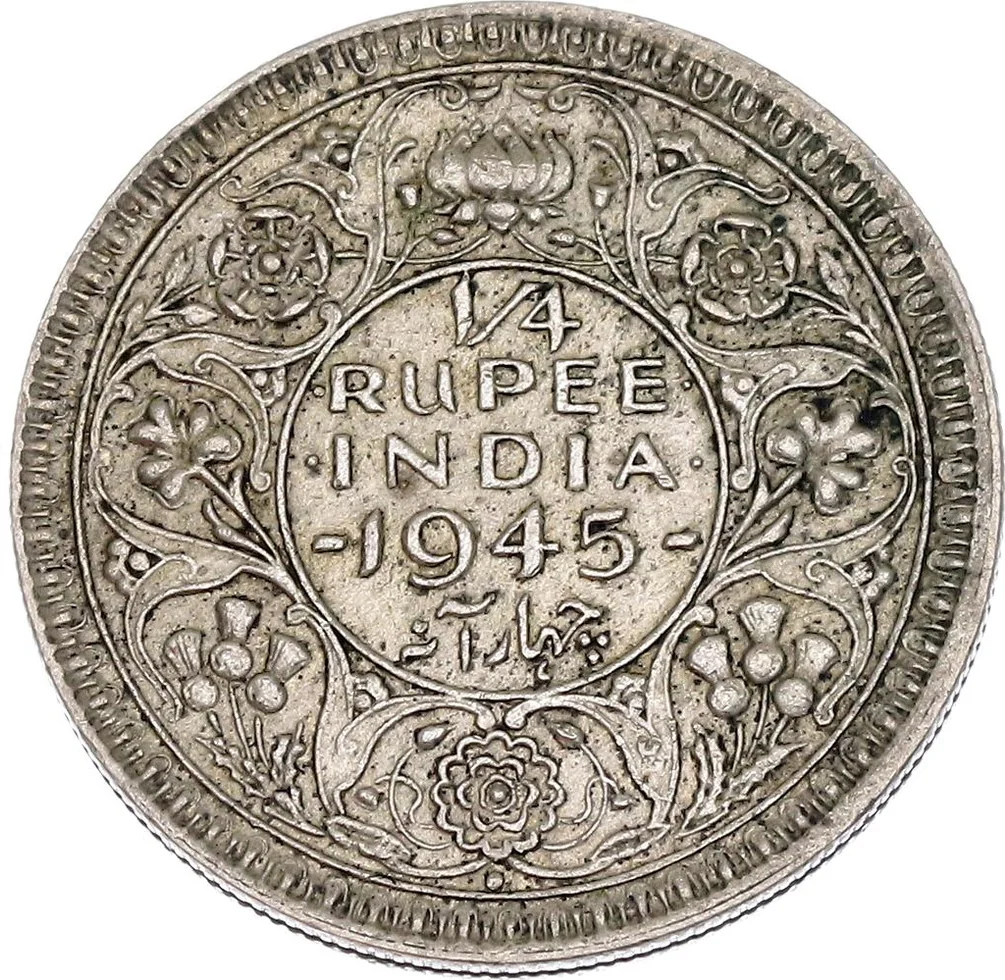
¼ Rupee – India - British
India
Context
Years: 1943–1945
Country: India 
Issuer: India - British
Ruler: George VI
Currency:
(1770—1947)
Demonetized: Yes
Total mintage: 375,804,000
Material
References
KM: #Click to copy to clipboard547
Numista: #4854
Value
Bullion value: $4.10
Obverse
Description:
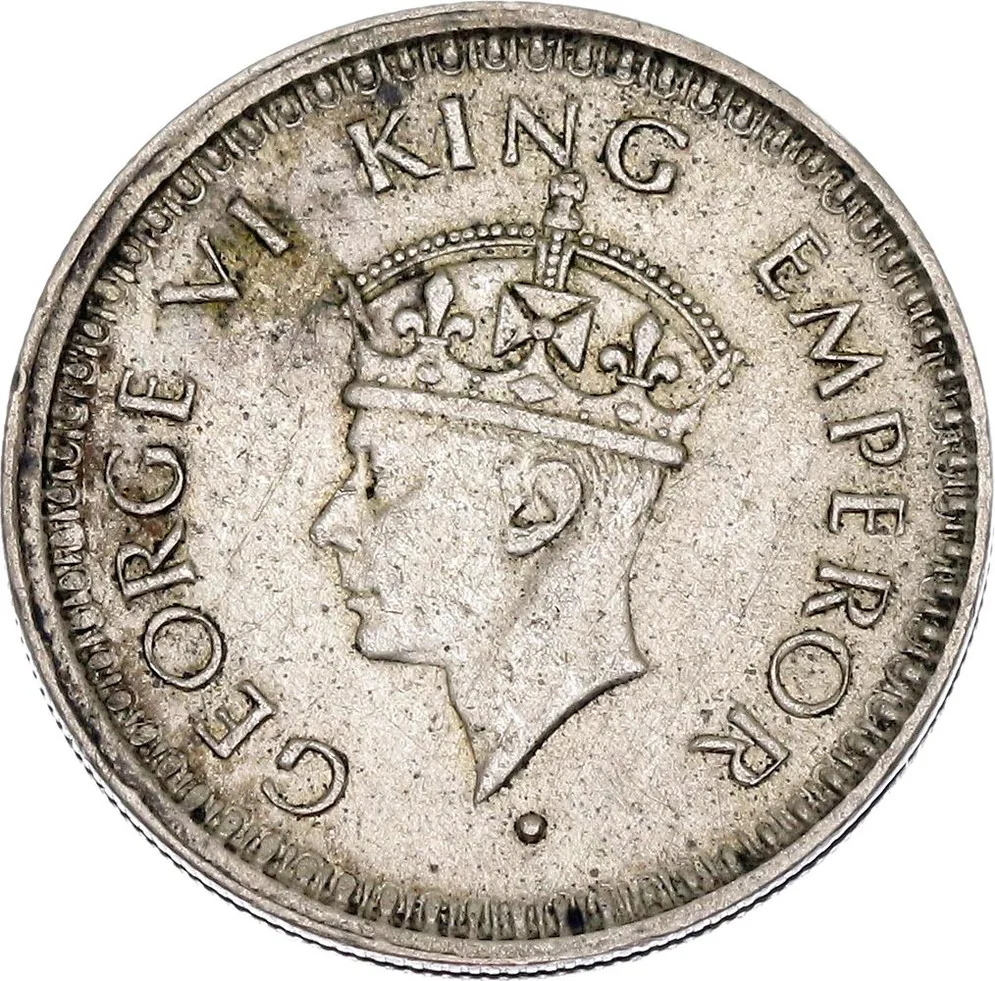
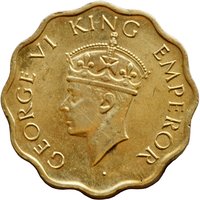
George VI left, English legend, toothed rim.
Inscription:
GEORGE VI KING EMPEROR
Translation:
GEORGE VI KING EMPEROR
Language: English
Engraver: Percy Metcalfe
Reverse
Edge
Security
Mints
| Name | Mark |
|---|---|
| Lahore | L |
| Mumbai / Bombay | Large dot or diamond |
Mintings
Historical background
In 1943, British India's currency situation was deeply strained by the immense pressures of the Second World War. The colonial government, financing a massive Allied military campaign in the Asia-Pacific theater, was compelled to print currency on an unprecedented scale to cover its war expenditures. This rapid expansion of the money supply, without a corresponding increase in goods, created severe inflationary pressures across the economy, eroding the purchasing power of the rupee and placing great hardship on the civilian population.
This monetary crisis intersected catastrophically with administrative failures and wartime disruptions to produce the Bengal Famine of 1943. While the famine had multiple causes, including the loss of rice imports from Japanese-occupied Burma and a disastrous "denial policy" that removed local boats and rice stocks, hyperinflation played a crucial role. Skyrocketing food prices, driven by the flood of currency, speculation, and hoarding, put basic sustenance far beyond the reach of millions of rural laborers and the poor, leading to mass starvation.
Ultimately, the currency situation of 1943 exposed the extractive priorities of the colonial war economy. The Sterling balances accumulated in London—credit for Indian resources and manpower supplied to Britain—grew vastly, but this financial claim was built on the domestic devastation of inflation and famine. The crisis starkly highlighted how colonial monetary and economic policy could be directed toward imperial needs with devastating local consequences, fueling the growing demand for economic self-determination that would culminate in independence four years later.
This monetary crisis intersected catastrophically with administrative failures and wartime disruptions to produce the Bengal Famine of 1943. While the famine had multiple causes, including the loss of rice imports from Japanese-occupied Burma and a disastrous "denial policy" that removed local boats and rice stocks, hyperinflation played a crucial role. Skyrocketing food prices, driven by the flood of currency, speculation, and hoarding, put basic sustenance far beyond the reach of millions of rural laborers and the poor, leading to mass starvation.
Ultimately, the currency situation of 1943 exposed the extractive priorities of the colonial war economy. The Sterling balances accumulated in London—credit for Indian resources and manpower supplied to Britain—grew vastly, but this financial claim was built on the domestic devastation of inflation and famine. The crisis starkly highlighted how colonial monetary and economic policy could be directed toward imperial needs with devastating local consequences, fueling the growing demand for economic self-determination that would culminate in independence four years later.


🌱 Very Common