

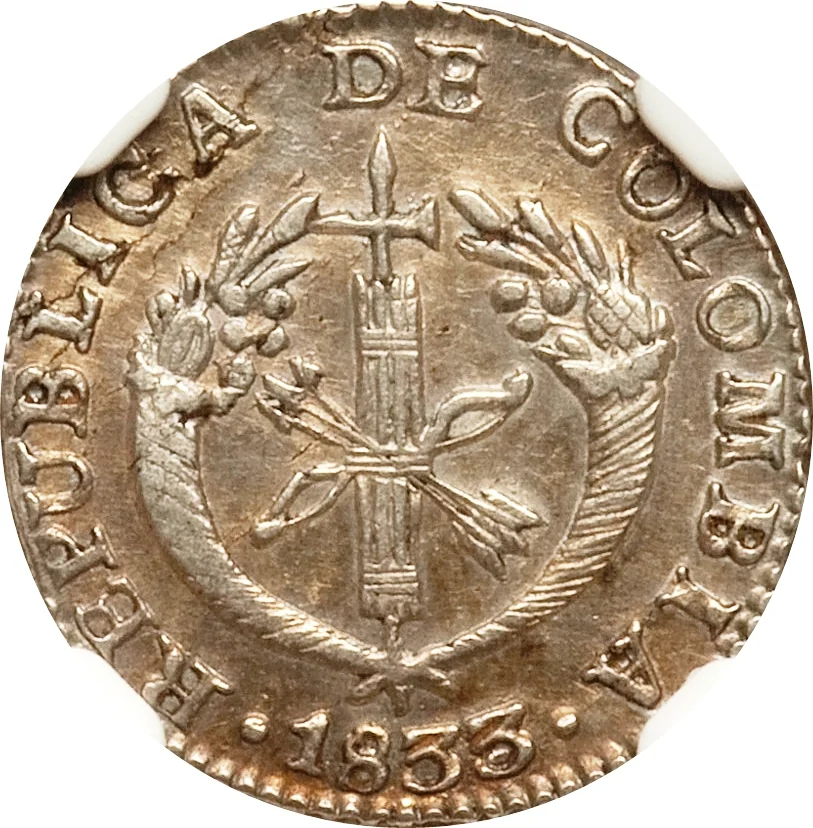
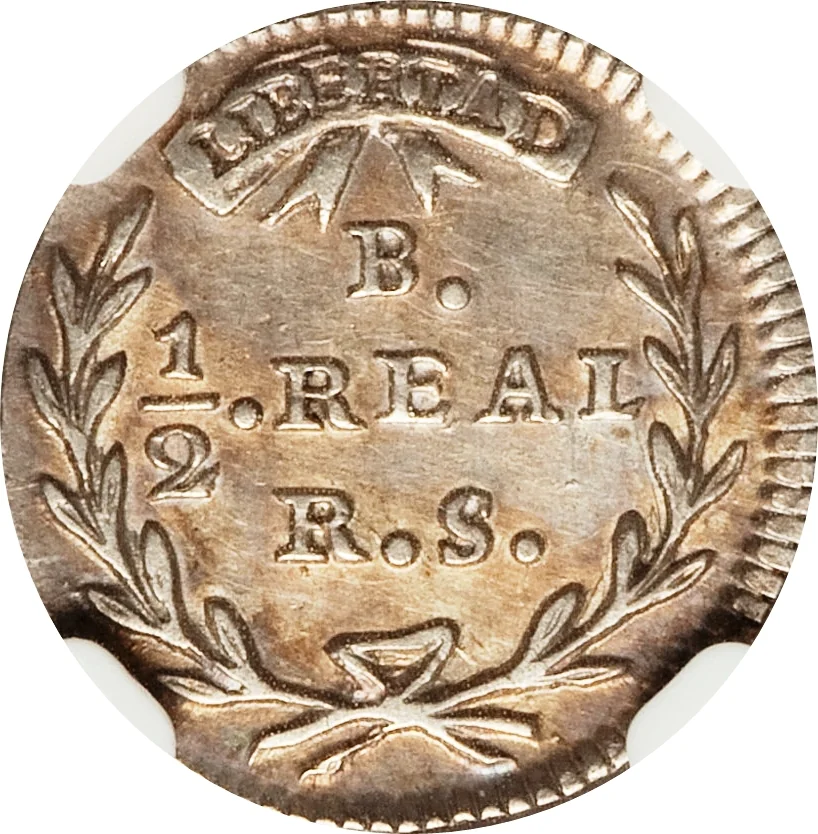
½ real – Colombia
Add to wishlist
Colombia
Context
Material
Weight: 1.55 g
Silver Weight:: 1.03 g
Shape: Round
Composition: 66.6% Silver
Standard: Gold twentieth ounce
Magnetic: No
Technique: Milled
Alignment: Coin alignment
flip
References
KM: #
Numista: #48278
Value
Bullion value: $2.53
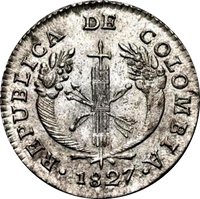
Obverse
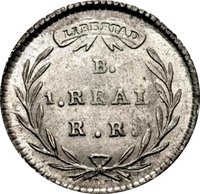
Reverse
Edge
Categories
| Symbol> Cornucopia |
| Symbol> Fasces |
Mintings
| Year | Mint Mark | Mintage | Quality | Collection |
|---|---|---|---|---|
| 1833 | BRS | — | ||
| 1834 | BRS | — | ||
| 1834 | PRU | — | ||
| 1835 | BRS | — | ||
| 1835 | PRU | — | ||
| 1836 | PRU | — |
Historical background
In 1833, Colombia was navigating the complex aftermath of the dissolution of Gran Colombia, a large republic that had fractured into the separate nations of New Granada (modern Colombia and Panama), Venezuela, and Ecuador just two years prior. The new Republic of New Granada inherited a monetary system in profound disarray. The colonial-era Spanish silver peso, known as the real, remained the foundational unit, but the economy was saturated with a chaotic mix of coins from various Spanish American mints, as well as clipped, worn, and counterfeit pieces, leading to widespread confusion in trade and valuation.
The government, under the centralist constitution of 1832, faced the urgent task of establishing monetary sovereignty and stability. A key challenge was the severe shortage of small-denomination coinage for everyday transactions, which stifled local commerce. While efforts to establish a national mint (Casa de Moneda) in Bogotá were underway, its output was still limited. Consequently, foreign coins—particularly those from Bolivia, Peru, and Great Britain—continued to circulate widely, their values fluctuating based on metal content and local trust, creating a de facto multi-currency system.
President Francisco de Paula Santander’s administration recognized that a sound currency was essential for economic recovery and state-building. Although comprehensive reform was still on the horizon, the period was one of transition and ad-hoc management. The financial foundations laid in the early 1830s, including attempts to standardize the currency and regulate the money in circulation, would set the stage for more definitive laws later in the decade, as the young republic sought to unify its economy under a single, reliable monetary standard.
The government, under the centralist constitution of 1832, faced the urgent task of establishing monetary sovereignty and stability. A key challenge was the severe shortage of small-denomination coinage for everyday transactions, which stifled local commerce. While efforts to establish a national mint (Casa de Moneda) in Bogotá were underway, its output was still limited. Consequently, foreign coins—particularly those from Bolivia, Peru, and Great Britain—continued to circulate widely, their values fluctuating based on metal content and local trust, creating a de facto multi-currency system.
President Francisco de Paula Santander’s administration recognized that a sound currency was essential for economic recovery and state-building. Although comprehensive reform was still on the horizon, the period was one of transition and ad-hoc management. The financial foundations laid in the early 1830s, including attempts to standardize the currency and regulate the money in circulation, would set the stage for more definitive laws later in the decade, as the young republic sought to unify its economy under a single, reliable monetary standard.
💎 Extremely Rare