

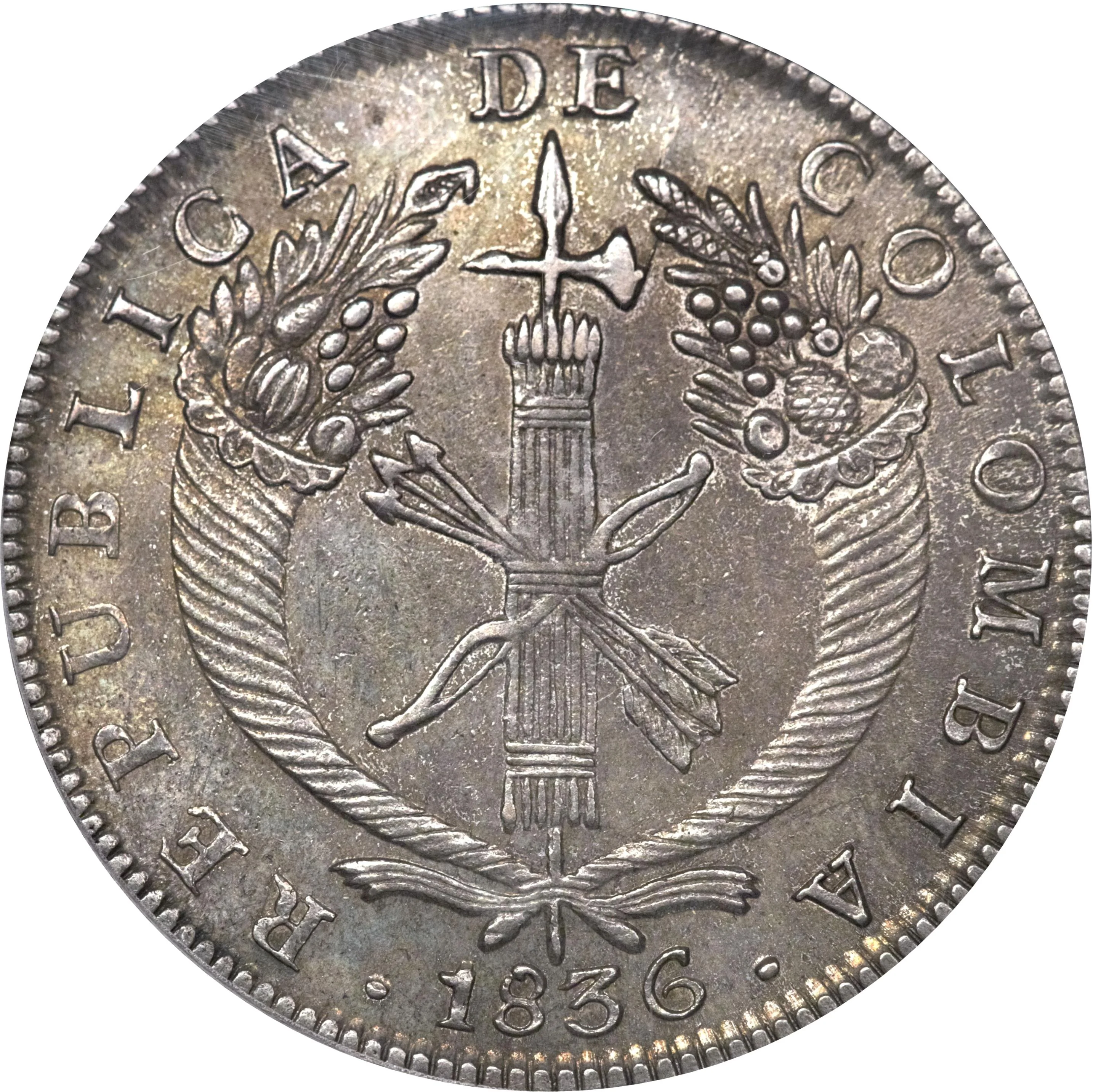
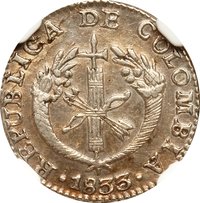
Obverse
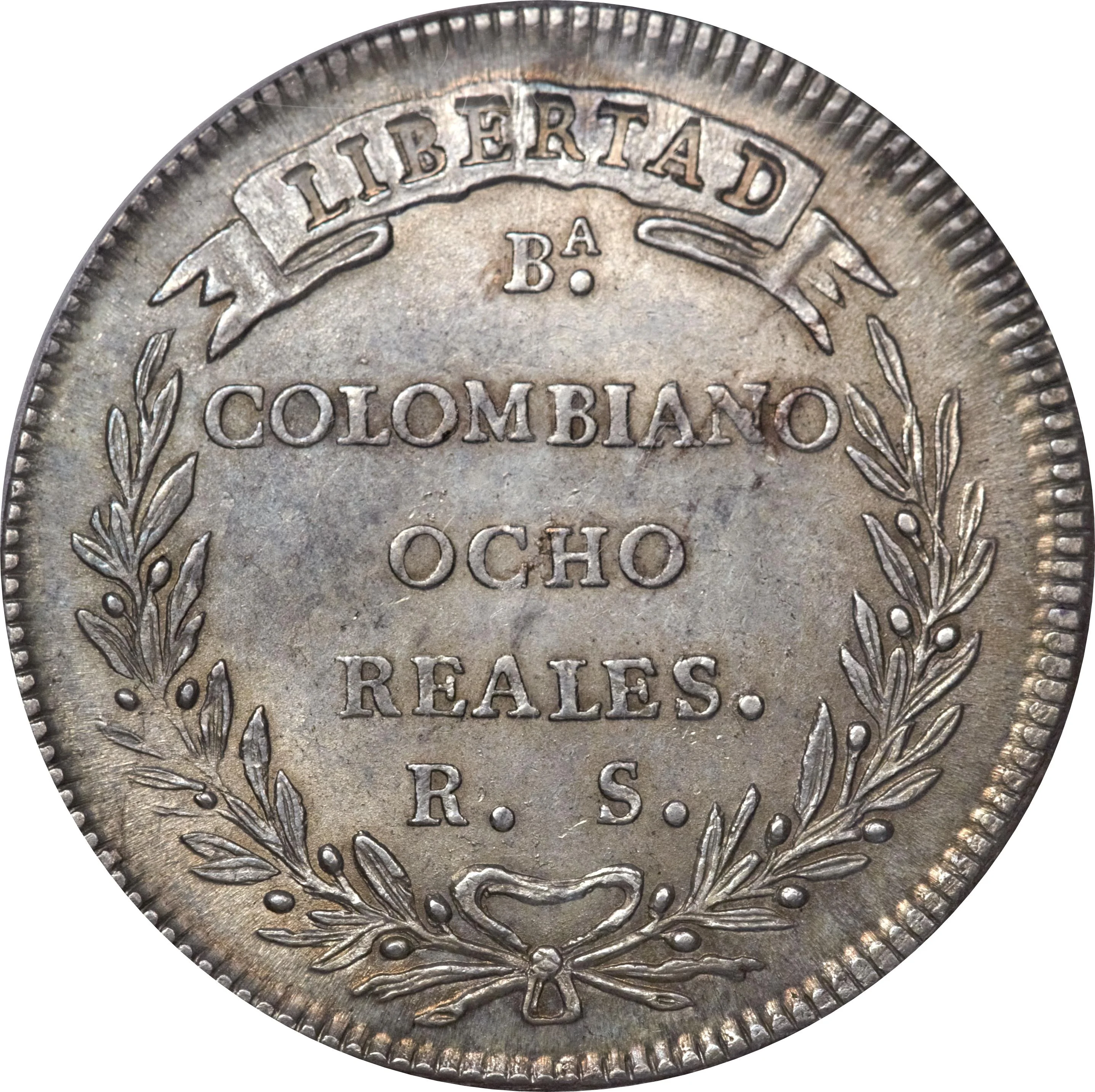
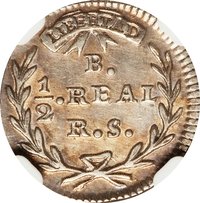
Reverse
Edge
Lettering:○□○□
Legend:
○□○□
Categories
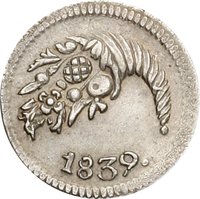
| Symbol> Cornucopia |
| Symbol> Fasces |
Mints
| Name | Mark |
|---|---|
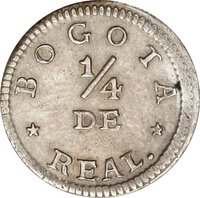
| Bogota Mint | (B.A) |
Mintings
| Year | Mint Mark | Mintage | Quality | Collection |
|---|---|---|---|---|
| 1834 | B.A | — | ||
| 1835 | B.A | — | ||
| 1836 | B.A | — |
Historical background
In 1834, Colombia was navigating the complex aftermath of the dissolution of Gran Colombia in 1830, which fractured into the separate republics of New Granada (modern Colombia and Panama), Venezuela, and Ecuador. This political fragmentation had severe economic consequences, particularly for the monetary system. The new Republic of New Granada inherited a chaotic currency landscape characterized by a severe shortage of specie (gold and silver coins), a proliferation of debased and counterfeit coins from the colonial era and the recent wars, and a confusing mix of foreign coins, primarily Spanish, Peruvian, and Bolivian. The lack of a unified, trustworthy national currency severely hampered domestic commerce and international trade, creating an urgent need for monetary reform and stability.
The government, under President Francisco de Paula Santander, recognized that a stable and sovereign currency was fundamental to national sovereignty and economic recovery. Consequently, the Congress enacted a pivotal monetary law on April 12, 1834. This law established the peso as the official unit of account, defining it on a bimetallic standard. It precisely fixed the weight and fineness of both gold and silver coins, pegging their value to one another at a ratio of 1 gram of gold to 16 grams of silver. The law also authorized the minting of new national coins at the Bogotá mint, prominently featuring the national crest and the iconic "Libertad Americana" (American Liberty) design, which symbolized a definitive break from colonial monetary systems.
The 1834 reform was a foundational step toward modernizing the Colombian economy, providing a much-needed legal and uniform standard. However, its implementation faced significant practical challenges. The scarcity of precious metals, the continued circulation of old and foreign coins, and the global fluctuations in the market value of gold and silver (which often deviated from the fixed 1:16 ratio) meant that monetary instability persisted for decades. Thus, while 1834 marks the critical legislative origin of Colombia's national currency system, the full realization of a stable and exclusive circulating medium remained a work in progress throughout the 19th century.
The government, under President Francisco de Paula Santander, recognized that a stable and sovereign currency was fundamental to national sovereignty and economic recovery. Consequently, the Congress enacted a pivotal monetary law on April 12, 1834. This law established the peso as the official unit of account, defining it on a bimetallic standard. It precisely fixed the weight and fineness of both gold and silver coins, pegging their value to one another at a ratio of 1 gram of gold to 16 grams of silver. The law also authorized the minting of new national coins at the Bogotá mint, prominently featuring the national crest and the iconic "Libertad Americana" (American Liberty) design, which symbolized a definitive break from colonial monetary systems.
The 1834 reform was a foundational step toward modernizing the Colombian economy, providing a much-needed legal and uniform standard. However, its implementation faced significant practical challenges. The scarcity of precious metals, the continued circulation of old and foreign coins, and the global fluctuations in the market value of gold and silver (which often deviated from the fixed 1:16 ratio) meant that monetary instability persisted for decades. Thus, while 1834 marks the critical legislative origin of Colombia's national currency system, the full realization of a stable and exclusive circulating medium remained a work in progress throughout the 19th century.
💎 Extremely Rare