

Spain
Context
Material
References
KM: #Click to copy to clipboardA579
Numista: #103186
Value
Bullion value: $977.46
Obverse
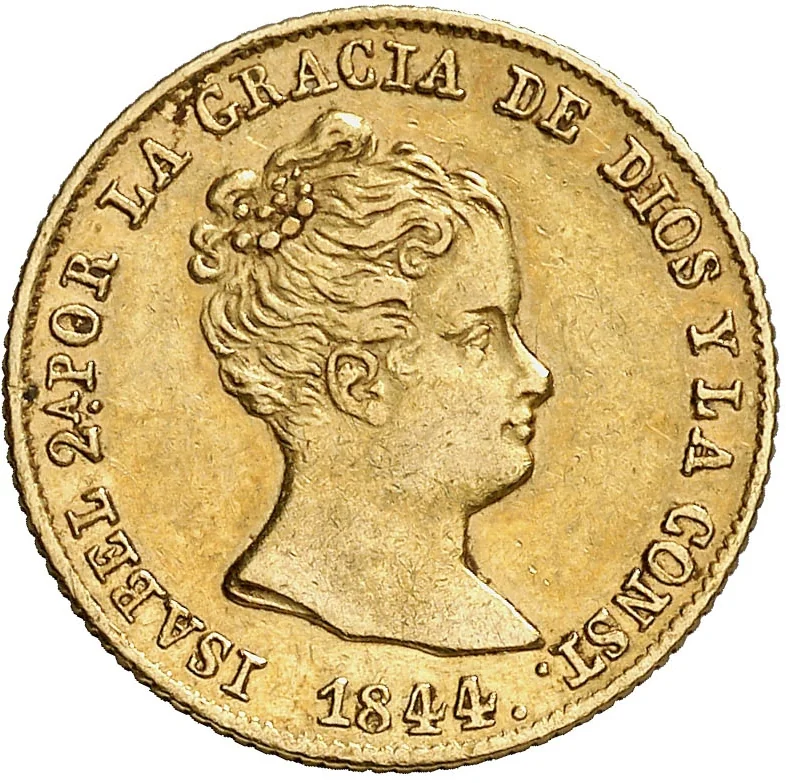
Description:
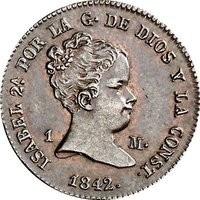
Queen Isabella II facing right.
Inscription:
ISABEL 2A. POR LA GRACIA DE DIOS Y LA CONST.
1844.
1844.
Translation:
ISABELLA 2ND. BY THE GRACE OF GOD AND THE CONST.
1844.
1844.
Script: Latin
Language: Spanish
Engraver: Mariano González de Sepúlveda Salazar
Reverse
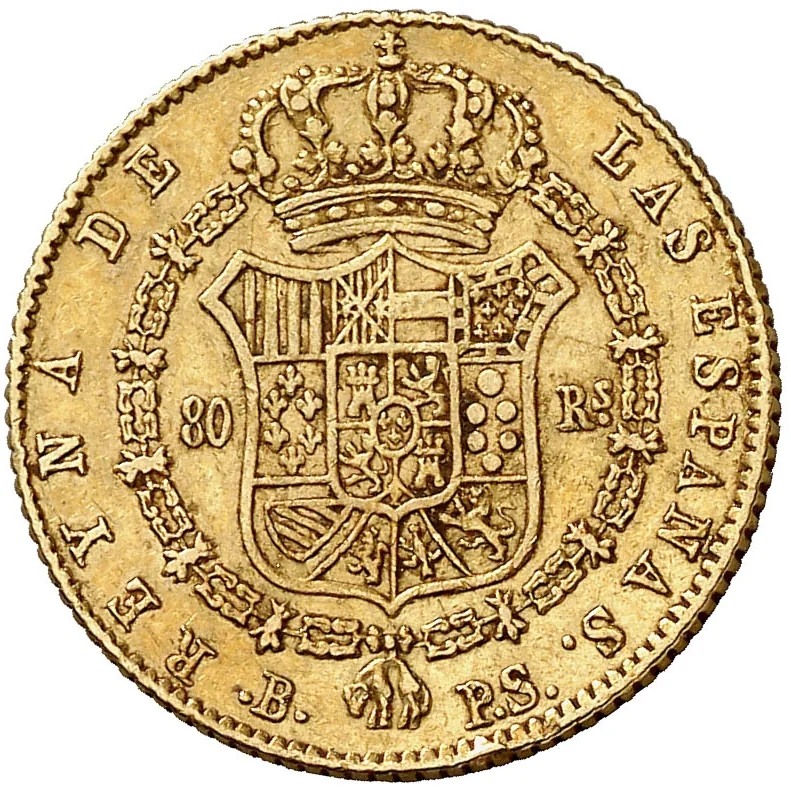
Description:
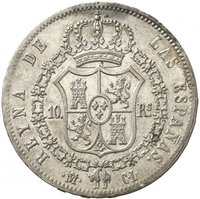
Crowned Spanish coat of arms with the Golden Fleece.
Inscription:
REYNA DE LAS ESPAÑAS
80 RS.
·B· P.S.
80 RS.
·B· P.S.
Translation:
Queen of the Spains
80 Reales
·B· P.S.
80 Reales
·B· P.S.
Script: Latin
Language: Spanish
Engraver: Mariano González de Sepúlveda Salazar
Edge
Reeded
Mints
| Name | Mark |
|---|---|
| Barcelona Mint / La Seca | (B) |
Mintings
| Year | Mint Mark | Mintage | Quality | Collection |
|---|---|---|---|---|
| 1841 | BPS | — | ||
| 1844 | BPS | — |
Historical background
In 1841, Spain's currency situation was a complex and unstable legacy of the early 19th century's political and economic turmoil. The country was emerging from the First Carlist War (1833-1840), a devastating civil conflict that had crippled state finances and severely disrupted economic activity. The national treasury was deeply indebted, and the government, under the regency of General Baldomero Espartero, struggled to assert fiscal control. The monetary system itself was a chaotic patchwork, with various regional mints operating semi-autonomously and a proliferation of foreign coins, particularly French francs and British sovereigns, circulating alongside official Spanish coinage, undermining the state's monetary sovereignty.
The official currency was theoretically based on the real and the escudo, but the most significant unit for larger transactions was the peseta, which had been introduced as an accounting unit in the previous century. However, the silver and gold content of coins had been frequently debased by successive governments to finance wars and deficits, leading to a severe shortage of sound, full-bodied specie. This resulted in a disconnect between the face value of coins and their intrinsic metal value, causing Gresham's Law ("bad money drives out good") to operate in practice, as hoarding of good coinage was widespread. The Bank of San Fernando (precursor to the Bank of Spain), founded in 1829, issued paper banknotes, but public trust in this fiat money was extremely low, limiting its circulation primarily to major commercial centers like Madrid and Barcelona.
Consequently, the period was characterized by monetary confusion, with a lack of a unified, trusted national currency hindering commerce and economic recovery. This unstable environment set the stage for the major monetary reform that would follow in 1848, when the peseta was formally established as the sole monetary unit in an attempt to create a decimal-based, unified national currency system. The situation in 1841, therefore, represents a critical point of financial fragility and transition, where the pressures of war debt, regional fragmentation, and specie shortage made comprehensive currency reform an urgent necessity for the modernizing Spanish state.
The official currency was theoretically based on the real and the escudo, but the most significant unit for larger transactions was the peseta, which had been introduced as an accounting unit in the previous century. However, the silver and gold content of coins had been frequently debased by successive governments to finance wars and deficits, leading to a severe shortage of sound, full-bodied specie. This resulted in a disconnect between the face value of coins and their intrinsic metal value, causing Gresham's Law ("bad money drives out good") to operate in practice, as hoarding of good coinage was widespread. The Bank of San Fernando (precursor to the Bank of Spain), founded in 1829, issued paper banknotes, but public trust in this fiat money was extremely low, limiting its circulation primarily to major commercial centers like Madrid and Barcelona.
Consequently, the period was characterized by monetary confusion, with a lack of a unified, trusted national currency hindering commerce and economic recovery. This unstable environment set the stage for the major monetary reform that would follow in 1848, when the peseta was formally established as the sole monetary unit in an attempt to create a decimal-based, unified national currency system. The situation in 1841, therefore, represents a critical point of financial fragility and transition, where the pressures of war debt, regional fragmentation, and specie shortage made comprehensive currency reform an urgent necessity for the modernizing Spanish state.
💎 Extremely Rare